
心脏手术中的加速康复外科(ERAS)方案:对阿片类药物使用的影响。
Enhanced Recovery After Surgery (ERAS) Protocols in Cardiac Surgery: Impact on Opioid Consumption.
作者信息
Othenin-Girard Alexandra, Ltaief Zied, Verdugo-Marchese Mario, Lavanchy Luc, Vuadens Patrice, Nowacka Anna, Gunga Ziyad, Melly Valentine, Abdurashidova Tamila, Botteau Caroline, Hennemann Marius, Graf Jérôme, Schoettker Patrick, Kirsch Matthias, Rancati Valentina
机构信息
Department of Anesthesia, Lausanne University Hospital (CHUV), 1011 Lausanne, Switzerland.
Department of Intensive Care, Lausanne University Hospital (CHUV), 1011 Lausanne, Switzerland.
出版信息
J Clin Med. 2025 Mar 6;14(5):1768. doi: 10.3390/jcm14051768.
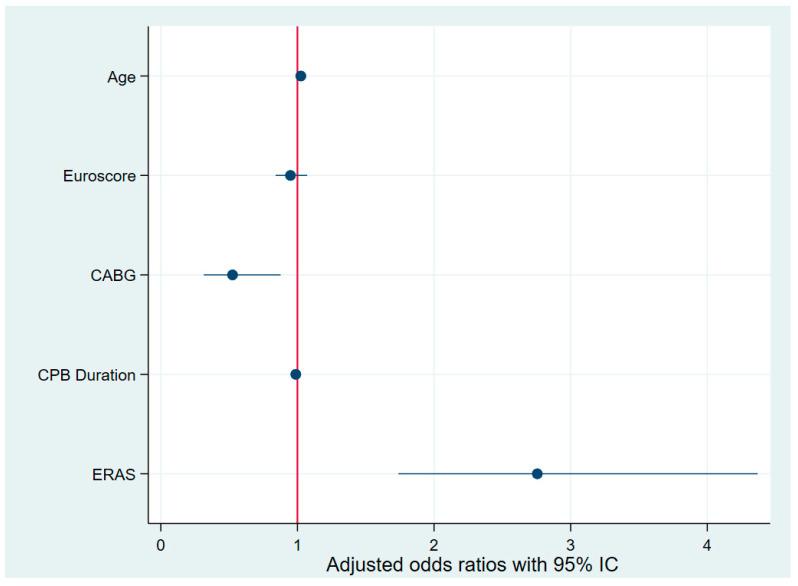
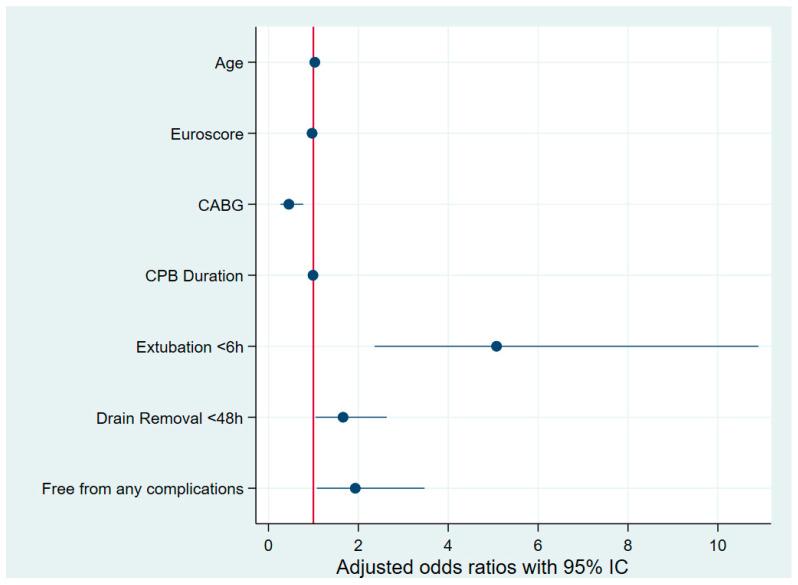
: Enhanced Recovery After Surgery (ERAS) protocols have been implemented in various surgical specialties to improve patient outcomes and reduce opioid consumption. In cardiac surgery, the traditionally high-dose opioid use is associated with prolonged ventilation, intensive care unit (ICU) stays, and opioid-related adverse drug events (ORADEs). This study evaluates the impact of an ERAS Society-certified program on opioid consumption in patients undergoing elective cardiac surgery at Lausanne University Hospital. : A retrospective, monocentric observational study was conducted comparing two patient cohorts: one treated with ERAS protocols (2023-2024) and a retrospective control group from 2019. Data were collected from the hospital's electronic medical records and the ERAS program database. The primary outcome was total opioid consumption, measured intraoperatively and postoperatively (postoperative day (POD) 0-3). Secondary outcomes included pain control, length of stay, complications, and recovery parameters. Statistical analyses included multivariate logistic regression to identify factors associated with reduced opioid consumption. : Patients in the ERAS group demonstrated significantly lower total opioid consumption, whether intraoperatively (median sufentanil: 40 mcg vs. 51 mcg, < 0.0001) or postoperatively (POD 0-3: < 0.001). The ERAS group had faster extubation times, earlier mobilization and pain control with non-opioid analgesics, fewer complications, and shorter hospital stays (9 vs. 12 days, < 0.001). Logistic regression identified fast-track extubation and absence of complications as strong predictors of reduced opioid use. : The implementation of an ERAS protocol in cardiac surgery significantly reduces opioid consumption while enhancing recovery.
加速康复外科(ERAS)方案已在各个外科专业中实施,以改善患者预后并减少阿片类药物的使用。在心脏外科手术中,传统上高剂量使用阿片类药物与通气时间延长、重症监护病房(ICU)住院时间延长以及阿片类药物相关不良药物事件(ORADEs)有关。本研究评估了一项经ERAS协会认证的方案对洛桑大学医院接受择期心脏手术患者阿片类药物使用的影响。:进行了一项回顾性、单中心观察性研究,比较了两个患者队列:一组接受ERAS方案治疗(2023 - 2024年),另一组是2019年的回顾性对照组。数据从医院的电子病历和ERAS方案数据库中收集。主要结局是术中及术后(术后第0 - 3天)测量的阿片类药物总使用量。次要结局包括疼痛控制、住院时间、并发症和恢复参数。统计分析包括多因素逻辑回归,以确定与阿片类药物使用减少相关的因素。:ERAS组患者的阿片类药物总使用量显著降低,无论是术中(舒芬太尼中位数:40 mcg对51 mcg,< 0.0001)还是术后(术后第0 - 3天:< 0.001)。ERAS组拔管时间更快,使用非阿片类镇痛药更早实现活动和疼痛控制,并发症更少,住院时间更短(9天对12天,< 0.001)。逻辑回归确定快速通道拔管和无并发症是阿片类药物使用减少的有力预测因素。:在心脏手术中实施ERAS方案可显著减少阿片类药物使用,同时促进康复。

 Zotero 插件