
MYBL2通过PI3K/AKT和BCL2/BAX/裂解的半胱天冬酶-3信号通路促进胃癌细胞增殖并抑制细胞凋亡。
MYBL2 promotes cell proliferation and inhibits cell apoptosis via PI3K/AKT and BCL2/BAX/Cleaved-caspase-3 signaling pathway in gastric cancer cells.
作者信息
Chen Jingya, Ji Zhenglei, Wu Di, Wei Siyang, Zhu Wanjing, Peng Guisen, Hu Mingjie, Zhao Yunli, Wu Huazhang
机构信息
School of Public Health, Bengbu Medical University, Bengbu, China.
School of Life Science, Anhui Provincial Key Laboratory of Tumor Evolution and Intelligent Diagnosis and Treatment, Bengbu Medical University, Bengbu, China.
出版信息
Sci Rep. 2025 Mar 17;15(1):9148. doi: 10.1038/s41598-025-93022-4.
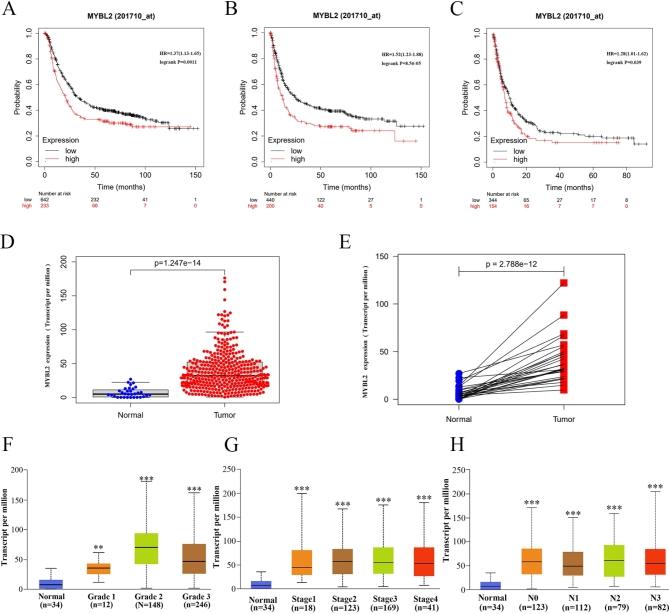
The transcription factor MYB proto-oncogene like 2 (MYBL2) has been reported to be involved in the occurrence and development of various tumors, however, its role in gastric cancer (GC) remains to be elucidated. In this study, the Kaplan-Meier plotter was used to evaluate the prognostic value of different MYBL2 expression levels in GC patients. The UALCAN database were applied to analyze the relationships between MYBL2 and clinicopathological characteristics of GC. GC cell proliferation, cell cycle and apoptosis were determined by CCK-8 and flow cytometry assays, and proteins were examined by Western blot analysis. Next, signaling pathway enrichment analysis of MYBL2-related genes and protein expression were analyzed by Gene Set Enrichment Analysis (GSEA) and Western blot assays. The results found that MYBL2 expression was significantly upregulated in GC compared with adjacent non-malignant tissues and associated with poor patient survival, tumor, stages and lymph node metastasis. Forced expression of MYBL2 could promote cell proliferation, resulting in an accelerated S phase progression and inhibiting cell apoptosis in GC cells. Conversely, MYBL2 silencing inhibited cell proliferation, induced G2/M phase arrest and promoted cell apoptosis in GC cells. Mechanistically, Western blot analysis showed that MYBL2 silencing decreased the expression of BCL2 and upregulated the expression of Cleaved-caspase-3 and BAX in HGC-27 cells. Conversely, MYBL2 overexpression in AGS cells resulted in the opposite effects. Furthermore, enforced expression of MYBL2 activated the PI3K/AKT signaling pathway, especially AKT phosphorylation. Additionally, the AKT inhibitor MK2206 significantly reversed the proliferation capacity of GC cells induced by MYBL2 overexpression. Therefore, these results suggest that upregulated expression of MYBL2 contributes to GC cell growth and inhibits cell apoptosis by regulating the PI3K/AKT and BCL2/BAX/Cleaved-caspase-3 signaling pathways in GC cells indicating that MYBL2 may be a new therapeutic target and prognostic marker for GC.
据报道,转录因子原癌基因MYB样2(MYBL2)参与多种肿瘤的发生发展,然而,其在胃癌(GC)中的作用仍有待阐明。在本研究中,使用Kaplan-Meier绘图仪评估不同MYBL2表达水平对GC患者的预后价值。应用UALCAN数据库分析MYBL2与GC临床病理特征之间的关系。通过CCK-8和流式细胞术检测GC细胞增殖、细胞周期和凋亡情况,并通过蛋白质免疫印迹分析检测相关蛋白。接下来,通过基因集富集分析(GSEA)和蛋白质免疫印迹分析对MYBL2相关基因进行信号通路富集分析和蛋白质表达分析。结果发现,与相邻非恶性组织相比,GC中MYBL2表达显著上调,且与患者生存率低、肿瘤分期及淋巴结转移相关。MYBL2的强制表达可促进细胞增殖,导致GC细胞S期进程加速并抑制细胞凋亡。相反,MYBL2沉默则抑制GC细胞增殖,诱导G2/M期阻滞并促进细胞凋亡。机制上,蛋白质免疫印迹分析显示,MYBL2沉默降低了HGC-27细胞中BCL2的表达,上调了Cleaved-caspase-3和BAX的表达。相反,AGS细胞中MYBL2过表达则产生相反的效果。此外,MYBL2的强制表达激活了PI3K/AKT信号通路,尤其是AKT磷酸化。此外,AKT抑制剂MK2206显著逆转了MYBL2过表达诱导的GC细胞增殖能力。因此,这些结果表明,MYBL2表达上调通过调节GC细胞中的PI3K/AKT和BCL2/BAX/Cleaved-caspase-3信号通路促进GC细胞生长并抑制细胞凋亡,表明MYBL2可能是GC的一个新的治疗靶点和预后标志物。



 Zotero 插件