
SAE1上调驱动肿瘤发生并与乳腺癌不良临床预后相关。
Upregulated SAE1 Drives Tumorigenesis and Is Associated with Poor Clinical Outcomes in Breast Cancer.
作者信息
Liu Hong, Wang Jing, Li Yunhai, Luo Feng, Xing Lei
机构信息
Department of Breast and Thyroid Surgery The First Affiliated Hospital of Chongqing Medical University, No. 1 Youyi Rd, Chongqing 400016, China.
Chongqing Key Laboratory of Molecular Oncology and Epigenetics The First Affiliated Hospital of Chongqing Medical University, No. 1 Youyi Rd, Chongqing 400016, China.
出版信息
Breast J. 2024 Jun 30;2024:2981722. doi: 10.1155/2024/2981722. eCollection 2024.
BACKGROUND
The purpose of this study was to analyze SUMO activating enzyme subunit 1 (SAE1) expression in breast cancer (BC). Through bioinformatics analysis and in vitro experiments, the biological function and possibly associated signal pathways of SAE1 in BC were further analyzed.
METHODS
Bioinformatics analysis was applied to analyze SAE1 expression in BC and normal breast tissues, its relationship with clinicopathologic characteristics and prognosis in BC patients, and data from the Cancer Genome Atlas database and Gene Expression Omnibus dataset. We performed immunohistochemistry to analyze SAE1 expression in BC tissues and para-cancer tissues in 79 breast cancer patients. BC cell proliferation was detected with the Cell Counting Kit-8 and by the colony formation assay. Cell cycle progression was analyzed by flow cytometry, and the expression of cell cycle-related proteins (E2F1, cyclin D3, and cyclin-dependent kinase 2) was determined by western blots in SAE1 small interfering RNA (siRNA) transfected cells. The GSE1456 dataset was used to analyze possible signal pathways associated with SAE1 by gene set enrichment analysis (GSEA), and the expression of PI3K/AKT/mTOR pathway-related proteins (such as p-PI3K, p-AKT, and mTOR) in SAE1-siRNA cells was detected by western blots.
RESULTS
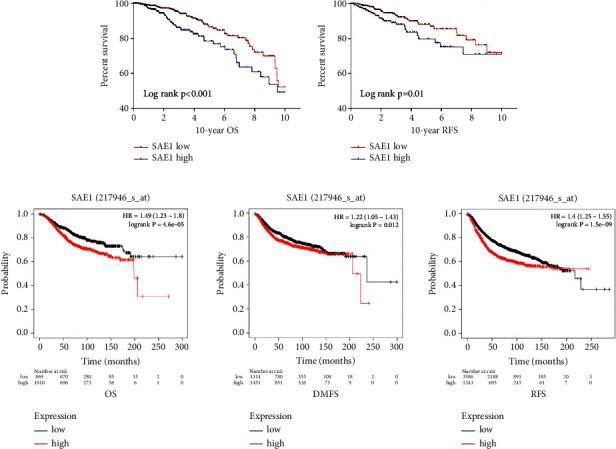
The bioinformatics and immunohistochemical results showed that SAE1 mRNA and protein expression in BC tissues were significantly higher than those in normal tissues. The SAE1 overexpression was significantly associated with the tumor size, tumor-node-metastasis stage, estrogen receptor, progesterone receptor, human epidermal growth factor receptor 2, and whether or not it was a triple-negative BC. Patients with SAE1 overexpression had a worse overall survival (OS), recurrence-free survival (RFS), and distant metastasis-free survival compared with lower expression patients. Multivariate Cox regression analysis showed that SAE1 may be an independent prognostic factor for OS of BC patients. The proliferation and cell cycle process of BC cells were inhibited by SAE1-siRNA in vitro. The result of GSEA showed that SAE1 was significantly associated with 12 gene sets, including unfolded protein reaction, DNA repair, oxidative phosphorylation, and cell cycle, among others. Additionally, two signal pathways, mTORC1 and PI3K/Akt/mTOR, were significantly correlated with SAE1 overexpression. Western blots confirmed that the expression of PI3K/Akt/mTOR pathway-related proteins (p-PI3K, p-AKT, and mTOR) in BC cells was decreased after knocking down SAE1.
CONCLUSION
SAE1 was highly expressed in BC. Its overexpression was associated with poor BC prognosis. Additionally, it was an independent prognostic factor for BC patients. We demonstrated that in vitro SAE1 knockdown effectively inhibited BC proliferation and its cell cycle process. Furthermore, the biological function of SAE1 may be associated with the PI3K/Akt/mTOR pathway. SAE1 will be a potential target for BC treatment.
背景
本研究旨在分析乳腺癌(BC)中SUMO激活酶亚基1(SAE1)的表达情况。通过生物信息学分析和体外实验,进一步分析SAE1在BC中的生物学功能及可能相关的信号通路。
方法
应用生物信息学分析来分析SAE1在BC组织和正常乳腺组织中的表达、其与BC患者临床病理特征及预后的关系,以及来自癌症基因组图谱数据库和基因表达综合数据集的数据。我们对79例乳腺癌患者的BC组织和癌旁组织进行免疫组织化学分析以检测SAE1的表达。用细胞计数试剂盒-8和集落形成试验检测BC细胞增殖。通过流式细胞术分析细胞周期进程,并在转染了SAE1小干扰RNA(siRNA)的细胞中用蛋白质免疫印迹法测定细胞周期相关蛋白(E2F1、细胞周期蛋白D3和细胞周期蛋白依赖性激酶2)的表达。利用基因集富集分析(GSEA)对GSE1456数据集进行分析,以分析与SAE1可能相关的信号通路,并通过蛋白质免疫印迹法检测SAE1-siRNA细胞中PI3K/AKT/mTOR信号通路相关蛋白(如p-PI3K、p-AKT和mTOR)的表达。
结果
生物信息学和免疫组织化学结果显示,BC组织中SAE1的mRNA和蛋白表达显著高于正常组织。SAE1过表达与肿瘤大小、肿瘤-淋巴结-转移分期、雌激素受体、孕激素受体、人表皮生长因子受体2以及是否为三阴性乳腺癌显著相关。与低表达患者相比,SAE1过表达的患者总生存期(OS)、无复发生存期(RFS)和无远处转移生存期更差。多因素Cox回归分析表明,SAE1可能是BC患者OS的独立预后因素。体外实验中,SAE1-siRNA抑制了BC细胞的增殖和细胞周期进程。GSEA结果显示,SAE1与12个基因集显著相关,包括未折叠蛋白反应、DNA修复、氧化磷酸化和细胞周期等。此外,两条信号通路,即mTORC1和PI3K/Akt/mTOR,与SAE1过表达显著相关。蛋白质免疫印迹法证实,敲低SAE1后BC细胞中PI3K/Akt/mTOR信号通路相关蛋白(p-PI3K、p-AKT和mTOR)的表达降低。
结论
SAE1在BC中高表达。其过表达与BC预后不良相关。此外,它是BC患者的独立预后因素。我们证明,体外敲低SAE1可有效抑制BC增殖及其细胞周期进程。此外,SAE1的生物学功能可能与PI3K/Akt/mTOR信号通路有关。SAE1将成为BC治疗的潜在靶点。




 Zotero 插件