
2821种蛋白质水平比值对非小细胞肺癌的因果效应:一项两样本孟德尔随机化研究
The causal effects of 2,821 protein level ratios on non-small cell lung cancer: a two-sample Mendelian randomization study.
作者信息
Zou Xinyun, Shen Jinlan, Li Xiaokai, Diao Yong, Zhang Ling
机构信息
Department of Oncology, The General Hospital of Western Theater Command, Chengdu, China.
Department of Laboratory Medicine, The General Hospital of Western Theater Command, Chengdu, China.
出版信息
Transl Cancer Res. 2025 Feb 28;14(2):1101-1110. doi: 10.21037/tcr-24-1523. Epub 2025 Jan 8.
BACKGROUND
Non-small cell lung cancer (NSCLC) has a complex etiology, making early diagnosis difficult and leading to high mortality rates, thus necessitating personalized treatment strategies. While protein level ratios have shown potential as biomarkers or therapeutic targets, their causal relationship with NSCLC remains unclear. This study aimed to investigate these causal links using Mendelian randomization (MR), providing insights into potential biomarkers and therapeutic avenues.
METHODS
We executed an intricate two-sample MR study to explore the stochastic causal links between 2,821 protein level ratios and NSCLC. The genome-wide association study (GWAS) statistics for NSCLC and protein level ratios were sourced from the Finnish Database (version 10) and the UK Biobank, respectively. For the instrumental variables (IVs) related to protein level ratios, we selected IVs with a P value <1.0×10. Throughout this analysis, we applied five established MR techniques.
RESULTS
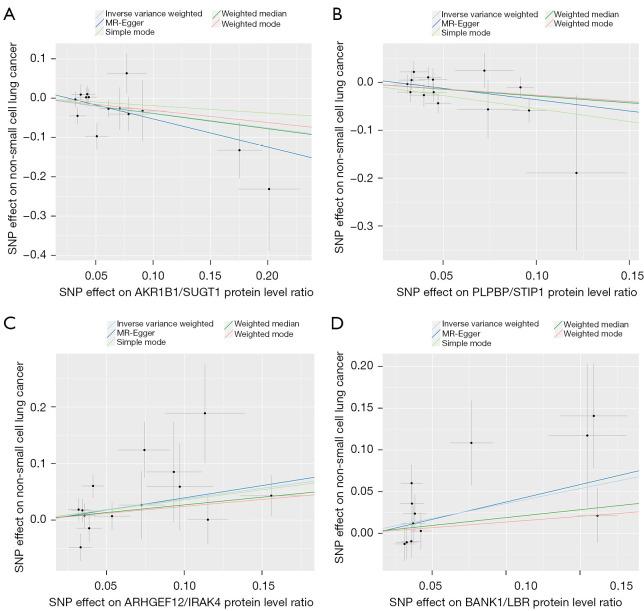
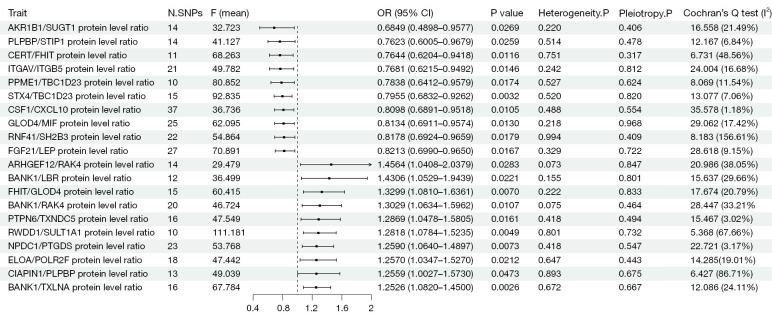
Our study identified causal relationships between 142 protein level ratios and NSCLC. Notably, the AKR1B1/SUGT1 protein level ratio and the PLPBP/STIP1 protein level ratio demonstrated the most significant negative correlations with NSCLC risk. On the other hand, the ARHGEF12/IRAK4 protein level ratio and the BANK1/LBR protein level ratio exhibited the most significant positive correlations. Furthermore, sensitivity analyses did not reveal any significant heterogeneity or horizontal pleiotropy.
CONCLUSIONS
Studying specific protein level ratios in patients can reveal the molecular mechanisms and pathological processes of NSCLC, which has certain clinical significance for early diagnosis of NSCLC, understanding drug resistance mechanisms and developing personalized treatment strategies. However, these findings necessitate further validation through extensive clinical research.
背景
非小细胞肺癌(NSCLC)病因复杂,导致早期诊断困难且死亡率高,因此需要个性化治疗策略。虽然蛋白质水平比值已显示出作为生物标志物或治疗靶点的潜力,但其与NSCLC的因果关系仍不清楚。本研究旨在使用孟德尔随机化(MR)来研究这些因果联系,为潜在的生物标志物和治疗途径提供见解。
方法
我们进行了一项复杂的两样本MR研究,以探索2821种蛋白质水平比值与NSCLC之间的随机因果联系。NSCLC和蛋白质水平比值的全基因组关联研究(GWAS)统计数据分别来自芬兰数据库(第10版)和英国生物银行。对于与蛋白质水平比值相关的工具变量(IVs),我们选择P值<1.0×10的IVs。在整个分析过程中,我们应用了五种既定的MR技术。
结果
我们的研究确定了142种蛋白质水平比值与NSCLC之间的因果关系。值得注意的是,AKR1B1/SUGT1蛋白质水平比值和PLPBP/STIP1蛋白质水平比值与NSCLC风险呈现出最显著的负相关。另一方面,ARHGEF12/IRAK4蛋白质水平比值和BANK1/LBR蛋白质水平比值呈现出最显著的正相关。此外,敏感性分析未发现任何显著的异质性或水平多效性。
结论
研究患者体内特定的蛋白质水平比值可以揭示NSCLC的分子机制和病理过程,这对NSCLC的早期诊断、理解耐药机制以及制定个性化治疗策略具有一定的临床意义。然而,这些发现需要通过广泛的临床研究进一步验证。

 Zotero 插件