
炎症细胞因子与尿路结石的因果关联:一项两样本孟德尔随机化研究。
Causal associations of inflammatory cytokines and urinary stones: a two-sample Mendelian randomization study.
作者信息
Yao Huan, Yu Dan, He Qingyun, Ning Xiaoya
机构信息
Nephrology Department, Affiliated Hospital of Guizhou Medical University, Guiyang, China.
Nephrology Department, Guizhou Hospital of The First Affiliated Hospital of Sun Yat-sen University, Guiyang, China.
出版信息
Transl Androl Urol. 2025 Feb 28;14(2):258-265. doi: 10.21037/tau-24-445. Epub 2025 Feb 25.
BACKGROUND
Prior research has shown potential changes in cytokine and growth factor levels in patients with urinary stones, but the causal relationship remains uncertain. The purpose of this study was to investigate the causal relationship between cytokine and growth factor levels and urinary tract stones.
METHODS
This study used a two-sample Mendelian randomization (MR) with 41 circulating cytokines and growth factors datasets alongside urinary stone disease (USD) data. It employed various analytical methods including inverse variance weighted (IVW) analysis, maximum likelihood estimation, MR-Egger regression, weighted median approach, simple median method, and weighted mode to establish causal relationships. Sensitivity analysis included the MR-Egger regression intercept test and Cochrane's Q statistic.
RESULTS
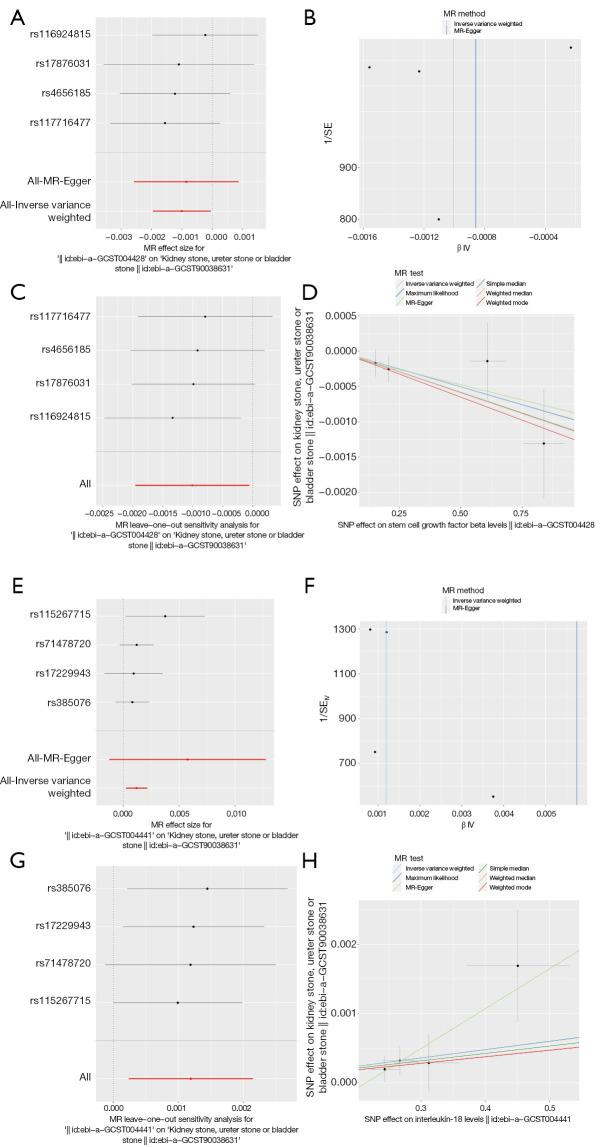
Using the IVW method, an increase in stem cell growth factor β levels was associated with decreased urinary stone risk [odds ratio (OR) =0.9990; 95% confidence interval (CI): 0.9980-0.9999; P=0.04]. Conversely, an increase in interleukin-18 levels elevated the risk of urinary stones (OR =1.0012; 95% CI: 1.0002-1.0022; P=0.01). Various analytical methods consistently supported these findings.
CONCLUSIONS
Our findings suggest a causal and unidirectional relationship between interleukin-18, stem cell growth factors, and USD. This indicates that these cytokines may actively contribute to the development or prevention of USD, offering a new avenue for clinical intervention based on cytokines modulation.
背景
先前的研究表明,尿路结石患者的细胞因子和生长因子水平可能发生变化,但因果关系仍不确定。本研究的目的是探讨细胞因子和生长因子水平与尿路结石之间的因果关系。
方法
本研究采用两样本孟德尔随机化(MR)方法,将41个循环细胞因子和生长因子数据集与尿路结石疾病(USD)数据相结合。采用多种分析方法,包括逆方差加权(IVW)分析、最大似然估计、MR-Egger回归、加权中位数法、简单中位数法和加权模式法来建立因果关系。敏感性分析包括MR-Egger回归截距检验和Cochrane's Q统计量。
结果
采用IVW方法,干细胞生长因子β水平升高与尿路结石风险降低相关[比值比(OR)=0.9990;95%置信区间(CI):0.9980-0.9999;P=0.04]。相反,白细胞介素-18水平升高会增加尿路结石的风险(OR =1.0012;95%CI:1.0002-1.0022;P=0.01)。各种分析方法均一致支持这些发现。
结论
我们的研究结果表明白细胞介素-18、干细胞生长因子与USD之间存在因果单向关系。这表明这些细胞因子可能积极促进USD的发生或预防,并为基于细胞因子调节的临床干预提供了新途径。

 Zotero 插件