
多组学在促进前列腺癌理解与治疗中的作用(综述)
Role of multi‑omics in advancing the understanding and treatment of prostate cancer (Review).
作者信息
Yan Li, Su Pengxiao, Sun Xiaoke
机构信息
Department of Urology, Honghui Hospital, Xi'an Jiaotong University, Xi'an, Shaanxi 710054, P.R. China.
Department of Urology, Honghui Hospital, Xi'an Jiaotong University, Xi'an, Shaanxi 710054, P.R. China.
出版信息
Mol Med Rep. 2025 May;31(5). doi: 10.3892/mmr.2025.13495. Epub 2025 Mar 21.
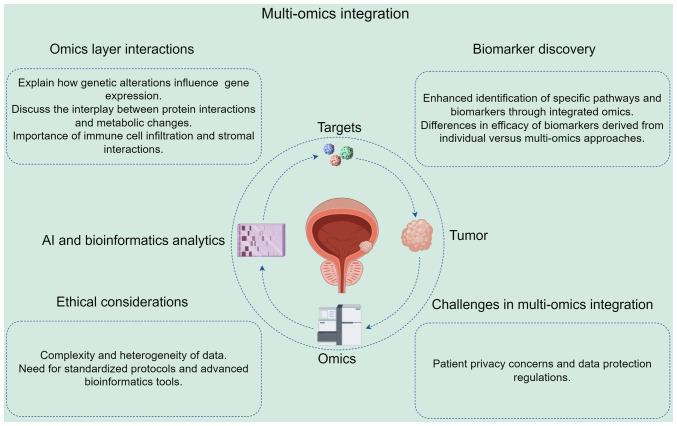
The application of multi‑omics methodologies, encompassing genomics, transcriptomics, proteomics, metabolomics and integrative genomics, has markedly enhanced the understanding of prostate cancer (PCa). These methods have facilitated the identification of molecular pathways and biomarkers crucial for the early detection, prognostic evaluation and personalized treatment of PCa. Studies using multi‑omics technologies have elucidated how alterations in gene expression and protein interactions contribute to PCa progression and treatment resistance. Furthermore, the integration of multi‑omics data has been used in the identification of novel therapeutic targets and the development of innovative treatment modalities, such as precision medicine. The evolving landscape of multi‑omics research holds promise for not only deepening the understanding of PCa biology but also for fostering the development of more effective and tailored therapeutic interventions, ultimately improving patient outcomes. The present review aims to synthesize current findings from multi‑omics studies associated with PCa and to assess their implications for the improvement of patient management and therapeutic outcomes. The insights provided may guide future research directions and clinical practices in the fight against PCa.
多组学方法的应用,包括基因组学、转录组学、蛋白质组学、代谢组学和整合基因组学,显著提高了对前列腺癌(PCa)的认识。这些方法有助于识别对PCa的早期检测、预后评估和个性化治疗至关重要的分子途径和生物标志物。使用多组学技术的研究已经阐明了基因表达和蛋白质相互作用的改变如何促进PCa的进展和治疗抗性。此外,多组学数据的整合已被用于识别新的治疗靶点和开发创新的治疗模式,如精准医学。多组学研究不断发展的前景不仅有望加深对PCa生物学的理解,还能促进更有效和个性化治疗干预措施的发展,最终改善患者的治疗结果。本综述旨在综合与PCa相关的多组学研究的当前发现,并评估它们对改善患者管理和治疗结果的影响。所提供的见解可能会指导未来对抗PCa的研究方向和临床实践。

 Zotero 插件