
1990-2021年全球、区域和国家层面家庭空气污染负担:全球疾病负担研究2021的系统分析
Global, regional, and national burden of household air pollution, 1990-2021: a systematic analysis for the Global Burden of Disease Study 2021.
出版信息
Lancet. 2025 Apr 5;405(10485):1167-1181. doi: 10.1016/S0140-6736(24)02840-X. Epub 2025 Mar 18.
BACKGROUND
Despite a substantial reduction in the use of solid fuels for cooking worldwide, exposure to household air pollution (HAP) remains a leading global risk factor, contributing considerably to the burden of disease. We present a comprehensive analysis of spatial patterns and temporal trends in exposure and attributable disease from 1990 to 2021, featuring substantial methodological updates compared with previous iterations of the Global Burden of Diseases, Injuries, and Risk Factors Study, including improved exposure estimations accounting for specific fuel types.
METHODS
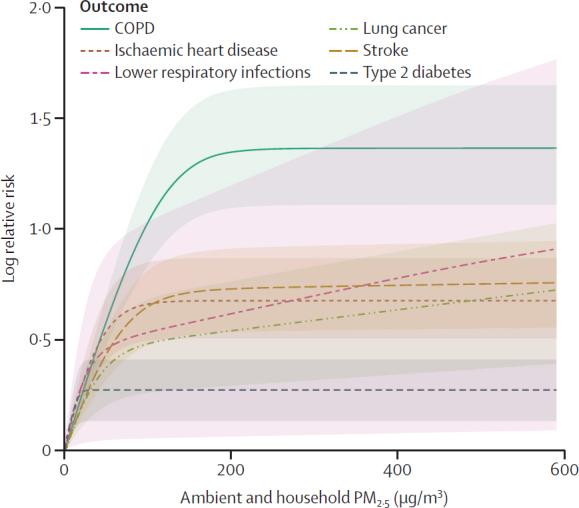
We estimated HAP exposure and trends and attributable burden for cataract, chronic obstructive pulmonary disease, ischaemic heart disease, lower respiratory infections, tracheal cancer, bronchus cancer, lung cancer, stroke, type 2 diabetes, and causes mediated via adverse reproductive outcomes for 204 countries and territories from 1990 to 2021. We first estimated the mean fuel type-specific concentrations (in μg/m) of fine particulate matter (PM) pollution to which individuals using solid fuels for cooking were exposed, categorised by fuel type, location, year, age, and sex. Using a systematic review of the epidemiological literature and a newly developed meta-regression tool (meta-regression: Bayesian, regularised, trimmed), we derived disease-specific, non-parametric exposure-response curves to estimate relative risk as a function of PM concentration. We combined our exposure estimates and relative risks to estimate population attributable fractions and attributable burden for each cause by sex, age, location, and year.
FINDINGS
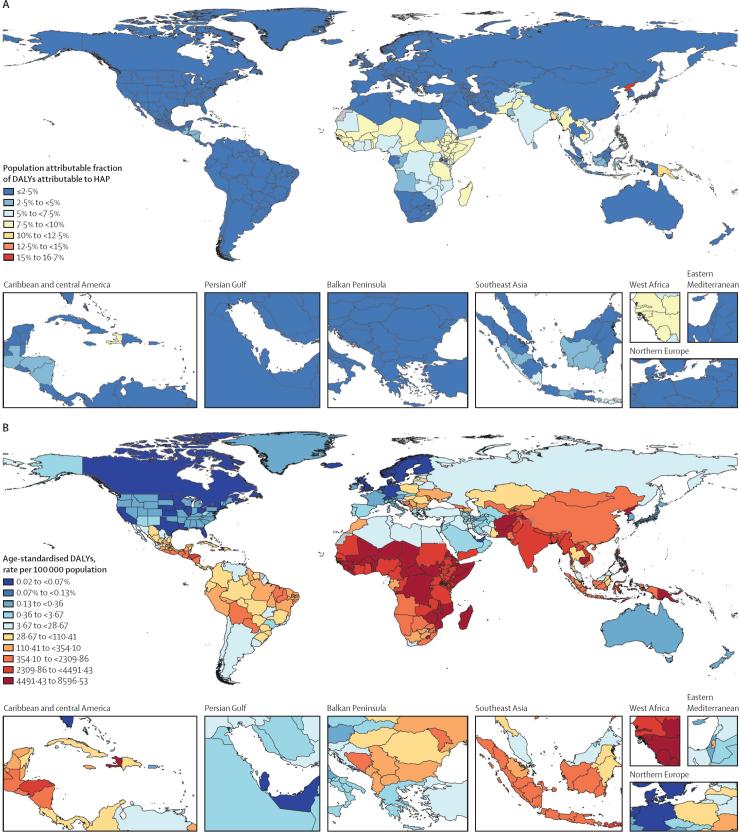
In 2021, 2·67 billion (95% uncertainty interval [UI] 2·63-2·71) people, 33·8% (95% UI 33·2-34·3) of the global population, were exposed to HAP from all sources at a mean concentration of 84·2 μg/m. Although these figures show a notable reduction in the percentage of the global population exposed in 1990 (56·7%, 56·4-57·1), in absolute terms, there has been only a decline of 0·35 billion (10%) from the 3·02 billion people exposed to HAP in 1990. In 2021, 111 million (95% UI 75·1-164) global disability-adjusted life-years (DALYs) were attributable to HAP, accounting for 3·9% (95% UI 2·6-5·7) of all DALYs. The rate of global, HAP-attributable DALYs in 2021 was 1500·3 (95% UI 1028·4-2195·6) age-standardised DALYs per 100 000 population, a decline of 63·8% since 1990, when HAP-attributable DALYs comprised 4147·7 (3101·4-5104·6) age-standardised DALYs per 100 000 population. HAP-attributable burden remained highest in sub-Saharan Africa and south Asia, with 4044·1 (3103·4-5219·7) and 3213·5 (2165·4-4409·4) age-standardised DALYs per 100 000 population, respectively. The rate of HAP-attributable DALYs was higher for males (1530·5, 1023·4-2263·6) than for females (1318·5, 866·1-1977·2). Approximately one-third of the HAP-attributable burden (518·1, 410·1-641·7) was mediated via short gestation and low birthweight. Decomposition of trends and drivers behind changes in the HAP-attributable burden highlighted that declines in exposures were counteracted by population growth in most regions of the world, especially sub-Saharan Africa.
INTERPRETATION
Although the burden attributable to HAP has decreased considerably, HAP remains a substantial risk factor, especially in sub-Saharan Africa and south Asia. Our comprehensive estimates of HAP exposure and attributable burden offer a robust and reliable resource for health policy makers and practitioners to precisely target and tailor health interventions. Given the persistent and substantial impact of HAP in many regions and countries, it is imperative to accelerate efforts to transition under-resourced communities to cleaner household energy sources. Such initiatives are crucial for mitigating health risks and promoting sustainable development, ultimately improving the quality of life and health outcomes for millions of people.
FUNDING
Bill & Melinda Gates Foundation.
背景
尽管全球范围内用于烹饪的固体燃料使用量大幅减少,但家庭空气污染(HAP)暴露仍是主要的全球风险因素,对疾病负担有相当大的影响。我们对1990年至2021年期间暴露情况及归因疾病的空间模式和时间趋势进行了全面分析,与全球疾病、伤害和风险因素研究的先前版本相比,在方法上有重大更新,包括改进了考虑特定燃料类型的暴露估计。
方法
我们估计了1990年至2021年期间204个国家和地区的HAP暴露、趋势以及白内障、慢性阻塞性肺疾病、缺血性心脏病、下呼吸道感染、气管癌、支气管癌、肺癌、中风、2型糖尿病以及通过不良生殖结局介导的病因的归因负担。我们首先估计了使用固体燃料烹饪的个体暴露于细颗粒物(PM)污染的特定燃料类型平均浓度(μg/m),按燃料类型、地点、年份、年龄和性别分类。通过对流行病学文献的系统综述和新开发的元回归工具(元回归:贝叶斯、正则化、修剪),我们得出特定疾病的非参数暴露-反应曲线,以估计作为PM浓度函数的相对风险。我们将暴露估计值和相对风险相结合,按性别、年龄、地点和年份估计每种病因的人群归因分数和归因负担。
结果
2021年,26.7亿人(95%不确定区间[UI]26.3 - 27.1亿),占全球人口的33.8%(95% UI 33.2 - 34.3%),暴露于各种来源的HAP,平均浓度为84.2 μg/m。尽管这些数字显示1990年全球暴露人口百分比显著下降(56.7%,56.4 - 57.1%),但绝对数量上,与1990年暴露于HAP的30.2亿人相比仅减少了0.35亿人(10%)。2021年,1.11亿(95% UI 7510万 - 1.64亿)全球残疾调整生命年(DALYs)归因于HAP,占所有DALYs的3.9%(95% UI 2.6 - 5.7%)。2021年全球归因于HAP的DALYs率为每10万人口1500.3(95% UI 1028.4 - 2195.6)年龄标准化DALYs,自1990年以来下降了63.8%,1990年归因于HAP的DALYs为每10万人口4147.7(3101.4 - 5104.6)年龄标准化DALYs。归因于HAP的负担在撒哈拉以南非洲和南亚仍然最高,分别为每10万人口4044.1(3103.4 - 5219.7)和3213.5(2165.4 - 4409.4)年龄标准化DALYs。归因于HAP的DALYs率男性(1530.5,1023.4 - 2263.6)高于女性(1318.5,866.1 - 1977.2)。约三分之一的归因于HAP的负担(518.1,410.1 - 641.7)是通过短孕期和低出生体重介导的。对归因于HAP负担变化背后的趋势和驱动因素的分解突出表明,在世界大多数地区,尤其是撒哈拉以南非洲,暴露的下降被人口增长抵消。
解读
尽管归因于HAP的负担已大幅下降,但HAP仍然是一个重大风险因素,尤其是在撒哈拉以南非洲和南亚。我们对HAP暴露和归因负担的全面估计为卫生政策制定者和从业者提供了一个强大而可靠的资源,以便精确地确定和调整卫生干预措施。鉴于HAP在许多地区和国家持续产生重大影响,必须加快努力,使资源匮乏社区转向更清洁的家庭能源。这些举措对于减轻健康风险和促进可持续发展至关重要,最终改善数百万人的生活质量和健康结果。
资助
比尔及梅琳达·盖茨基金会



 Zotero 插件