
人体代谢生物标志物在饮料消费与乳腺癌风险关联中的中介作用。
The mediating roles of anthropo-metabolic biomarkers on the association between beverage consumption and breast cancer risk.
作者信息
Lin Xiaoyi, Liang Boheng, Lam Tai Hing, Cheng Kar Keung, Zhang Weisen, Xu Lin
机构信息
School of Public Health, Sun Yat-sen University, No. 74 Zhongshan 2nd Road, Guangzhou, Guangdong Province, China.
Greater Bay Area, Greater Bay Area Public Health Research Collaboration, Guangzhou, China.
出版信息
Nutr J. 2025 Mar 22;24(1):46. doi: 10.1186/s12937-025-01110-y.
BACKGROUND
Breast cancer (BC) is the most common malignancy in women, yet the role of beverage consumption in BC risk remains unclear. Additionally, the contribution of anthropo-metabolic biomarkers as mediators is unknown, limiting the development of effective prevention strategies.
METHODS
This study included 13,567 participants from the Guangzhou Biobank Cohort Study (GBCS), where beverage consumption was assessed at baseline using a food frequency questionnaire. BC cases were identified through cancer registry linkage over a mean follow-up of 14.8 years. Mendelian randomization (MR) analyses were performed to evaluate the causal effects of beverage consumption on BC risk, with a two-step MR approach used to estimate mediation effects.
RESULTS
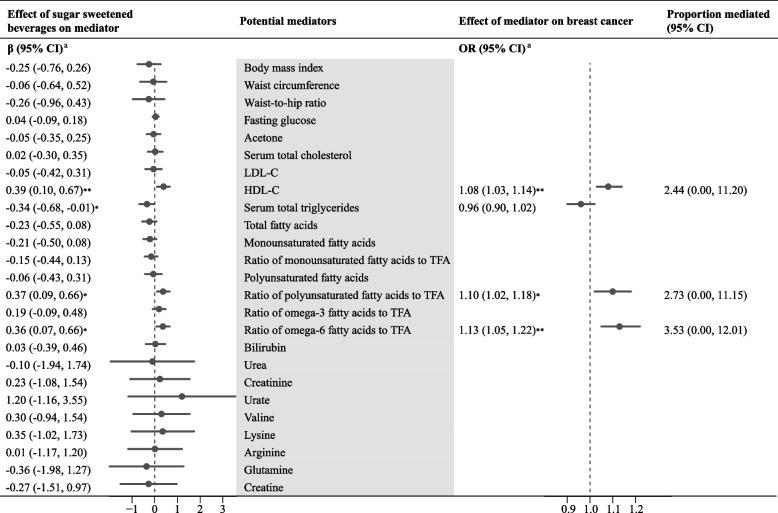
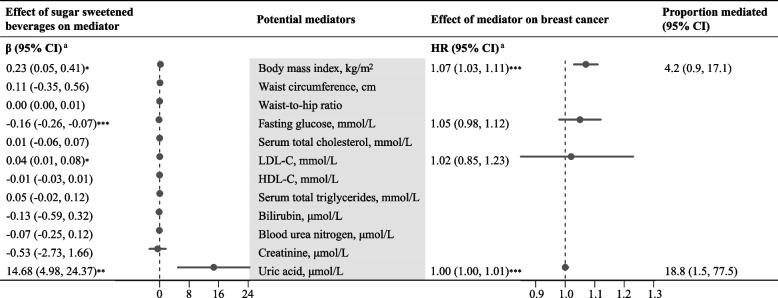
During follow-up, 243 BC cases were identified. Weekly consumption of ≥ 1 portion of sugar sweetened beverages (SSB), versus < 1 portion, was significantly associated with a higher risk of BC (hazard ratio [HR] 1.58, 95% confidence interval [CI] 1.12-2.23). This association was partly mediated by body mass index (proportion mediated [PM] 4.2%, 95% CI 0.9-17.1%) and uric acid (PM 18.8%, 95% CI 1.5-77.5%). Weekly consumption of > 6 portions of dairy-based milk was associated with a non-significantly higher BC risk (HR 1.41, 95% CI 0.99-2.03), while 3-6 portions of soy milk were associated with a lower BC risk (HR 0.31, 95% CI 0.10-0.98). No significant associations were found for pure fruit juice, coffee, tea, or alcoholic drinks. MR analyses supported the detrimental effect of SSB on BC risk, with high-density lipoprotein cholesterol, polyunsaturated fatty acids to total fatty acids (TFAs) ratio, and omega-6 fatty acids to TFAs ratio mediating 2.44%, 2.73%, and 3.53% of the association, respectively.
CONCLUSION
This study suggested that SSB consumption was a risk factor for BC and identified key anthropo-metabolic biomarkers mediating this relationship. Reducing SSB consumption and addressing associated metabolic pathways may offer effective strategies for BC prevention.
背景
乳腺癌(BC)是女性中最常见的恶性肿瘤,然而饮料消费在乳腺癌风险中的作用仍不明确。此外,人体代谢生物标志物作为中介的作用尚不清楚,这限制了有效预防策略的制定。
方法
本研究纳入了来自广州生物样本库队列研究(GBCS)的13567名参与者,在基线时使用食物频率问卷评估饮料消费情况。通过癌症登记链接在平均14.8年的随访中确定乳腺癌病例。进行孟德尔随机化(MR)分析以评估饮料消费对乳腺癌风险的因果效应,并采用两步MR方法估计中介效应。
结果
在随访期间,确定了243例乳腺癌病例。每周饮用≥1份含糖甜味饮料(SSB)与<1份相比,与更高的乳腺癌风险显著相关(风险比[HR]1.58,95%置信区间[CI]1.12 - 2.23)。这种关联部分由体重指数介导(中介比例[PM]4.2%,95%CI 0.9 - 17.1%)和尿酸介导(PM 18.8%,95%CI 1.5 - 77.5%)。每周饮用>6份乳制品牛奶与略高的乳腺癌风险相关(HR 1.41,95%CI 0.99 - 2.03),而每周饮用3 - 6份豆浆与较低的乳腺癌风险相关(HR 0.31,95%CI 0.10 - 0.98)。纯果汁、咖啡、茶或酒精饮料未发现显著关联。MR分析支持SSB对乳腺癌风险的有害影响,高密度脂蛋白胆固醇、多不饱和脂肪酸与总脂肪酸(TFA)的比例以及ω-6脂肪酸与TFA的比例分别介导了该关联的2.44%、2.73%和3.53%。
结论
本研究表明饮用SSB是乳腺癌的一个风险因素,并确定了介导这种关系的关键人体代谢生物标志物。减少SSB消费并解决相关代谢途径可能为乳腺癌预防提供有效策略。
 Zotero 插件