
提高高危人群的中风意识与行动力:在不同医疗环境中的随机直邮干预措施
Enhancing Stroke Awareness and Activation Among High-Risk Populations: A Randomized Direct Mail Intervention in Diverse Healthcare Settings.
作者信息
Groves Christine C, Damush Teresa M, Myers Laura J, Baye Fitsum, Daggy Joanne K, Perkins Anthony J, Martin Holly, Mounsey Layne, Clark Daniel O, Williams Linda S
机构信息
Department of Physical Medicine and Rehabilitation (C.C.G.), Indiana University School of Medicine, Indianapolis.
Department of Physical Medicine and Rehabilitation, Eskenazi Health, Indianapolis, IN (C.C.G.).
出版信息
Circ Cardiovasc Qual Outcomes. 2025 May;18(5):e011425. doi: 10.1161/CIRCOUTCOMES.124.011425. Epub 2025 Mar 24.
BACKGROUND
Many patients are unaware of their stroke risk. The purpose of this research was to compare the effect of behaviorally tailored mailed messages on patient activation to reduce stroke risk.
METHODS
Randomized parallel group clinical trial. We used electronic health records to construct Framingham Stroke Risk Scores in primary care patients from 1 Veterans Health Administration (VA) and 1 non-VA healthcare system, Eskenazi Health System (EHS). Four stroke risk messages were developed through patient interviews: standard, incentive ($5 gift card), salience, and incentive plus salience. The standard message served as the comparison group. Patients in the highest Framingham Stroke Risk Score quintile were randomly assigned to receive one of the messages. All letters asked the patient to call a stroke prevention coordinator, the primary outcome. Response to the messages was modeled separately in the 2 cohorts using logistic regression.
RESULTS
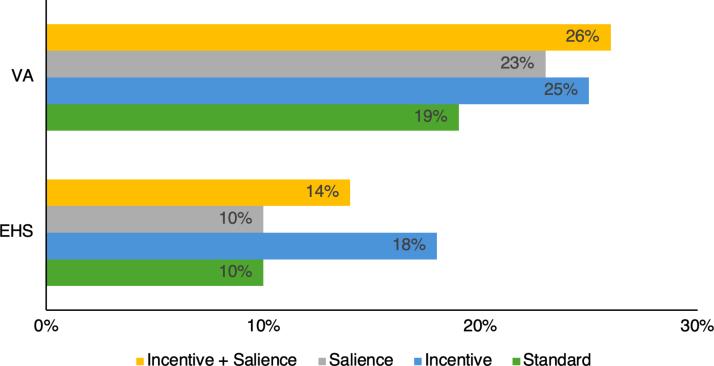
In total, 2084 EHS patients (mean age, 65.6; 36% male; 68% Black; mean Framingham Stroke Risk Score, 13.1) and 1759 VA patients (mean age, 75.6; 99% male; 86% White; mean Framingham Stroke Risk Score, 18.6) received a letter. Rates of calls to the coordinator were 13% among the EHS and 23% among the VA cohort. The EHS cohort was significantly more likely to respond to the incentive message compared with the standard message (odds ratio, 1.97 [95% CI, 1.17-3.09]), and the VA cohort was more likely to respond to the incentive plus salience message (odds ratio, 1.50 [95% CI, 1.02-2.22]). Among individuals calling the coordinator, 31% of the EHS cohort and 27% of the VA cohort were unaware they had stroke risk factors.
CONCLUSIONS
A mailed message including a $5 incentive was more effective than a standard message in engaging high-risk patients with their healthcare system, including a salience message may also be important in some patient populations. Many primary care patients are unaware of their stroke risk.
REGISTRATION
URL: https://www.clinicaltrials.gov; Unique identifier: NCT02721446.
背景
许多患者并不知晓自己的中风风险。本研究旨在比较行为定制的邮寄信息对患者激活以降低中风风险的效果。
方法
随机平行组临床试验。我们使用电子健康记录为来自1个退伍军人健康管理局(VA)和1个非VA医疗系统埃斯凯纳齐健康系统(EHS)的初级保健患者构建弗雷明汉中风风险评分。通过患者访谈制定了4条中风风险信息:标准信息、激励信息(5美元礼品卡)、突出信息以及激励加突出信息。标准信息作为对照组。弗雷明汉中风风险评分处于最高五分位数的患者被随机分配接受其中一条信息。所有信件均要求患者致电中风预防协调员,这是主要结局。在两个队列中分别使用逻辑回归对信息的回复情况进行建模。
结果
共有2084名EHS患者(平均年龄65.6岁;36%为男性;68%为黑人;平均弗雷明汉中风风险评分为13.1)和1759名VA患者(平均年龄75.6岁;99%为男性;86%为白人;平均弗雷明汉中风风险评分为18.6)收到了信件。EHS队列中致电协调员的比例为13%,VA队列中为23%。与标准信息相比,EHS队列对激励信息的回复可能性显著更高(优势比为1.97[95%CI,1.17 - 3.09]),而VA队列对激励加突出信息的回复可能性更高(优势比为1.50[95%CI,1.02 - 2.22])。在致电协调员的个体中,EHS队列中有31%、VA队列中有27%的人不知道自己有中风风险因素。
结论
包含5美元激励的邮寄信息在促使高危患者参与其医疗系统方面比标准信息更有效。在某些患者群体中,包含突出信息可能也很重要。许多初级保健患者不知道自己的中风风险。
注册

 Zotero 插件