
活检与胚胎/囊胚综合分析:深入探讨胚胎染色体评估
Biopsy vs comprehensive embryo/blastocyst analysis: a closer look at embryonic chromosome evaluation.
作者信息
Xu Jian, Chen Zhiheng, Li Meiyi, Sun Ling
机构信息
Center of Reproductive Medicine, Guangzhou Women and Children's Medical Center, Guangzhou Medical University, Guangzhou, Guangdong Province, China.
出版信息
Hum Reprod Open. 2025 Mar 12;2025(2):hoaf013. doi: 10.1093/hropen/hoaf013. eCollection 2025.
STUDY QUESTION
Compared with embryonic cytogenetic constitution of biopsied samples in human pre-implantation embryos, are there any differences in whole embryos?
SUMMARY ANSWER
Whole embryos exhibit a significantly higher euploidy rate and reduction in mosaic aneuploidy rate compared to biopsied samples.
WHAT IS KNOWN ALREADY
Much of the existing evidence of cytogenetic constitution of human pre-implantation embryos is based on biopsied cells obtained from blastomeres or trophectoderm biopsies. The mosaic rate of biopsies taken from blastocyst trophectoderm ranges widely, from 2% to 25%.
STUDY DESIGN SIZE DURATION
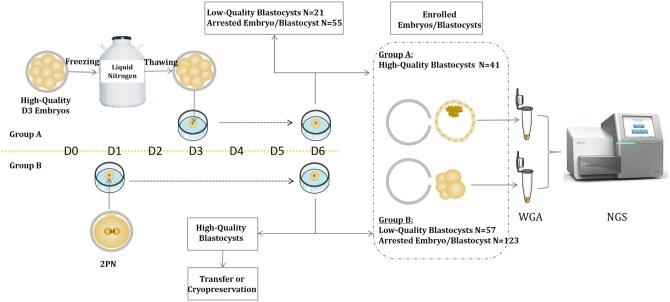
We investigated the embryonic cytogenetic constitution of 221 whole human embryos/blastocysts from 2019 to 2022, including 41 high-quality blastocysts, 57 low-quality blastocysts, and 123 arrested embryos/blastocysts.
PARTICIPANTS/MATERIALS SETTING METHODS: The cytogenetic constitution of whole embryos/blastocysts was assessed using next-generation sequencing. Mosaicism was diagnosed using a cut-off threshold of 30-70%, with embryos displaying 30-70% aneuploid cells classified as mosaic.
MAIN RESULTS AND THE ROLE OF CHANCE
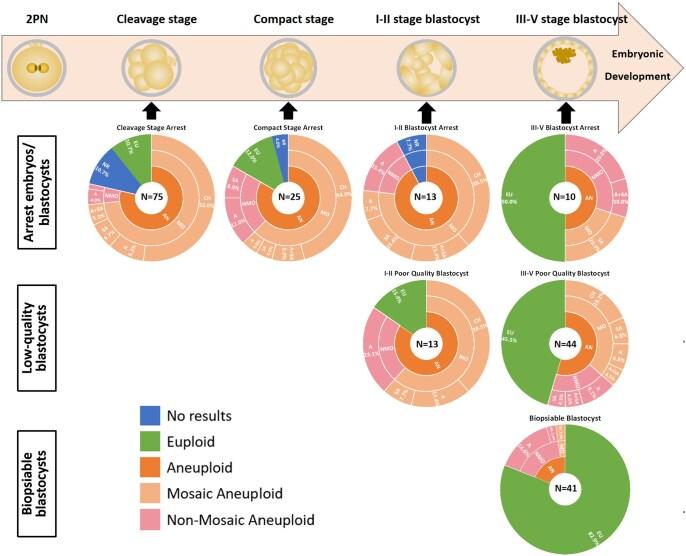
Among high-quality blastocysts, the euploidy rate was 82.9%, with a remarkably low mosaic aneuploidy of only 2.5%. The euploidy rates of viable low-quality blastocysts and arrested embryos/blastocysts were 38.6% and 13.0%, respectively. The mosaic aneuploidy rate decreased progressively with embryonic development, from 93.2% at the cleavage stage to 40% at the blastocyst stage. Chaotic aneuploidy was the primary factor (66.1%, 39/59) contributing to embryonic arrest at the cleavage stage. Additionally, 26.1% of embryos/blastocysts exhibited segmental aneuploidy, with segmental duplications (30.6%, 22/72) and deletions (54.2%, 39/72) being the most common types of segmental aneuploidy.
LIMITATIONS REASONS FOR CAUTION
The sample size in this study is relatively small, especially in the subgroup analysis. Furthermore, whole-embryo analysis is not a foolproof diagnostic method, since it may underestimate the presence of mosaicism.
WIDER IMPLICATIONS OF THE FINDINGS
The cytogenetic constitution of whole embryos provides a more accurate reflection of their physiological state compared to biopsied samples. The low mosaic aneuploidy rate in high-quality blastocysts supports the practice of transferring mosaic embryos in patients without euploid embryos. If blastocysts reach stage III by Day 6 post-fertilization, nearly half are euploid, suggesting that extending embryo culture to Day 7 may be beneficial in cases where high-quality embryos are lacking.
STUDY FUNDING/COMPETING INTERESTS: This study was supported by the Natural Science Foundation of Guangdong Province (No. 2023A1515010250) and Pilot Program-China Reproductive Health Public Welfare Fund Project (No. SZ202413). The authors report no conflicts of interest.
TRIAL REGISTRATION NUMBER
N/A.
研究问题
与人类植入前胚胎活检样本的胚胎细胞遗传学构成相比,完整胚胎是否存在差异?
简要回答
与活检样本相比,完整胚胎的整倍体率显著更高,嵌合非整倍体率降低。
已知信息
人类植入前胚胎细胞遗传学构成的现有证据大多基于从卵裂球或滋养外胚层活检获得的细胞。从囊胚滋养外胚层获取的活检样本的嵌合率范围广泛,从2%到25%不等。
研究设计、规模、持续时间:我们调查了2019年至2022年期间221个完整人类胚胎/囊胚的胚胎细胞遗传学构成,包括41个高质量囊胚、57个低质量囊胚以及123个停滞胚胎/囊胚。
参与者/材料、环境、方法:使用下一代测序评估完整胚胎/囊胚的细胞遗传学构成。使用30%-70%的截断阈值诊断嵌合现象,将显示30%-70%非整倍体细胞的胚胎分类为嵌合体。
主要结果及偶然性的作用
在高质量囊胚中,整倍体率为82.9%,嵌合非整倍体率极低,仅为2.5%。存活的低质量囊胚和停滞胚胎/囊胚的整倍体率分别为38.6%和13.0%。嵌合非整倍体率随着胚胎发育逐渐降低,从卵裂期的93.2%降至囊胚期的40%。混乱非整倍体是导致卵裂期胚胎停滞的主要因素(66.1%,39/59)。此外,26.1%的胚胎/囊胚表现出节段性非整倍体,节段性重复(30.6%,22/72)和缺失(54.2%,39/72)是节段性非整倍体最常见的类型。
局限性、谨慎的原因:本研究中的样本量相对较小,尤其是在亚组分析中。此外,全胚胎分析并非万无一失的诊断方法,因为它可能低估嵌合现象的存在。
研究结果的更广泛影响
与活检样本相比,完整胚胎的细胞遗传学构成能更准确地反映其生理状态。高质量囊胚中低嵌合非整倍体率支持在没有整倍体胚胎的患者中移植嵌合胚胎的做法。如果囊胚在受精后第6天达到III期,近一半是整倍体,这表明在缺乏高质量胚胎的情况下,将胚胎培养延长至第7天可能有益。
研究资金/利益冲突:本研究得到广东省自然科学基金(编号:2023A1515010250)和中国生殖健康公益基金试点项目(编号:SZ202413)的支持。作者声明无利益冲突。
试验注册号
无。



 Zotero 插件