
通过毛细管凝胶电泳对治疗性mRNA完整性进行可靠评估的关键分析方法参数的综合评估
A Comprehensive Evaluation of Analytical Method Parameters Critical to the Reliable Assessment of Therapeutic mRNA Integrity by Capillary Gel Electrophoresis.
作者信息
Tran Jessica P, Gao Jun, Lansdell Casey, Lorbetskie Barry, Johnston Michael J W, Wang Lisheng, Li Xuguang, Lu Huixin
机构信息
Centre for Oncology, Radiopharmaceuticals and Research, Biologic and Radiopharmaceutical Drugs Directorate, Health Products and Food Branch, Health Canada, Ottawa, Ontario, Canada.
Department of Biochemistry, Microbiology and Immunology, Faculty of Medicine, University of Ottawa, Ottawa, Ontario, Canada.
出版信息
Electrophoresis. 2025 Apr;46(7-8):365-375. doi: 10.1002/elps.8123. Epub 2025 Mar 25.
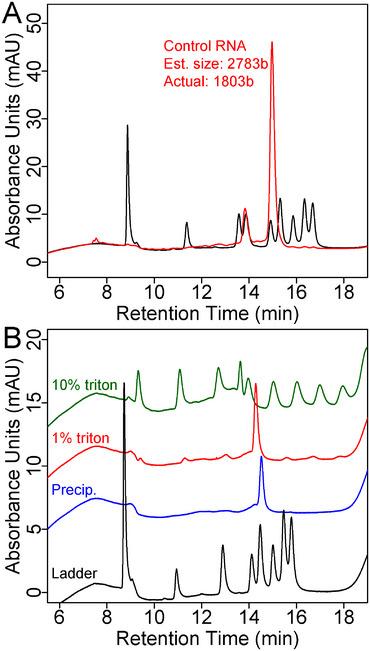
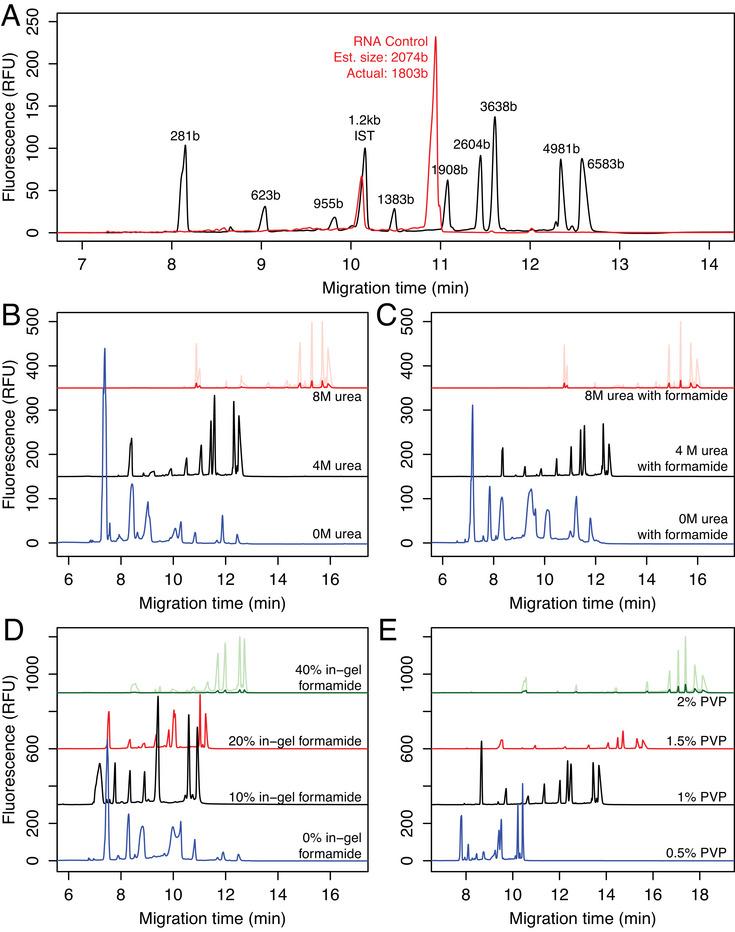
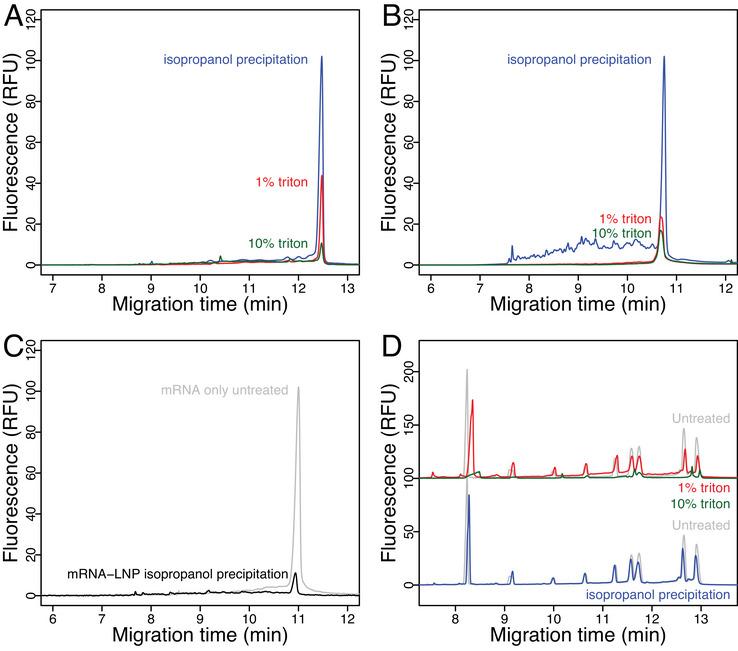
In recent years, messenger ribonucleic acid (mRNA)-lipid nanoparticle (LNP) biotherapeutics have demonstrated significant promise in disease treatment and prevention given their rapidly modifiable production processes and considerable capacity to adapt to complex or low-yielding proteins of interest. As a result, many products are currently being developed in this space. Critically, well-characterized and appropriately designed assays are required to monitor purity and integrity in order to maintain the efficacy and consistency of these novel products. Currently, capillary gel electrophoresis with laser-induced fluorescence (CGE-LIF) and ion-pair reversed-phase liquid chromatography (IP-RPLC) are techniques of choice for mRNA integrity analysis. However, most methods proposed for biotherapeutic analysis have been developed using naked mRNA without LNP components or proprietary buffer formulations, which can obscure undiscovered impurities or complex interactions between mRNA and the sample matrix. In this study, we addressed these methodological challenges by using a biotherapeutically relevant commercial mRNA-LNP sample (approx. 4200 b) to refine and optimize a customizable CGE-LIF method currently under consideration for mRNA-LNP biotherapeutic analysis. We systematically characterized how critical method parameters-such as denaturant type, concentration, and usage-and LNP disruption protocols can interfere with accurate mRNA integrity analysis in CGE-LIF and IP-RPLC. We found that optimal conditions for CGE-LIF assay sensitivity, variability, and resolution included sample precipitation by isopropanol, high urea concentrations, no formamide as a sample diluent, and high concentrations of dye. Finally, the advantages and disadvantages of both CGE-LIF and IP-RPLC are highlighted, and a discussion of key considerations when using or designing methods for mRNA integrity assessment is presented.
近年来,信使核糖核酸(mRNA)-脂质纳米颗粒(LNP)生物疗法因其快速可修改的生产工艺以及适应复杂或低产量目标蛋白的强大能力,在疾病治疗和预防方面展现出巨大潜力。因此,目前该领域正在研发许多产品。至关重要的是,需要经过充分表征和合理设计的检测方法来监测纯度和完整性,以维持这些新型产品的疗效和一致性。目前,激光诱导荧光毛细管凝胶电泳(CGE-LIF)和离子对反相液相色谱(IP-RPLC)是mRNA完整性分析的首选技术。然而,大多数针对生物疗法分析提出的方法都是使用不含LNP成分或专有缓冲液配方的裸mRNA开发的,这可能会掩盖未发现的杂质或mRNA与样品基质之间的复杂相互作用。在本研究中,我们通过使用一种与生物疗法相关的商业化mRNA-LNP样品(约4200个碱基)来解决这些方法学挑战,以完善和优化一种目前正在考虑用于mRNA-LNP生物疗法分析的可定制CGE-LIF方法。我们系统地研究了关键方法参数,如变性剂类型、浓度和用量,以及LNP破坏方案如何干扰CGE-LIF和IP-RPLC中mRNA完整性的准确分析。我们发现,CGE-LIF检测灵敏度、变异性和分辨率的最佳条件包括用异丙醇沉淀样品、高尿素浓度、不用甲酰胺作为样品稀释剂以及高浓度染料。最后,我们强调了CGE-LIF和IP-RPLC的优缺点,并讨论了在使用或设计mRNA完整性评估方法时的关键注意事项。

 Zotero 插件