
新发痴呆症的血液DNA甲基化特征:来自纵向队列研究的证据。
Blood DNA methylation signature for incident dementia: Evidence from longitudinal cohorts.
作者信息
Zhang Wei, Young Juan I, Gomez Lissette, Schmidt Michael A, Lukacsovich David, Kunkle Brian W, Chen X Steven, Martin Eden R, Wang Lily
机构信息
Division of Biostatistics, Department of Public Health Sciences, Miller School of Medicine, University of Miami, Miami, Florida, USA.
Dr. John T. Macdonald Foundation Department of Human Genetics, Miller School of Medicine, University of Miami, Miami, Florida, USA.
出版信息
Alzheimers Dement. 2025 Mar;21(3):e14496. doi: 10.1002/alz.14496.
INTRODUCTION
Distinguishing between molecular changes that precede dementia onset and those resulting from the disease is challenging with cross-sectional studies.
METHODS
We studied blood DNA methylation (DNAm) differences and incident dementia in two large longitudinal cohorts: the Offspring cohort of the Framingham Heart Study (FHS) and the Alzheimer's Disease Neuroimaging Initiative (ADNI) study. We analyzed blood DNAm samples from > 1000 cognitively unimpaired subjects.
RESULTS
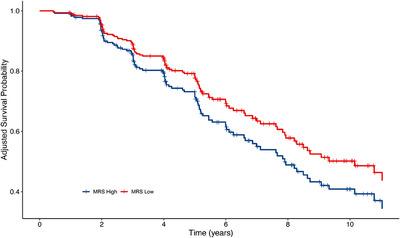
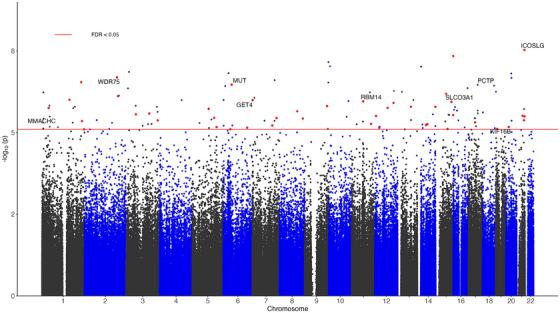
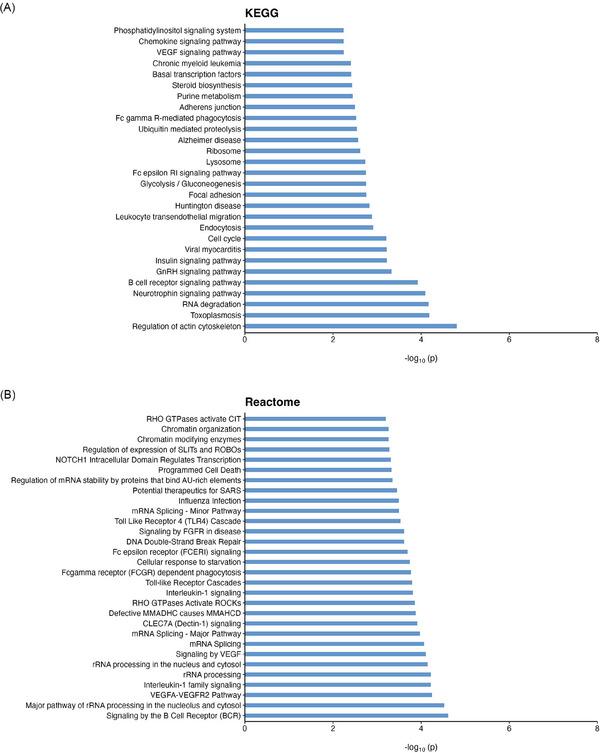
Meta-analysis identified 44 CpGs and 44 differentially methylated regions consistently associated with time to dementia in both cohorts. Our integrative analysis identified early processes in dementia, such as immune responses and metabolic dysfunction. Furthermore, we developed a methylation-based risk score, which successfully predicted future cognitive decline in an independent validation set, even after accounting for age, sex, apolipoprotein E ε4, years of education, baseline diagnosis, and baseline Mini-Mental State Examination score.
DISCUSSION
DNAm offers a promising source as a biomarker for dementia risk assessment.
HIGHLIGHTS
Blood DNA methylation (DNAm) differences at individual CpGs and differentially methylated regions are significantly associated with incident dementia. Pathway analysis revealed DNAm differences associated with incident dementia are significantly enriched in biological pathways involved in immune responses and metabolic processes. Out-of-sample validation analysis demonstrated that a methylation-based risk score successfully predicted future cognitive decline in an independent dataset, even after accounting for age, sex, apolipoprotein E ε4, years of education, baseline diagnosis, and baseline Mini-Mental State Examination score.
引言
对于横断面研究而言,区分在痴呆症发病之前出现的分子变化和由该疾病导致的分子变化具有挑战性。
方法
我们在两个大型纵向队列中研究了血液DNA甲基化(DNAm)差异与新发痴呆症的关系:弗雷明汉心脏研究(FHS)的后代队列和阿尔茨海默病神经影像学倡议(ADNI)研究。我们分析了来自1000多名认知未受损受试者的血液DNAm样本。
结果
荟萃分析确定了44个CpG位点和44个差异甲基化区域,在两个队列中均与痴呆症发病时间持续相关。我们的综合分析确定了痴呆症的早期过程,如免疫反应和代谢功能障碍。此外,我们开发了一种基于甲基化的风险评分,即使在考虑了年龄、性别、载脂蛋白Eε4、受教育年限、基线诊断和基线简易精神状态检查评分之后,该评分仍能在独立验证集中成功预测未来的认知衰退。
讨论
DNAm作为痴呆症风险评估的生物标志物具有广阔前景。
要点
个体CpG位点和差异甲基化区域的血液DNA甲基化(DNAm)差异与新发痴呆症显著相关。通路分析显示,与新发痴呆症相关的DNAm差异在参与免疫反应和代谢过程的生物通路中显著富集。样本外验证分析表明,即使在考虑了年龄、性别、载脂蛋白Eε4、受教育年限、基线诊断和基线简易精神状态检查评分之后,基于甲基化的风险评分仍能在独立数据集中成功预测未来的认知衰退。
 Zotero 插件