
萨克森州和勃兰登堡州临床分离株中潘顿-瓦伦丁杀白细胞素产生的快速检测及其分子特征分析
Rapid Detection of Panton-Valentine Leukocidin Production in Clinical Isolates of from Saxony and Brandenburg and Their Molecular Characterisation.
作者信息
Müller Elke, Monecke Stefan, Armengol Porta Marc, Narvaez Encalada Marco Vinicio, Reissig Annett, Rüttiger Lukas, Schröttner Percy, Schwede Ilona, Söffing Hans-Herman, Thürmer Alexander, Ehricht Ralf
机构信息
Leibniz Institute of Photonic Technology (Leibniz-IPHT), Leibniz Center for Photonics in Infection Research (LPI), Germany and InfectoGnostics Research Campus, 07745 Jena, Germany.
InfectoGnostics Research Campus, Centre for Applied Research, 07745 Jena, Germany.
出版信息
Pathogens. 2025 Mar 1;14(3):238. doi: 10.3390/pathogens14030238.
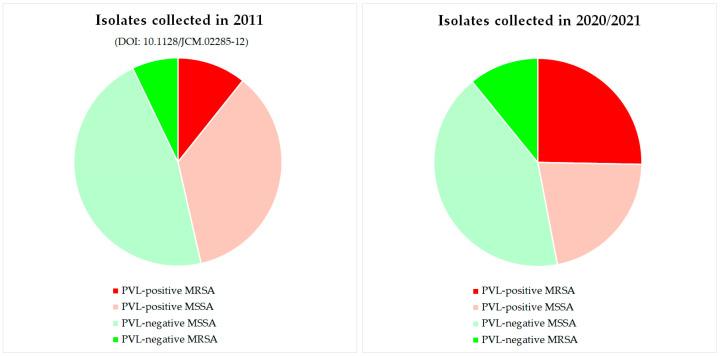
Panton-Valentine leukocidin (PVL) is a staphylococcal toxin associated with chronic/recurrent skin and soft tissue infections (SSTIs) and necrotizing pneumonia. Its detection in clinical isolates of warrants aggressive therapy and infection control measures. However, PVL detection relies on molecular methods of limited use, especially in outpatient or resource-poor settings. In order to aid the development of a lateral flow (LF) test for PVL, clinical isolates from SSTIs were collected in 2020/21 at three laboratories in two cities in the Eastern part of Germany. After the exclusion of duplicate and serial isolates, 83 isolates were eligible. These were tested using an experimental LF test for PVL production. They were also characterized using DNA microarrays, facilitating the detection of virulence and resistance markers as well as the assignment to clonal complexes and epidemic/pandemic strains. Thirty-nine isolates (47%) were PVL-positive, and the LF results were in 81 cases (97.6%) concordant with genotyping. One false-positive and one false-negative case were observed. This translated into a diagnostic sensitivity of 0.974 and a diagnostic specificity of 0.977. The most common PVL-positive MSSA lineages were CC152 (n = 6), CC121 (n = 4), and CC5 and CC30 (each n = 2). Thirty isolates (36%) were -positive. The MRSA rate among PVL-negatives was 20% (nine isolates), but among the PVL-positives, it was as high as 54% (n = 21). The most common PVL-MRSA strains were CC398-MRSA-VT (n = 5), CC5-MRSA-IV "Sri Lanka Clone" (n = 4), CC8-MRSA-[ IV+Hg] "Latin American USA300" (n = 4), and CC22-MRSA-IV (PVL+/+) (n = 2). While the PVL rate was similar just like the German isolates from a previous study a decade before, the MRSA rate among PVL-positives was clearly higher. All PVL-MRSA strains detected, as well as the most common methicillin-susceptible lineage (CC152), are known to be common locally in other parts of the world, and might, thus, be regarded as travel-associated. Therefore, patients with suspected PVL-associated disease should be asked for their history of travel or migration, and, in case of hospitalization, they should be treated as MRSA cases until proven otherwise.
潘顿-瓦伦丁杀白细胞素(PVL)是一种与慢性/复发性皮肤和软组织感染(SSTIs)及坏死性肺炎相关的葡萄球菌毒素。在临床分离株中检测到该毒素需要积极的治疗和感染控制措施。然而,PVL检测依赖于使用受限的分子方法,尤其是在门诊或资源匮乏的环境中。为了辅助开发用于检测PVL的侧向流动(LF)检测方法,2020年/21年在德国东部两个城市的三个实验室收集了SSTIs的临床分离株。排除重复和系列分离株后,83株分离株符合条件。使用用于检测PVL产生的实验性LF检测方法对这些分离株进行检测。还使用DNA微阵列对它们进行表征,便于检测毒力和耐药性标记以及将其归类到克隆复合体和流行/大流行菌株。39株分离株(47%)为PVL阳性,LF检测结果在81例(97.6%)中与基因分型结果一致。观察到1例假阳性和1例假阴性病例。这转化为诊断敏感性为0.974,诊断特异性为0.977。最常见的PVL阳性甲氧西林敏感金黄色葡萄球菌谱系为CC152(n = 6)、CC121(n = 4)以及CC5和CC30(各n = 2)。30株分离株(36%)为[此处原文似乎不完整]阳性。PVL阴性菌株中的耐甲氧西林金黄色葡萄球菌(MRSA)率为20%(9株分离株),但在PVL阳性菌株中,该率高达54%(n = 21)。最常见的PVL-MRSA菌株为CC398-MRSA-VT(n = 5)、CC5-MRSA-IV“斯里兰卡克隆”(n = 4)、CC8-MRSA-[IV+Hg]“拉丁美洲USA300”(n = 4)以及CC22-MRSA-IV(PVL+/+)(n = 2)。虽然PVL率与十年前德国一项先前研究中的分离株相似,但PVL阳性菌株中的MRSA率明显更高。所有检测到的PVL-MRSA菌株以及最常见的甲氧西林敏感谱系(CC152)在世界其他地区当地都很常见,因此可能被视为与旅行相关。因此,对于疑似与PVL相关疾病的患者,应询问其旅行或移民史,并且如果住院,在未得到其他证明之前应将他们作为MRSA病例进行治疗。
 Zotero 插件