
新型冠状病毒肺炎感染后长达24个月的感染后症状:德国柏林的一项匹配队列研究。
Post-infection symptoms up to 24 months after COVID-19: a matched cohort study in Berlin, Germany.
作者信息
Meierkord Anne, Schulze Daniel, Gertler Maximilian, Seybold Joachim, Mall Marcus A, Kurth Tobias, Mockenhaupt Frank P, Theuring Stefanie
机构信息
Institute of International Health, Charité Center for Global Health, Charité - Universitätsmedizin Berlin, Corporate Member of Freie Universität Berlin and Humboldt-Universität zu Berlin, Berlin, Germany.
Centre for International Health Protection, Robert Koch Institute, Berlin, Germany.
出版信息
Front Public Health. 2025 Mar 12;13:1513664. doi: 10.3389/fpubh.2025.1513664. eCollection 2025.
INTRODUCTION
Long-term health consequences after mild COVID-19 are not well described. Our aim was to estimate their prevalence and describe the time course of signs and symptoms for a period of up to 24 months after SARS-CoV-2 infection.
METHODS
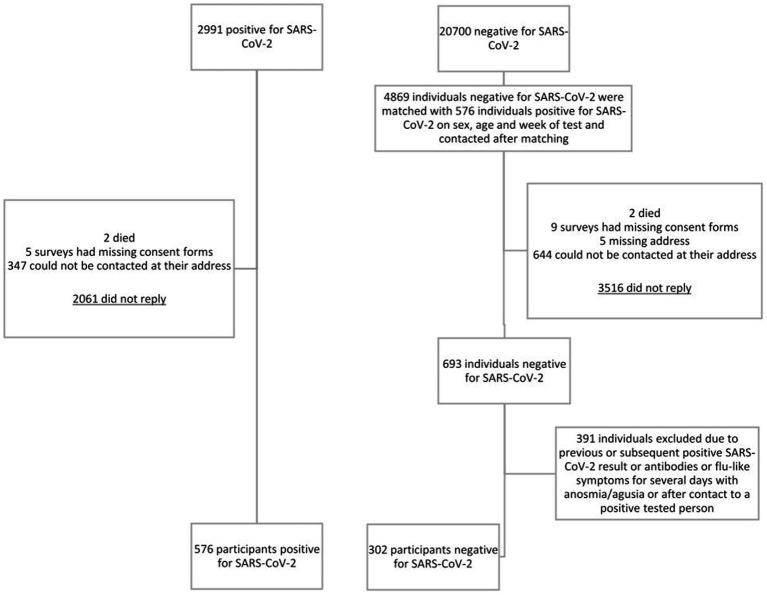
We conducted a cohort study matched for age, sex, and test week among individuals who had attended the public COVID-19 test center at Charité-Universitätsmedizin Berlin, Germany. In early 2022, 576 former COVID-19 patients (>95% non-hospitalized) and 302 uninfected individuals responded to a questionnaire on retrospective monthly symptoms since the test date up to 24 months ago.
RESULTS
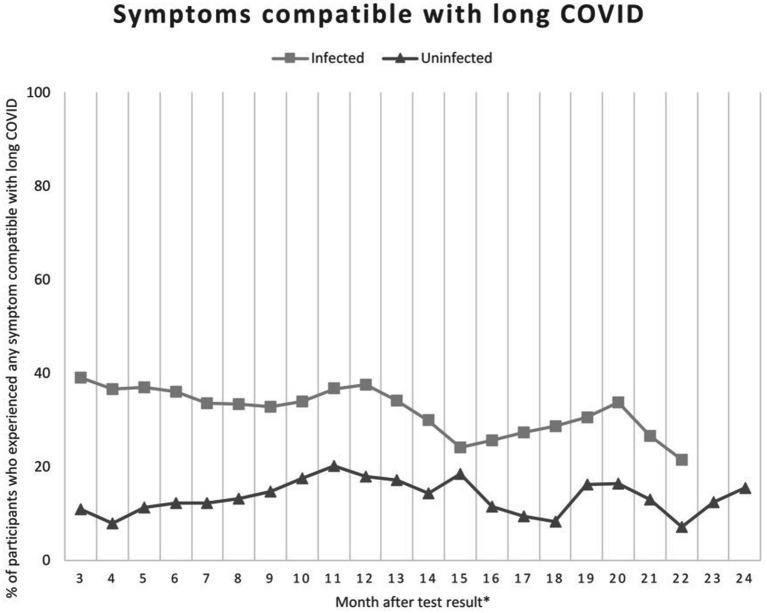
Symptoms compatible with long COVID were present in 42.9% (247/576) of former COVID-19 patients, compared with 21.2% (64/302) in the uninfected group. In former patients, unadjusted odds ratios (OR) were highest for disturbed taste/smell (OR 9.1 [95% CI: 4.0-21.1]), memory difficulties (OR 5.1 [95% CI: 2.9-8.9]), and shortness of breath at rest (OR 4.5 [95% CI: 1.9-10.6]). In most former COVID-19 patients, symptoms occurred in one coherent period and resolved after a median of 6.5 months, while taste/smell disturbance and neurological/cognitive symptoms showed longer times until recovery. Factors associated with long COVID-compatible symptoms included hospitalization, symptomatic COVID-19 infection, low household income and female sex.
CONCLUSION
Post-infection symptoms in mild COVID-19 patients mostly persist for about half a year, but sometimes longer. Among uninfected individuals who never experienced COVID-19, 21.2% also reported long COVID-compatible symptoms. The current long COVID definition might require revision to prevent misclassification and over-reporting, and to improve diagnosis and prevalence estimates.
引言
轻度新冠病毒感染后的长期健康后果尚未得到充分描述。我们的目的是估计其患病率,并描述严重急性呼吸综合征冠状病毒2(SARS-CoV-2)感染后长达24个月期间症状和体征的时间进程。
方法
我们在德国柏林夏里特大学医学中心的公共新冠病毒检测中心进行了一项队列研究,对年龄、性别和检测周进行匹配。2022年初,576名曾感染新冠病毒的患者(超过95%未住院)和302名未感染个体回答了一份关于自检测日期起至24个月前每月回顾性症状的问卷。
结果
曾感染新冠病毒的患者中,42.9%(247/576)出现了与长期新冠病毒感染相符的症状,而未感染组为21.2%(64/302)。在曾感染新冠病毒的患者中,未经调整的优势比(OR)在味觉/嗅觉障碍(OR 9.1 [95%置信区间:4.0 - 21.1])、记忆困难(OR 5.1 [95%置信区间:2.9 - 8.9])和静息时呼吸急促(OR 4.5 [95%置信区间:1.9 - 10.6])方面最高。在大多数曾感染新冠病毒的患者中,症状在一个连贯的时期出现,并在中位时间6.5个月后缓解,而味觉/嗅觉障碍以及神经/认知症状恢复所需时间更长。与长期新冠病毒感染相符症状相关的因素包括住院治疗、有症状的新冠病毒感染、家庭收入低和女性性别。
结论
轻度新冠病毒感染患者的感染后症状大多持续约半年,但有时更长。在从未感染过新冠病毒的未感染个体中,21.2%也报告了与长期新冠病毒感染相符的症状。当前的长期新冠病毒感染定义可能需要修订,以防止错误分类和过度报告,并改善诊断和患病率估计。
 Zotero 插件