
新冠后状况核心症状、亚型、决定因素及健康影响的细化:一项整合真实世界数据和患者报告结局的队列研究
Refinement of post-COVID condition core symptoms, subtypes, determinants, and health impacts: a cohort study integrating real-world data and patient-reported outcomes.
作者信息
Wang Yunhe, Alcalde-Herraiz Marta, Güell Kim López, Chen Li, Mateu Lourdes, Li Chunxiao, Ali Raghib, Wareham Nicholas, Paredes Roger, Prieto-Alhambra Daniel, Xie Junqing
机构信息
Nuffield Department of Population Health, University of Oxford, Oxford, UK.
Centre for Statistics in Medicine and NIHR Biomedical Research Centre Oxford, NDORMS, University of Oxford, Oxford, UK.
出版信息
EBioMedicine. 2025 Jan;111:105493. doi: 10.1016/j.ebiom.2024.105493. Epub 2024 Dec 10.
BACKGROUND
Post-COVID-19 condition (PCC) affects millions of people, and is an essential component of the long-term impact of COVID-19 during the post-pandemic era. Yet, consensus on clinical case definition and core components of PCC remains lacking, affecting our ability to inform research and evidence-based management. Our study aims 1) to identify the most specific symptoms for PCC, and identify clinical subtypes; 2) to evaluate both virus- and host-related determinants of PCC, and 3) assess the impact of PCC on physical and mental health.
METHODS
We studied participants from UK Biobank who completed a health and wellbeing survey between June and September 2022. Participants reported the current conditions of the presence, duration, and functional limitations of 45 symptoms, using an online questionnaire designed specifically for COVID-19 research. SARS-CoV-2 infection status and disease history were obtained through linkage to surveillance data and electronic medical records, respectively. Participants reporting symptoms within 30 days after infection (acute phase) were excluded. The most specific PCC symptoms were defined using two criteria: statistical significance (P < 0.05 after Bonferroni correction) and clinical relevance (absolute risk increase > 5%). Propensity score weighting was used to control for confounding. Subtypes of PCC were then defined based on the specific symptoms among the COVID-19 infected individuals. A multivariable regression was used to study pathogen- and host-related risk factors for PCC, and its impact on 13 physical and 4 mental health patient-reported functional outcomes.
FINDINGS
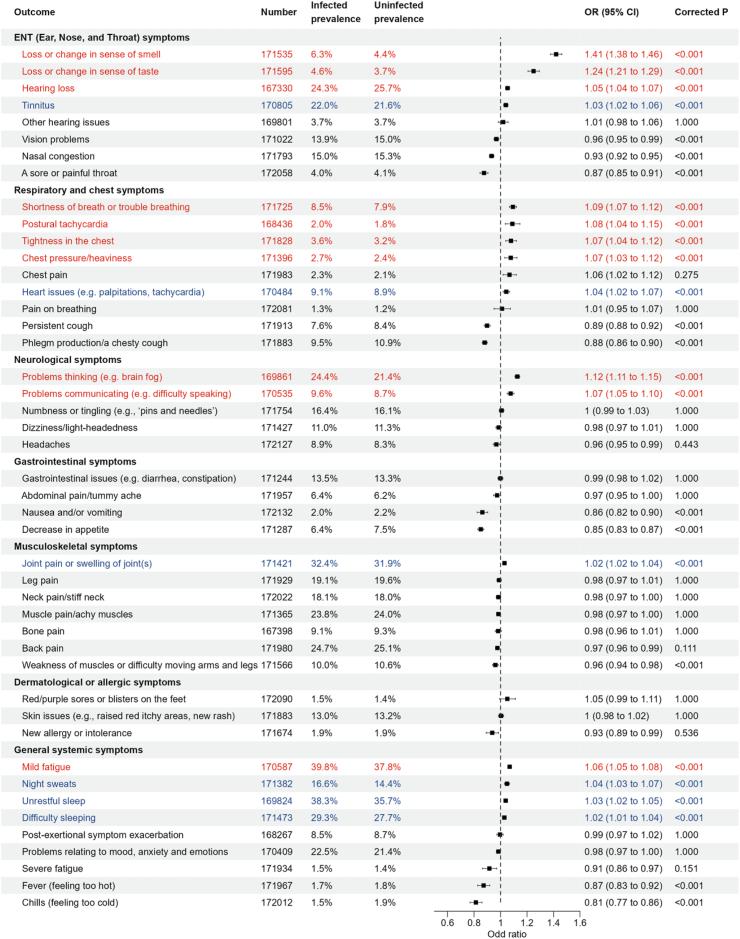
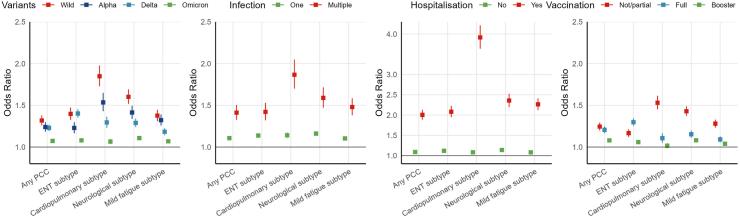
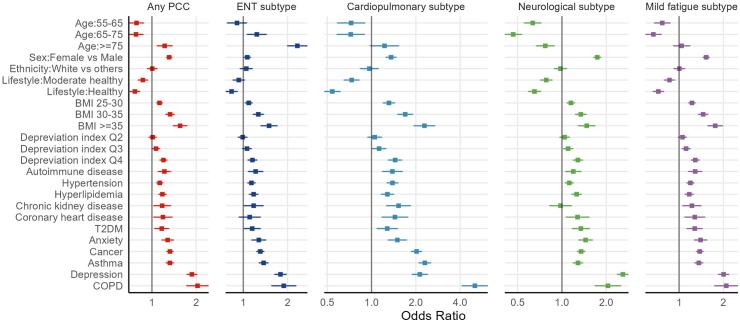
172,303 participants (mean age 68.9, 57.4% female) were included in the analysis, of whom 43,395 had PCR-confirmed COVID-19. We identified 10 most specific symptoms and classified four PCC subtypes: ENT subtype (30.1%), characterized by alterations in smell, taste, and hearing loss; cardiopulmonary subtype (10.4%), characterized by shortness of breath, postural tachycardia, chest tightness, and chest pressure; neurological subtype (23.5%), characterized by brain fog and difficulty speaking; and general fatigue subtype (38.0%), characterized by mild fatigue. A higher PCC risk was observed for patients with Wild-type variant, multiple infections, and severe acute COVID-19 illness, consistently across the four PCC subtypes. In addition, a range of factors, including socioeconomic deprivation, higher BMI, unhealthy lifestyle, and multiple chronic health conditions, were associated with increased PCC risk, except for age and sex. Conversely, vaccination was associated with a largely reduced PCC risk, particularly for the cardiopulmonary subtypes. Individuals with PCC experienced a much worse physical and mental health. Specifically, the cardiopulmonary subtype had the most pronounced adverse impact on function impairments, followed by neurological, mild fatigue, and ENT subtype. The most affected functions included the ability to concentrate, participate in day-to-day work, and emotional vulnerability to health problems.
INTERPRETATION
PCC can be categorized into four distinct subtypes based on ten core symptoms. These subtypes appeared to share a majority of pathogen and host-related risk factors, but their impact on health varied markedly by subtype. Our findings could help refine current guidelines for precise PCC diagnosis and progression, enhance the identification of PCC subgroups for targeted research, and inform evidence-based policy making to tackle this new and debilitating condition.
FUNDING
NIHR Senior Research Fellowship (grant SRF-2018-11-ST2-004).
背景
新冠后状况(PCC)影响着数百万人,是新冠疫情后时代新冠长期影响的重要组成部分。然而,目前仍缺乏关于PCC临床病例定义和核心组成部分的共识,这影响了我们开展研究和进行循证管理的能力。我们的研究旨在:1)确定PCC最具特异性的症状,并识别临床亚型;2)评估PCC的病毒相关和宿主相关决定因素;3)评估PCC对身心健康的影响。
方法
我们研究了英国生物银行中在2022年6月至9月期间完成健康与幸福调查的参与者。参与者通过一份专门为新冠研究设计的在线问卷,报告了45种症状的当前状况、持续时间和功能限制。分别通过与监测数据和电子病历的关联获取严重急性呼吸综合征冠状病毒2(SARS-CoV-2)感染状况和疾病史。排除在感染后30天内报告症状(急性期)的参与者。使用两个标准定义最具特异性的PCC症状:统计学显著性(Bonferroni校正后P<0.05)和临床相关性(绝对风险增加>5%)。采用倾向得分加权法控制混杂因素。然后根据新冠感染个体中的特定症状定义PCC亚型。使用多变量回归研究PCC的病原体相关和宿主相关风险因素,及其对13项身体和4项心理健康患者报告的功能结局的影响。
结果
172303名参与者(平均年龄68.9岁,57.4%为女性)纳入分析,其中43395人经聚合酶链反应(PCR)确诊感染新冠。我们确定了10种最具特异性的症状,并将PCC分为四种亚型:耳鼻喉亚型(30.1%),特征为嗅觉、味觉改变和听力丧失;心肺亚型(10.4%),特征为呼吸急促、体位性心动过速、胸闷和胸痛;神经亚型(23.5%),特征为脑雾和言语困难;以及一般疲劳亚型(38.0%),特征为轻度疲劳。在四种PCC亚型中,野生型变体患者、多次感染患者和严重急性新冠疾病患者的PCC风险均较高。此外,一系列因素,包括社会经济剥夺、较高的体重指数(BMI)、不健康的生活方式和多种慢性健康状况,均与PCC风险增加相关,但年龄和性别除外。相反,接种疫苗与PCC风险大幅降低相关,尤其是对心肺亚型。患有PCC的个体身心健康状况更差。具体而言,心肺亚型对功能损害的负面影响最为明显,其次是神经亚型、轻度疲劳亚型和耳鼻喉亚型。受影响最大的功能包括注意力集中能力、参与日常工作的能力以及对健康问题的情绪易感性。
解读
PCC可根据十种核心症状分为四种不同亚型。这些亚型似乎有大部分共同的病原体和宿主相关风险因素,但其对健康的影响因亚型而异。我们的研究结果有助于完善当前关于PCC精确诊断和病情进展的指南,加强对PCC亚组的识别以进行针对性研究,并为应对这一新型致残性疾病的循证政策制定提供依据。
资助
英国国家卫生研究院高级研究奖学金(资助编号SRF-2018-11-ST2-004)

 Zotero 插件