
在 COVID 症状研究应用程序的英国用户中,疫苗接种后 SARS-CoV-2 感染的风险因素和疾病特征:一项前瞻性、基于社区的、嵌套的病例对照研究。
Risk factors and disease profile of post-vaccination SARS-CoV-2 infection in UK users of the COVID Symptom Study app: a prospective, community-based, nested, case-control study.
机构信息
School of Biomedical Engineering and Imaging Sciences, King's College London, London, UK.
Department of Twin Research and Genetic Epidemiology, King's College London, London, UK; Department of Ageing and Health, Guy's and St Thomas' NHS Foundation Trust, London, UK.
出版信息
Lancet Infect Dis. 2022 Jan;22(1):43-55. doi: 10.1016/S1473-3099(21)00460-6. Epub 2021 Sep 1.
BACKGROUND
COVID-19 vaccines show excellent efficacy in clinical trials and effectiveness in real-world data, but some people still become infected with SARS-CoV-2 after vaccination. This study aimed to identify risk factors for post-vaccination SARS-CoV-2 infection and describe the characteristics of post-vaccination illness.
METHODS
This prospective, community-based, nested, case-control study used self-reported data (eg, on demographics, geographical location, health risk factors, and COVID-19 test results, symptoms, and vaccinations) from UK-based, adult (≥18 years) users of the COVID Symptom Study mobile phone app. For the risk factor analysis, cases had received a first or second dose of a COVID-19 vaccine between Dec 8, 2020, and July 4, 2021; had either a positive COVID-19 test at least 14 days after their first vaccination (but before their second; cases 1) or a positive test at least 7 days after their second vaccination (cases 2); and had no positive test before vaccination. Two control groups were selected (who also had not tested positive for SARS-CoV-2 before vaccination): users reporting a negative test at least 14 days after their first vaccination but before their second (controls 1) and users reporting a negative test at least 7 days after their second vaccination (controls 2). Controls 1 and controls 2 were matched (1:1) with cases 1 and cases 2, respectively, by the date of the post-vaccination test, health-care worker status, and sex. In the disease profile analysis, we sub-selected participants from cases 1 and cases 2 who had used the app for at least 14 consecutive days after testing positive for SARS-CoV-2 (cases 3 and cases 4, respectively). Controls 3 and controls 4 were unvaccinated participants reporting a positive SARS-CoV-2 test who had used the app for at least 14 consecutive days after the test, and were matched (1:1) with cases 3 and 4, respectively, by the date of the positive test, health-care worker status, sex, body-mass index (BMI), and age. We used univariate logistic regression models (adjusted for age, BMI, and sex) to analyse the associations between risk factors and post-vaccination infection, and the associations of individual symptoms, overall disease duration, and disease severity with vaccination status.
FINDINGS
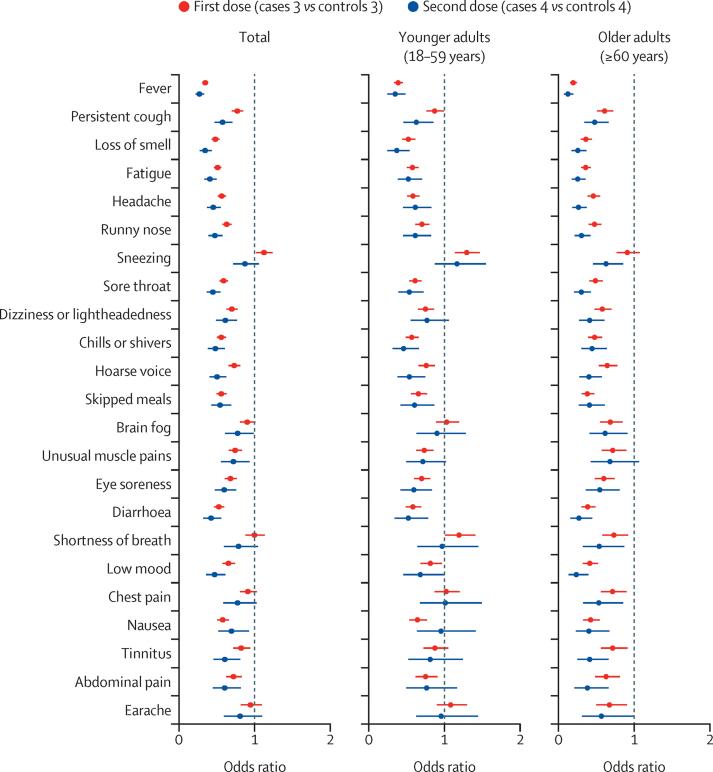
Between Dec 8, 2020, and July 4, 2021, 1 240 009 COVID Symptom Study app users reported a first vaccine dose, of whom 6030 (0·5%) subsequently tested positive for SARS-CoV-2 (cases 1), and 971 504 reported a second dose, of whom 2370 (0·2%) subsequently tested positive for SARS-CoV-2 (cases 2). In the risk factor analysis, frailty was associated with post-vaccination infection in older adults (≥60 years) after their first vaccine dose (odds ratio [OR] 1·93, 95% CI 1·50-2·48; p<0·0001), and individuals living in highly deprived areas had increased odds of post-vaccination infection following their first vaccine dose (OR 1·11, 95% CI 1·01-1·23; p=0·039). Individuals without obesity (BMI <30 kg/m) had lower odds of infection following their first vaccine dose (OR 0·84, 95% CI 0·75-0·94; p=0·0030). For the disease profile analysis, 3825 users from cases 1 were included in cases 3 and 906 users from cases 2 were included in cases 4. Vaccination (compared with no vaccination) was associated with reduced odds of hospitalisation or having more than five symptoms in the first week of illness following the first or second dose, and long-duration (≥28 days) symptoms following the second dose. Almost all symptoms were reported less frequently in infected vaccinated individuals than in infected unvaccinated individuals, and vaccinated participants were more likely to be completely asymptomatic, especially if they were 60 years or older.
INTERPRETATION
To minimise SARS-CoV-2 infection, at-risk populations must be targeted in efforts to boost vaccine effectiveness and infection control measures. Our findings might support caution around relaxing physical distancing and other personal protective measures in the post-vaccination era, particularly around frail older adults and individuals living in more deprived areas, even if these individuals are vaccinated, and might have implications for strategies such as booster vaccinations.
FUNDING
ZOE, the UK Government Department of Health and Social Care, the Wellcome Trust, the UK Engineering and Physical Sciences Research Council, UK Research and Innovation London Medical Imaging and Artificial Intelligence Centre for Value Based Healthcare, the UK National Institute for Health Research, the UK Medical Research Council, the British Heart Foundation, and the Alzheimer's Society.
背景
COVID-19 疫苗在临床试验中显示出优异的疗效,在真实世界数据中显示出有效性,但仍有一些人在接种疫苗后感染 SARS-CoV-2。本研究旨在确定接种疫苗后感染 SARS-CoV-2 的风险因素,并描述接种疫苗后疾病的特征。
方法
本前瞻性、基于社区的、嵌套、病例对照研究使用了来自英国 COVID-19 症状研究手机应用程序的成年(≥18 岁)用户的自我报告数据(例如人口统计学信息、地理位置、健康风险因素以及 COVID-19 检测结果、症状和疫苗接种情况)。对于风险因素分析,病例在 2020 年 12 月 8 日至 2021 年 7 月 4 日之间接种了第一剂或第二剂 COVID-19 疫苗;在第一剂疫苗接种后至少 14 天(但在第二剂之前)或第二剂疫苗接种后至少 7 天(病例 2)检测出 COVID-19 阳性,且在疫苗接种前没有阳性检测结果。选择了两个对照组(在疫苗接种前也未检测出 SARS-CoV-2 阳性):在第一剂疫苗接种后至少 14 天但在第二剂疫苗接种前报告阴性检测结果的用户(对照组 1)和在第二剂疫苗接种后至少 7 天报告阴性检测结果的用户(对照组 2)。对照组 1 和对照组 2 分别与病例 1 和病例 2 按接种后检测日期、医务人员身份和性别进行匹配(1:1)。在疾病特征分析中,我们从病例 1 和病例 2 中选择了至少连续 14 天检测出 SARS-CoV-2 阳性后使用该应用程序的参与者(病例 3 和病例 4)。对照组 3 和对照组 4 是未接种疫苗但至少连续 14 天报告 SARS-CoV-2 阳性检测结果的参与者,且与病例 3 和病例 4 分别按阳性检测日期、医务人员身份、性别、体重指数(BMI)和年龄进行匹配(1:1)。我们使用单变量逻辑回归模型(调整年龄、BMI 和性别)分析风险因素与接种后感染之间的关联,以及个体症状、整体疾病持续时间和疾病严重程度与接种状态之间的关联。
结果
2020 年 12 月 8 日至 2021 年 7 月 4 日期间,有 1240099 名 COVID-19 症状研究应用程序用户报告接种了第一剂疫苗,其中 6030 人(0.5%)随后检测出 SARS-CoV-2 阳性(病例 1),971504 人报告接种了第二剂疫苗,其中 2370 人(0.2%)随后检测出 SARS-CoV-2 阳性(病例 2)。在风险因素分析中,60 岁及以上老年人在接种第一剂疫苗后,体弱与接种后感染有关(比值比 [OR] 1.93,95%置信区间 [CI] 1.50-2.48;p<0.0001),居住在高度贫困地区的个体在接种第一剂疫苗后感染的几率增加(OR 1.11,95%CI 1.01-1.23;p=0.039)。无肥胖症(BMI<30 kg/m)的个体感染的几率较低(OR 0.84,95%CI 0.75-0.94;p=0.0030)。在疾病特征分析中,从病例 1 中纳入了 3825 名患者作为病例 3,从病例 2 中纳入了 906 名患者作为病例 4。与未接种疫苗相比,接种疫苗后第一或第二剂后第一周的住院或出现超过五种症状的几率降低,第二剂后出现持续时间较长(≥28 天)的症状的几率降低。与未接种疫苗的感染者相比,接种疫苗的感染者报告的几乎所有症状都较少,且接种疫苗的参与者更可能完全无症状,尤其是 60 岁及以上的人群。
结论
为了最大限度地减少 SARS-CoV-2 感染,必须针对高危人群,以提高疫苗的有效性并控制感染措施。我们的研究结果可能支持在接种疫苗后谨慎放松社交距离和其他个人防护措施,尤其是对于体弱的老年人和生活在更贫困地区的个体,即使这些个体已经接种了疫苗,这可能对加强针接种等策略产生影响。
资助
ZOE、英国卫生部和社会保健部、惠康信托基金会、英国工程和物理科学研究理事会、英国国家卫生研究院、英国医学研究理事会、英国心脏基金会和阿尔茨海默病协会。


 Zotero 插件