
接种 SARS-CoV-2 疫苗后的抗体水平:两项英国纵向研究中与接种后感染和危险因素的关系。
Antibody levels following vaccination against SARS-CoV-2: associations with post-vaccination infection and risk factors in two UK longitudinal studies.
机构信息
Department of Twin Research and Genetic Epidemiology, King's College London, London, United Kingdom.
Population Health Sciences, Bristol Medical School, University of Bristol, Bristol, United Kingdom.
出版信息
Elife. 2023 Jan 24;12:e80428. doi: 10.7554/eLife.80428.
BACKGROUND
Severe acute respiratory syndrome coronavirus 2 (SARS-CoV-2) antibody levels can be used to assess humoral immune responses following SARS-CoV-2 infection or vaccination, and may predict risk of future infection. Higher levels of SARS-CoV-2 anti-Spike antibodies are known to be associated with increased protection against future SARS-CoV-2 infection. However, variation in antibody levels and risk factors for lower antibody levels following each round of SARS-CoV-2 vaccination have not been explored across a wide range of socio-demographic, SARS-CoV-2 infection and vaccination, and health factors within population-based cohorts.
METHODS
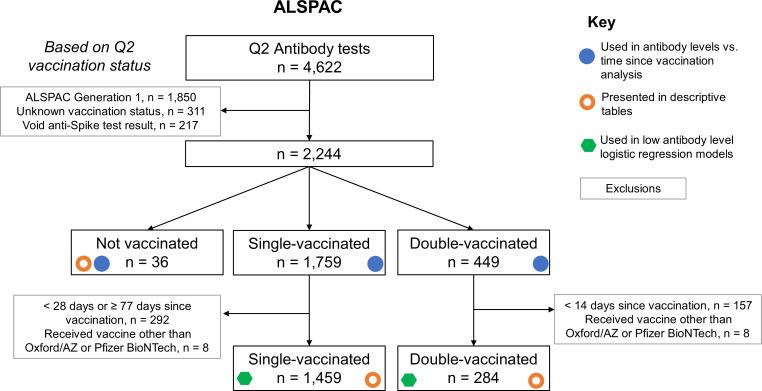
Samples were collected from 9361 individuals from TwinsUK and ALSPAC UK population-based longitudinal studies and tested for SARS-CoV-2 antibodies. Cross-sectional sampling was undertaken jointly in April-May 2021 (TwinsUK, N=4256; ALSPAC, N=4622), and in TwinsUK only in November 2021-January 2022 (N=3575). Variation in antibody levels after first, second, and third SARS-CoV-2 vaccination with health, socio-demographic, SARS-CoV-2 infection, and SARS-CoV-2 vaccination variables were analysed. Using multivariable logistic regression models, we tested associations between antibody levels following vaccination and: (1) SARS-CoV-2 infection following vaccination(s); (2) health, socio-demographic, SARS-CoV-2 infection, and SARS-CoV-2 vaccination variables.
RESULTS
Within TwinsUK, single-vaccinated individuals with the lowest 20% of anti-Spike antibody levels at initial testing had threefold greater odds of SARS-CoV-2 infection over the next 6-9 months (OR = 2.9, 95% CI: 1.4, 6.0), compared to the top 20%. In TwinsUK and ALSPAC, individuals identified as at increased risk of COVID-19 complication through the UK 'Shielded Patient List' had consistently greater odds (two- to fourfold) of having antibody levels in the lowest 10%. Third vaccination increased absolute antibody levels for almost all individuals, and reduced relative disparities compared with earlier vaccinations.
CONCLUSIONS
These findings quantify the association between antibody level and risk of subsequent infection, and support a policy of triple vaccination for the generation of protective antibodies.
FUNDING
Antibody testing was funded by UK Health Security Agency. The National Core Studies program is funded by COVID-19 Longitudinal Health and Wellbeing - National Core Study (LHW-NCS) HMT/UKRI/MRC ([MC_PC_20030] and [MC_PC_20059]). Related funding was also provided by the NIHR 606 (CONVALESCENCE grant [COV-LT-0009]). TwinsUK is funded by the Wellcome Trust, Medical Research Council, Versus Arthritis, European Union Horizon 2020, Chronic Disease Research Foundation (CDRF), Zoe Ltd and the National Institute for Health Research (NIHR) Clinical Research Network (CRN) and Biomedical Research Centre based at Guy's and St Thomas' NHS Foundation Trust in partnership with King's College London. The UK Medical Research Council and Wellcome (Grant ref: [217065/Z/19/Z]) and the University of Bristol provide core support for ALSPAC.
背景
严重急性呼吸系统综合征冠状病毒 2(SARS-CoV-2)抗体水平可用于评估 SARS-CoV-2 感染或接种疫苗后的体液免疫反应,并可能预测未来感染的风险。已知较高水平的 SARS-CoV-2 抗刺突抗体与对未来 SARS-CoV-2 感染的保护增加有关。然而,在基于人群的队列中,针对每一轮 SARS-CoV-2 接种疫苗后的抗体水平变化以及较低抗体水平的风险因素,尚未在广泛的社会人口统计学、SARS-CoV-2 感染和接种疫苗以及健康因素范围内进行研究。
方法
从英国双胞胎 UK 和 ALSPAC 基于人群的纵向研究中采集了 9361 名个体的样本,并对 SARS-CoV-2 抗体进行了检测。于 2021 年 4 月至 5 月(双胞胎 UK,N=4256;ALSPAC,N=4622)和仅在 2021 年 11 月至 2022 年 1 月(双胞胎 UK,N=3575)联合进行了横断面抽样。分析了首次、第二次和第三次 SARS-CoV-2 接种后与健康、社会人口统计学、SARS-CoV-2 感染和 SARS-CoV-2 接种变量相关的抗体水平变化。使用多变量逻辑回归模型,我们检验了以下因素与接种后抗体水平之间的关联:(1)接种疫苗后 SARS-CoV-2 感染;(2)健康、社会人口统计学、SARS-CoV-2 感染和 SARS-CoV-2 接种变量。
结果
在双胞胎 UK 中,在初次检测中抗刺突抗体水平最低的 20%的单接种个体在接下来的 6-9 个月内 SARS-CoV-2 感染的几率增加了三倍(OR=2.9,95%CI:1.4,6.0),与最高的 20%相比。在双胞胎 UK 和 ALSPAC 中,通过英国“受保护患者名单”确定为 COVID-19 并发症高风险的个体具有更高的几率(两倍至四倍)具有最低 10%的抗体水平。第三次接种几乎增加了所有个体的绝对抗体水平,并减少了与早期接种相比的相对差异。
结论
这些发现量化了抗体水平与随后感染风险之间的关联,并支持为产生保护性抗体而进行三次接种的政策。
资助
抗体检测由英国卫生安全局资助。国家核心研究计划由 COVID-19 纵向健康和幸福感-国家核心研究(LHW-NCS)HMT/UKRI/MRC([MC_PC_20030]和[MC_PC_20059])资助。相关资金还由英国国家健康研究所(NIHR)606(CONVALESCENCE 拨款[COV-LT-0009])提供。双胞胎 UK 由惠康信托基金会、医学研究委员会、对抗关节炎、欧盟地平线 2020、慢性疾病研究基金会(CDRF)、Zoe 有限公司和英国国家健康研究所(NIHR)临床研究网络(CRN)以及基于盖伊和圣托马斯 NHS 基金会信托基金的国王学院共同资助。英国医学研究理事会和惠康(资助编号:[217065/Z/19/Z])和布里斯托大学为 ALSPAC 提供核心支持。


 Zotero 插件