
自然感染和疫苗接种诱导暴露人群中的SARS-CoV-2抗体及中和动力学。
SARS-CoV-2 antibody and neutralization dynamics among persons with natural- and vaccine-induced exposures.
作者信息
Semancik Christopher S, Fantin Romain, Butt Julia, Abdelnour Arturo, Loria Viviana, Porras Carolina, Aparicio Amada, Jackson Sarah S, Wong-McClure Roy, Ocampo Rebeca, Morera Melvin, Zúñiga Michael, Calderón Alejandro, Cortés Bernal, Castro Roberto, Binder Marco, Waterboer Tim, Prevots D Rebecca, Herrero Rolando, Hildesheim Allan
机构信息
Epidemiology and Population Studies Section, National Institute of Allergy and Infectious Diseases, National Institutes of Health, Rockville, Maryland, United States of America.
Agencia Costarricense de Investigaciones Biomédicas-Fundación INCIENSA (ACIB-FUNIN), San José, Costa Rica.
出版信息
PLoS One. 2025 Sep 3;20(9):e0331212. doi: 10.1371/journal.pone.0331212. eCollection 2025.
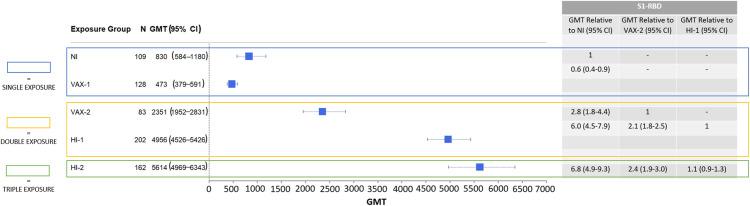
Previous SARS-CoV-2 research indicates that antibody levels and corresponding neutralization potential increase with additional exposures (comprising vaccination or infection), and that hybrid immunity resulting from combined vaccination and natural infection is more robust than either alone. However, it is unclear whether or how antibody levels increase or eventually plateau with repeated exposures and how SARS-CoV-2 exposure differs by sex or other demographic factors. Research regarding the association of antibody production with neutralization potential is also limited. We conducted this analysis within the RESPIRA population-based cohort in Costa Rica to investigate relationships between antibody levels and neutralization potential at increasing exposure levels. We examined immunological profiles from systematically defined single-exposure groups (one vaccine dose or one natural infection), double-exposure groups (two vaccine doses or one vaccine dose following a natural infection), and a triple-exposure group (two vaccine doses following a natural infection). We used a S1-RBD-based serological assay for antibody level detection and a pseudovirion assay for neutralization potential quantification. Using linear regression, we compared antibody levels and pseudoneutralization geometric mean titers between exposure groups. For single exposure groups, one vaccine dose was inferior to natural infection, but a second vaccine dose was superior to natural infection. For double exposure groups, those who were vaccinated once after infection developed higher levels of antibodies and higher neutralization potential compared with those who had only two vaccine doses. We note that peak antibody levels following an exposure may plateau after two exposures while neutralization potential continues to increase with a third exposure dose. Response patterns were comparable in males and females and in sensitivity analyses stratified by age, vaccine type, and pandemic wave. These results provide evidence that SARS-CoV-2 vaccination after COVID infection provides immunological benefit and suggest neutralization potential continues to increase after a second vaccine dose despite plateauing of antibody levels.
此前针对严重急性呼吸综合征冠状病毒2(SARS-CoV-2)的研究表明,抗体水平及相应的中和潜力会随着额外的接触(包括接种疫苗或感染)而增加,并且由接种疫苗和自然感染共同产生的混合免疫比单独的任何一种都更强。然而,尚不清楚抗体水平是否会随着反复接触而增加或最终趋于平稳,以及这种增加的方式如何,同时也不清楚SARS-CoV-2接触在性别或其他人口统计学因素方面存在何种差异。关于抗体产生与中和潜力之间关联的研究也很有限。我们在哥斯达黎加基于人群的RESPIRA队列中进行了这项分析,以研究在接触水平不断增加的情况下抗体水平与中和潜力之间的关系。我们检查了系统定义的单次接触组(一剂疫苗或一次自然感染)、两次接触组(两剂疫苗或自然感染后一剂疫苗)以及三次接触组(自然感染后两剂疫苗)的免疫特征。我们使用基于刺突蛋白受体结合域(S1-RBD)的血清学检测方法来检测抗体水平,并使用假病毒检测方法来定量中和潜力。通过线性回归,我们比较了各接触组之间的抗体水平和假中和几何平均滴度。对于单次接触组,一剂疫苗的效果不如自然感染,但第二剂疫苗优于自然感染。对于两次接触组,感染后接种一次疫苗的人比仅接种两剂疫苗的人产生了更高水平的抗体和更高的中和潜力。我们注意到,一次接触后的抗体水平峰值可能在两次接触后趋于平稳,而中和潜力在第三次接触剂量时仍会继续增加。在男性和女性中以及在按年龄、疫苗类型和疫情波次分层的敏感性分析中,反应模式具有可比性。这些结果提供了证据,表明新冠病毒感染后接种SARS-CoV-2疫苗具有免疫学益处,并表明尽管抗体水平趋于平稳,但第二剂疫苗接种后中和潜力仍会继续增加。



 Zotero 插件