
细胞机械记忆:基于间充质干细胞治疗的潜在工具。
Cellular mechanical memory: a potential tool for mesenchymal stem cell-based therapy.
作者信息
Kureel Sanjay Kumar, Maroto Rosario, Davis Kristen, Sheetz Michael
机构信息
Department of Biochemistry and Molecular Biology, University of Texas Medical Branch, Galveston, TX, 77555, USA.
出版信息
Stem Cell Res Ther. 2025 Mar 31;16(1):159. doi: 10.1186/s13287-025-04249-x.
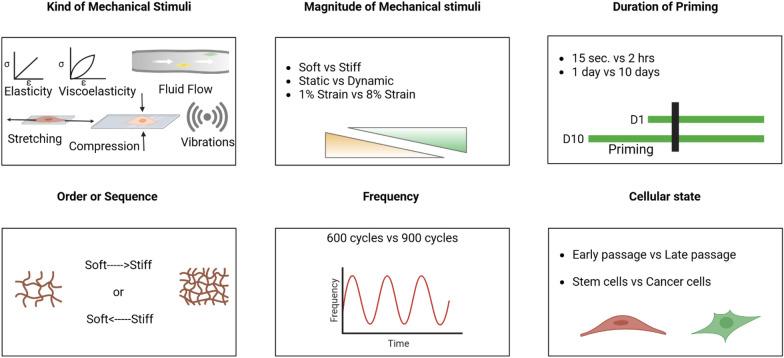
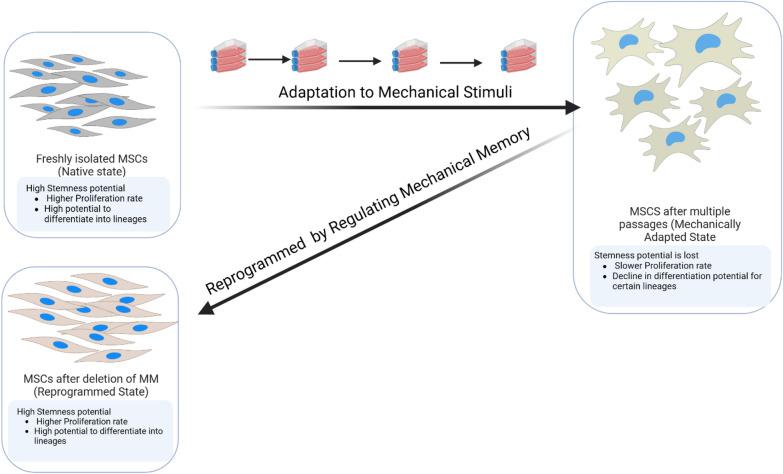
Recent studies have shown that mechanical properties such as extracellular matrix stiffness, fluid flow, weight loading, compression, and stretching can affect cellular functions. Some examples of cell responses to mechanical properties could be the migration of cancer cells from rigid to soft surfaces or the differentiation of fibroblasts into myofibroblasts. Cellular responses to mechanical changes can modify the insertion of proteins in the extracellular matrix (ECM), causing an increase in tissue stiffness with functional consequences. In general, mechanical and physical factors can affect any kind of cell phenotype in culture conditions and in vivo tissues. Cells sense mechanical stimuli by applying force and restructuring their shape and functions in response to the resistance of the stimuli. Furthermore, mechanical triggers can develop a "memory" for altering cellular plasticity and adaptation. This phenomenon is called cellular mechanical memory (CMM), a singular feature of mesenchymal stem cells (MSCs). Controlled targeting of CMM may resolve the scarcity of viable cells needed for cell based therapy (CBT) and implement studies concerning cancer research, fibrosis, and senescence. This review focusses on cells from the mesodermal lineage, such as MSCs, fibroblasts and chondrocytes, and the role of CMM as a potential target for CBT.
最近的研究表明,细胞外基质硬度、流体流动、重量负荷、压缩和拉伸等力学性质会影响细胞功能。细胞对力学性质作出反应的一些例子包括癌细胞从刚性表面向柔软表面的迁移,或成纤维细胞向肌成纤维细胞的分化。细胞对力学变化的反应可改变细胞外基质(ECM)中蛋白质的插入,导致组织硬度增加并产生功能后果。一般来说,力学和物理因素可在培养条件和体内组织中影响任何类型的细胞表型。细胞通过施加力并根据刺激的阻力重塑其形状和功能来感知力学刺激。此外,力学触发因素可形成一种用于改变细胞可塑性和适应性的“记忆”。这种现象称为细胞力学记忆(CMM),是间充质干细胞(MSC)的一个独特特征。对CMM进行可控靶向可能解决基于细胞的治疗(CBT)所需的活细胞稀缺问题,并开展有关癌症研究、纤维化和衰老的研究。本综述重点关注中胚层谱系的细胞,如MSC、成纤维细胞和软骨细胞,以及CMM作为CBT潜在靶点的作用。



 Zotero 插件