
美国人群中泛免疫炎症值与血脂异常之间的关联。
Association between pan-immune-inflammation value and dyslipidemia in the United States population.
作者信息
Yan Yu, Jia Shanshan, Huo Xingwei, Liu Lu, Sun Lirong, Ma Shuangliang, Chen Xiaoping
机构信息
Department of Cardiology, West China Hospital, Sichuan University, Chengdu, Sichuan, China.
Department of Cardiology, Peking University First Hospital, Beijing, China.
出版信息
Front Endocrinol (Lausanne). 2025 Mar 17;16:1518304. doi: 10.3389/fendo.2025.1518304. eCollection 2025.
OBJECT
To investigate the possible association between pan-immune-inflammation value (PIV) and dyslipidemia.
METHODS
This cross-sectional study used the data obtained from National Health and Nutrition Examination Survey (NHANES). The independent variable used the logarithmic form of PIV-log2 (PIV). The definition of dyslipidemia was based on the National Cholesterol Education Program standards. Weighted multivariate logistic regression analyses, the restricted cubic spline (RCS) and threshold effect analysis were explore the association between PIV and dyslipidemia. Stratified analyses were used to identify potential associations with other covariates. The receiver operating characteristic (ROC) curve was constructed compared to systemic immune-inflammation index (SII).
RESULTS
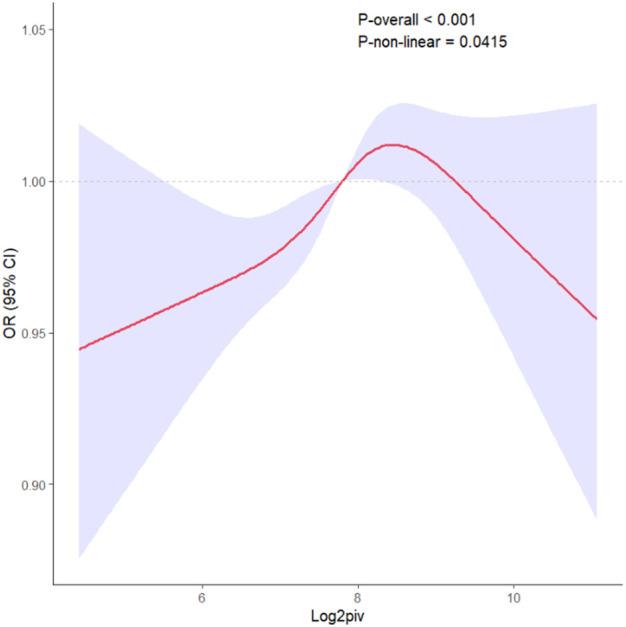
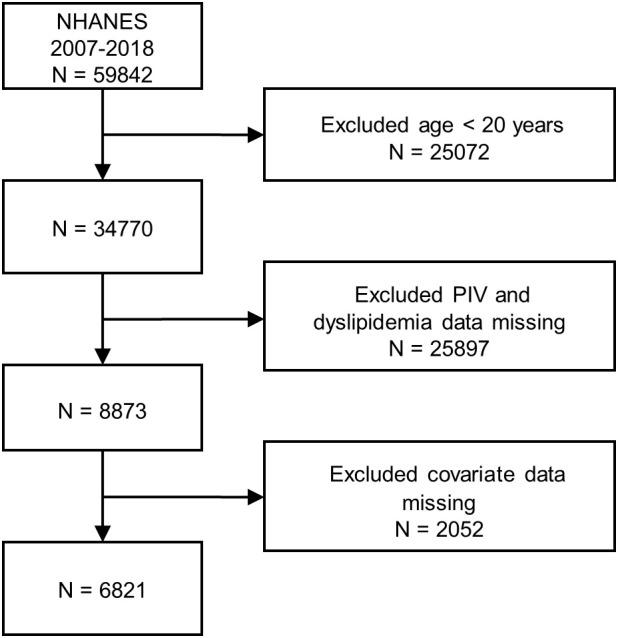
6,821 participants were included, of whom 47% were male and 77% had dyslipidemia. After adjusting for all confounders, PIV and dyslipidemia had an significantly positive association (OR (95%CI): 1.13 (1.01-1.25); 0.03). Compared to participants with lowest quartile (Q1) of PIV, participants with the highest quartile (Q4) had a significantly higher risk of dyslipidemia (OR (95%CI): 1.37 (1.05-1.80); 0.022). The RCS curve showed an inverted J-shaped relationship between PIV and dyslipidemia (-nonlinear = 0.0415, -overall < 0.001). The threshold effect analysis revealed that the inflection point was 9.192. Stratified analyses showed that age and BMI modified the PIV-dyslipidemia relationship ( for interaction < 0.05). The ROC curve found that compared with SII, PIV had a similar predictive value (area under curve (AUC): 0.566 vs 0.558; = 0.073).
CONCLUSION
This study discovered that PIV had a significantly positive relationship with dyslipidemia, especially in young and overweight individuals.
目的
探讨全免疫炎症值(PIV)与血脂异常之间可能存在的关联。
方法
这项横断面研究使用了从美国国家健康与营养检查调查(NHANES)获得的数据。自变量采用PIV的对数形式——log2(PIV)。血脂异常的定义基于美国国家胆固醇教育计划标准。采用加权多因素逻辑回归分析、受限立方样条(RCS)分析和阈值效应分析来探究PIV与血脂异常之间的关联。分层分析用于确定与其他协变量的潜在关联。构建受试者工作特征(ROC)曲线,并与全身免疫炎症指数(SII)进行比较。
结果
纳入6821名参与者,其中47%为男性,77%患有血脂异常。在对所有混杂因素进行校正后,PIV与血脂异常呈显著正相关(比值比(95%置信区间):1.13(1.01 - 1.25);P = 0.03)。与PIV处于最低四分位数(Q1)的参与者相比,处于最高四分位数(Q4)的参与者患血脂异常的风险显著更高(比值比(95%置信区间):1.37(1.05 - 1.80);P = 0.022)。RCS曲线显示PIV与血脂异常之间呈倒J形关系(非线性P = 0.0415,总体P < 0.001)。阈值效应分析显示拐点为9.192。分层分析表明年龄和体重指数改变了PIV与血脂异常之间的关系(交互作用P < 0.05)。ROC曲线发现,与SII相比,PIV具有相似的预测价值(曲线下面积(AUC):0.566对0.558;P = 0.073)。
结论
本研究发现PIV与血脂异常呈显著正相关关系,尤其是在年轻和超重个体中。
 Zotero 插件