
胃肠道外间质瘤预后列线图的建立与验证
Establishment and validation of a prognostic nomogram for extra-gastrointestinal stromal tumors.
作者信息
Jia Guohua, Li Xiangpan
机构信息
Department of Head and Neck Oncology (including Lymphoma and Pediatric Oncology), Renmin Hospital of Wuhan University, Wuhan, China.
出版信息
Front Oncol. 2025 Mar 20;15:1527237. doi: 10.3389/fonc.2025.1527237. eCollection 2025.
BACKGROUND
Extra-gastrointestinal stromal tumor (EGIST) is a rare subtype of gastrointestinal stromal tumor, with limited information on its clinical characteristics and prognostic factors. This study aims to identify the risk factors affecting survival in EGIST patients and to develop a prognostic nomogram for predicting EGIST-specific survival (TSS).
METHODS
Patients diagnosed with EGIST, aged 18 to 80, were enrolled from the Surveillance, Epidemiology, and End Results (SEER) Research Plus database, covering the years 2000 to 2019. Univariate and multivariate analyses were conducted to identify risk factors for developing a nomogram. The predictive accuracy of the nomogram was evaluated using time-dependent receiver operating characteristic curves, calibration plots, and the concordance index. Decision curve analysis (DCA) was performed to assess the nomogram's clinical utility and net benefit for application in clinical practice. Additionally, the nomogram's performance was compared with the tumor SEER stage.
RESULTS
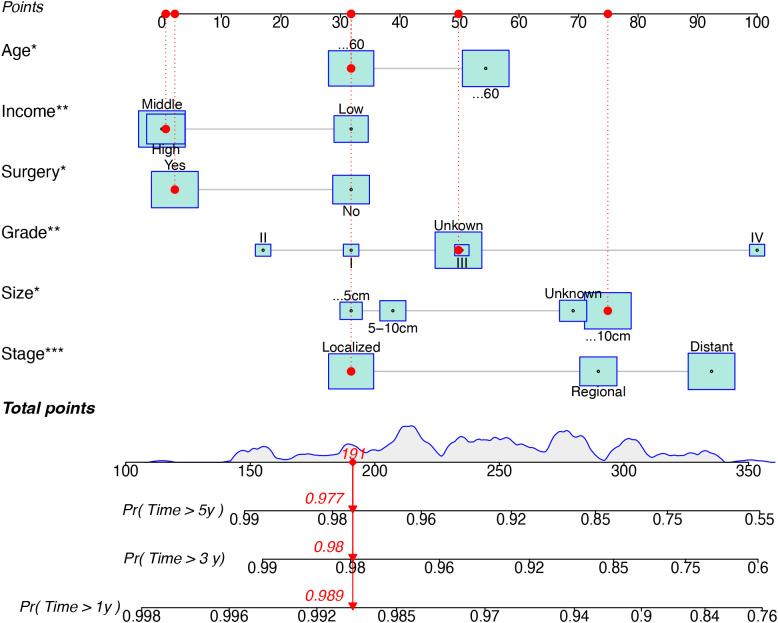
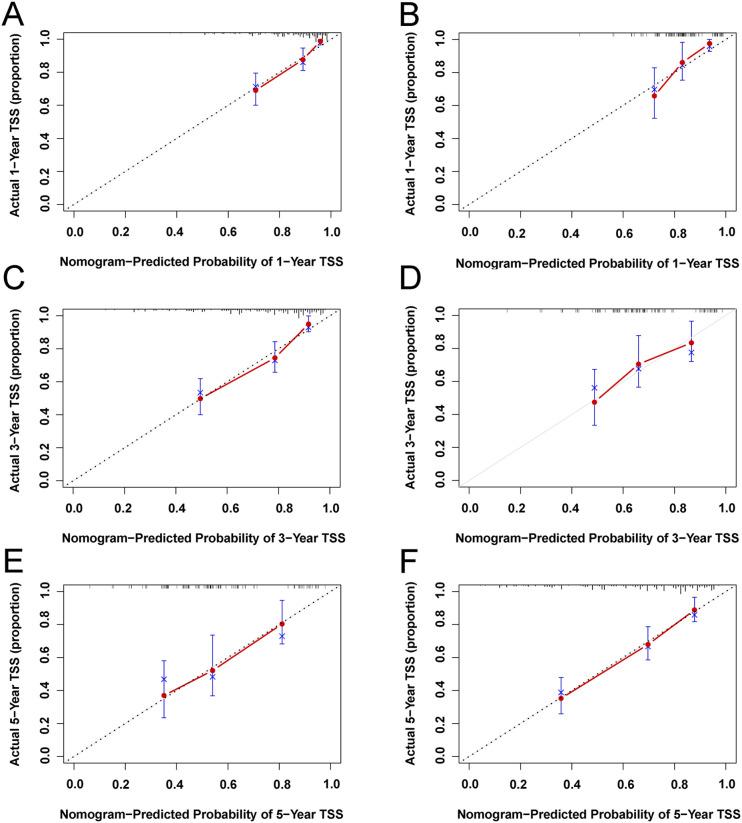
A total of 389 patients were included in this study. Univariate and multivariate analyses identified age, household income, surgery, tumor grade, tumor size, and tumor SEER stage as significant predictors of TSS (all P<0.05). These factors were incorporated into the prognostic nomogram. The nomogram demonstrated superior prognostic value compared to the tumor SEER stage alone, as evidenced by the area under the curve and concordance index. The calibration plot indicated a high level of accuracy in forecasting survival probabilities. Furthermore, DCA highlighted the nomogram's clinical applicability and positive net benefit. The nomogram also proved more effective than the tumor SEER stage alone in identifying patients with poorer prognoses.
CONCLUSIONS
Age, household income, surgery, tumor grade, tumor size, and tumor SEER stage were identified as risk factors for TSS in patients with EGIST. We have developed and validated a prognostic nomogram to predict TSS in EGIST patients, which may improve patient management and guide personalized medical treatment for EGIST.
背景
胃肠道外间质瘤(EGIST)是胃肠道间质瘤的一种罕见亚型,关于其临床特征和预后因素的信息有限。本研究旨在确定影响EGIST患者生存的危险因素,并开发一种预测EGIST特异性生存(TSS)的预后列线图。
方法
从监测、流行病学和最终结果(SEER)研究增强数据库中纳入2000年至2019年期间诊断为EGIST、年龄在18至80岁之间的患者。进行单因素和多因素分析以确定列线图的危险因素。使用时间依赖的受试者工作特征曲线、校准图和一致性指数评估列线图的预测准确性。进行决策曲线分析(DCA)以评估列线图在临床实践中的临床实用性和净效益。此外,将列线图的性能与肿瘤SEER分期进行比较。
结果
本研究共纳入389例患者。单因素和多因素分析确定年龄、家庭收入、手术、肿瘤分级、肿瘤大小和肿瘤SEER分期是TSS的重要预测因素(所有P<0.05)。这些因素被纳入预后列线图。列线图显示出比单独的肿瘤SEER分期更高的预后价值,曲线下面积和一致性指数证明了这一点。校准图表明在预测生存概率方面具有较高的准确性。此外,DCA突出了列线图的临床适用性和正净效益。列线图在识别预后较差的患者方面也比单独的肿瘤SEER分期更有效。
结论
年龄、家庭收入、手术、肿瘤分级、肿瘤大小和肿瘤SEER分期被确定为EGIST患者TSS的危险因素。我们已经开发并验证了一种预测EGIST患者TSS的预后列线图,这可能会改善患者管理并指导EGIST的个性化医疗。




 Zotero 插件