
时间焦点、双系统自我控制与大学生短视频成瘾:一种以变量为中心和以人为中心的方法。
Temporal focus, dual-system self-control, and college students' short-video addiction: a variable-centered and person-centered approach.
作者信息
Liu Yang, Huang Yaqing, Wen Lan, Chen Peng, Zhang Shuyue
机构信息
Faculty of Education, Guangxi Normal University, Guilin, China.
Beibu Gulf University, Qinzhou, China.
出版信息
Front Psychol. 2025 Mar 24;16:1538948. doi: 10.3389/fpsyg.2025.1538948. eCollection 2025.
BACKGROUND
Short video addiction has become increasingly prevalent among college students. It can negatively impact their physical and mental health, yet its influencing factors and underlying mechanisms require further exploration. Time focus and self-control are recognized as critical determinants in shaping addictive behaviors.
OBJECTIVE
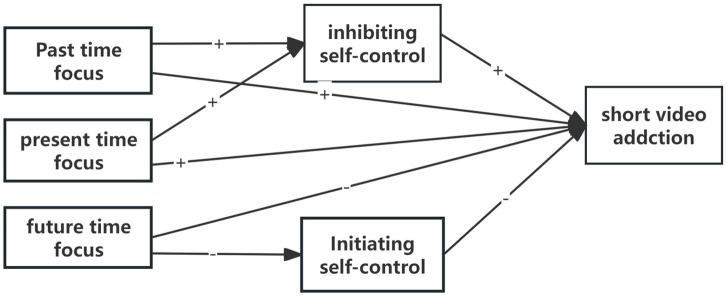
Grounded in the I-PACE theory, this study examines the relationship between emotional and cognitive responses (various temporal focuses and dual systems of self-control) and short video addiction, while also investigating the mediating roles of inhibitory and initiation control.
METHODS
Methodologically, it integrates both variable-centered and person-centered approaches, utilizing the Time Focus Scale, Multidimensional Self-Control Scale, and Short Video Addiction Scale. A total of 2,239 university students participated in the survey.
RESULTS
The results revealed the following: (1) Past and present time focus were positively correlated with short video addiction, while future time focus showed a negative correlation. Inhibitory self-control was positively associated with short video addiction, whereas initiatory self-control was negatively correlated. Variable-centered analysis demonstrated that past and present time focus positively predicted short video addiction, with inhibitory self-control mediating the relationship between these time orientations and addiction. Conversely, initiatory self-control played a mediating role between future time focus and addiction risk, with a negative predictive effect on the likelihood of short video addiction. (2) Person-centered analysis identified four categories of short video addiction: non-addicted (12.68%), low-risk addiction (34.21%), moderate-risk addiction (42.20%), and high-risk addiction (10.89%). (3) Logistic regression analysis indicated that students with excessive past and present time focus were more likely to fall into the high-risk addiction category, while those employing inhibitory self-control strategies were more likely to be categorized into low, moderate, or high-risk addiction groups. Students utilizing initiatory self-control were less likely to develop high-risk addiction. Female students were more likely than male students to fall into the low, moderate, or high addiction categories, and only children were more likely to belong to the moderate or high-risk addiction categories than non-only children.
CONCLUSION
This study emphasizes the pivotal role of time focus and dual-system self-control in the intervention and prevention of short video addiction,further highlighting the role of emotional and cognitive responses in the development of short-video addiction. The implications of the findings, as well as the limitations of the study, are also discussed.
背景
短视频成瘾在大学生中日益普遍。它会对他们的身心健康产生负面影响,但其影响因素和潜在机制仍需进一步探索。时间焦点和自我控制被认为是形成成瘾行为的关键决定因素。
目的
本研究以I-PACE理论为基础,探讨情绪和认知反应(各种时间焦点和自我控制的双重系统)与短视频成瘾之间的关系,同时研究抑制控制和发起控制的中介作用。
方法
在方法上,它整合了以变量为中心和以人为中心的方法,使用时间焦点量表、多维自我控制量表和短视频成瘾量表。共有2239名大学生参与了调查。
结果
结果显示如下:(1)过去和现在的时间焦点与短视频成瘾呈正相关,而未来时间焦点呈负相关。抑制性自我控制与短视频成瘾呈正相关,而发起性自我控制呈负相关。以变量为中心的分析表明,过去和现在的时间焦点正向预测短视频成瘾,抑制性自我控制在这些时间取向与成瘾之间起中介作用。相反,发起性自我控制在未来时间焦点与成瘾风险之间起中介作用,对短视频成瘾的可能性有负向预测作用。(2)以人为中心的分析确定了四类短视频成瘾:非成瘾(12.68%)、低风险成瘾(34.21%)、中度风险成瘾(42.20%)和高风险成瘾(10.89%)。(3)逻辑回归分析表明,过去和现在时间焦点过多的学生更有可能属于高风险成瘾类别,而采用抑制性自我控制策略的学生更有可能被归类为低、中或高风险成瘾组。采用发起性自我控制的学生发展为高风险成瘾的可能性较小。女生比男生更有可能属于低、中或高成瘾类别,独生子女比非独生子女更有可能属于中度或高风险成瘾类别。
结论
本研究强调了时间焦点和双系统自我控制在短视频成瘾干预和预防中的关键作用,进一步突出了情绪和认知反应在短视频成瘾发展中的作用。还讨论了研究结果的意义以及研究的局限性。


 Zotero 插件