
自噬:缺血再灌注损伤中的双刃剑
Autophagy: a double-edged sword in ischemia-reperfusion injury.
作者信息
Tang Lingxuan, Zhang Wangzheqi, Liao Yan, Wang Weijie, Deng Xiaoming, Wang Changli, Shi Wenwen
机构信息
Basic Medical University, Naval Medical University, Shanghai, 200433, China.
School of Anesthesiology, Naval Medical University, 168 Changhai Road, Shanghai, 200433, China.
出版信息
Cell Mol Biol Lett. 2025 Apr 7;30(1):42. doi: 10.1186/s11658-025-00713-x.
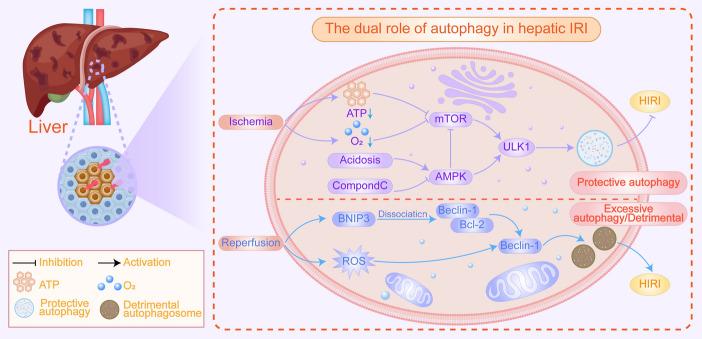
Ischemia-reperfusion (I/R) injury describes the pathological process wherein tissue damage, initially caused by insufficient blood supply (ischemia), is exacerbated upon the restoration of blood flow (reperfusion). This phenomenon can lead to irreversible tissue damage and is commonly observed in contexts such as cardiac surgery and stroke, where blood supply is temporarily obstructed. During ischemic conditions, the anaerobic metabolism of tissues and organs results in compromised enzyme activity. Subsequent reperfusion exacerbates mitochondrial dysfunction, leading to increased oxidative stress and the accumulation of reactive oxygen species (ROS). This cascade ultimately triggers cell death through mechanisms such as autophagy and mitophagy. Autophagy constitutes a crucial catabolic mechanism within eukaryotic cells, facilitating the degradation and recycling of damaged, aged, or superfluous organelles and proteins via the lysosomal pathway. This process is essential for maintaining cellular homeostasis and adapting to diverse stress conditions. As a cellular self-degradation and clearance mechanism, autophagy exhibits a dualistic function: it can confer protection during the initial phases of cellular injury, yet potentially exacerbate damage in the later stages. This paper aims to elucidate the fundamental mechanisms of autophagy in I/R injury, highlighting its dual role in regulation and its effects on both organ-specific and systemic responses. By comprehending the dual mechanisms of autophagy and their implications for organ function, this study seeks to explore the potential for therapeutic interventions through the modulation of autophagy within clinical settings.
缺血再灌注(I/R)损伤描述的是一种病理过程,即最初由血液供应不足(缺血)引起的组织损伤,在血流恢复(再灌注)时会加剧。这种现象会导致不可逆的组织损伤,常见于心脏手术和中风等情况,其中血液供应会暂时受阻。在缺血状态下,组织和器官的无氧代谢会导致酶活性受损。随后的再灌注会加剧线粒体功能障碍,导致氧化应激增加和活性氧(ROS)积累。这一连串反应最终通过自噬和线粒体自噬等机制触发细胞死亡。自噬是真核细胞内一种关键的分解代谢机制,通过溶酶体途径促进受损、老化或多余的细胞器和蛋白质的降解与循环利用。这个过程对于维持细胞内稳态和适应各种应激条件至关重要。作为一种细胞自我降解和清除机制,自噬具有双重功能:它在细胞损伤的初始阶段可以提供保护,但在后期可能会加剧损伤。本文旨在阐明自噬在缺血再灌注损伤中的基本机制,突出其在调节中的双重作用以及对器官特异性和全身反应的影响。通过理解自噬的双重机制及其对器官功能的影响,本研究旨在探索在临床环境中通过调节自噬进行治疗干预的潜力。


 Zotero 插件