
韩国高血压风险人群的饮食调节:一项横断面研究。
Dietary modulation for the hypertension risk group in Koreans: a cross-sectional study.
作者信息
Han Youngmin, Huh Ryun, Jung Keum Ji, Kimm Heejin, Jee Sun Ha
机构信息
Institute for Health Promotion, Graduate School of Public Health, Yonsei University, Seoul, Republic of Korea.
Department of Epidemiology and Health Promotion, Graduate School of Public Health, Yonsei University, Seoul, Republic of Korea.
出版信息
Nutr Metab (Lond). 2025 Apr 10;22(1):30. doi: 10.1186/s12986-025-00921-4.
BACKGROUND
Hypertension (HTN) is a critical global health issue, contributing to high morbidity and mortality rates. Representative risk factors for HTN include aging, genetics, obesity, alcohol drinking, smoking, and diet. Dietary interventions like the Dietary Approaches to Stop HTN (DASH) diet plan effectively prevent and manage HTN. We intend to evaluate the influence of eating patterns on HTN, applying multiple risk factors.
METHODS
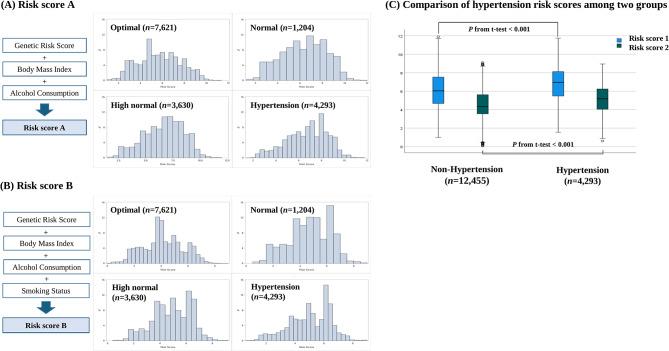
For cross-sectional design, study subjects were grouped into four groups: optimal (n = 7,712), normal (n = 1,220), high normal (n = 3,655), and HTN (n = 4,355) according to the 2022 HTN treatment guidelines of Korea. Factor analysis was performed to identify major dietary patterns based on nutritional data obtained from a brief dietary questionnaire, including 17 food items. Finally, we conducted a moderation analysis to evaluate the impact of dietary patterns on the HTN risk score, which is determined by genetic variables, body mass index, alcohol consumption, and smoking status.
RESULTS
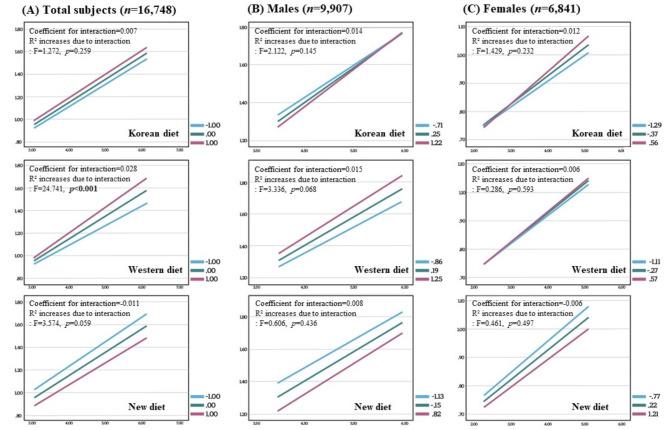
We identified three principal dietary patterns (Korean, Western, and New diet) in the study population. Adherence to the New diet was linked to lower HTN risk in all models (p < 0.001), while the Western and Korean diets were associated with a higher risk of HTN in some models. In high HTN-risk individuals, adherence to the Western diet increased the HTN risk trend (p < 0.001), whereas the New diet showed a potential protective trend (p = 0.059).
CONCLUSIONS
The nutritional moderation effect was evident in the HTN high-risk group, where the Western diet increased risk, while the New diet showed a borderline protective effect. If the findings are validated by longitudinal investigation, our findings could serve as the basis for developing dietary guidelines for HTN.
背景
高血压是一个关键的全球健康问题,导致高发病率和死亡率。高血压的代表性风险因素包括衰老、遗传、肥胖、饮酒、吸烟和饮食。像终止高血压膳食疗法(DASH)饮食计划这样的饮食干预措施能有效预防和管理高血压。我们打算应用多种风险因素来评估饮食模式对高血压的影响。
方法
对于横断面设计,根据韩国2022年高血压治疗指南,研究对象被分为四组:理想血压组(n = 7712)、正常血压组(n = 1220)、正常高值血压组(n = 3655)和高血压组(n = 4355)。基于从一份简短饮食问卷中获得的营养数据(包括17种食物)进行因子分析,以确定主要饮食模式。最后,我们进行了调节分析,以评估饮食模式对高血压风险评分的影响,该评分由基因变量、体重指数、饮酒量和吸烟状况决定。
结果
我们在研究人群中确定了三种主要饮食模式(韩国饮食模式、西方饮食模式和新饮食模式)。在所有模型中,坚持新饮食模式与较低的高血压风险相关(p < 0.001),而西方饮食模式和韩国饮食模式在某些模型中与较高的高血压风险相关。在高血压高风险个体中,坚持西方饮食模式增加了高血压风险趋势(p < 0.001),而新饮食模式显示出潜在的保护趋势(p = 0.059)。
结论
在高血压高风险组中营养调节作用明显,其中西方饮食模式增加风险,而新饮食模式显示出临界保护作用。如果这些发现通过纵向调查得到验证,我们的发现可为制定高血压饮食指南提供依据。
 Zotero 插件