
介孔二氧化硅纳米颗粒的表面修饰作为在三维肿瘤微环境中引入固有癌症靶向能力的一种手段。
Surface Modification of Mesoporous Silica Nanoparticles as a Means to Introduce Inherent Cancer-Targeting Ability in a 3D Tumor Microenvironment.
作者信息
Prabhakar Neeraj, Långbacka Erica, Özliseli Ezgi, Mattsson Jesse, Mahran Alaa, Suleymanova Ilida, Sahlgren Cecilia, Rosenholm Jessica M, Åkerfelt Malin, Nees Matthias
机构信息
Pharmaceutical Sciences Laboratory, Faculty of Science and Engineering Åbo Akademi University Turku 20520 Finland.
Centre for Structural Systems Biology (CSSB) c/o DESY Notkestrasse 85 22607 Hamburg Germany.
出版信息
Small Sci. 2024 Jul 8;4(9):2400084. doi: 10.1002/smsc.202400084. eCollection 2024 Sep.
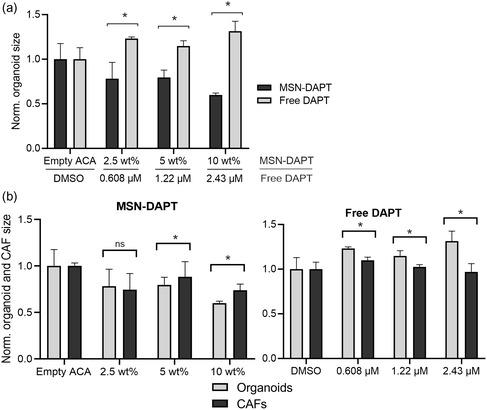
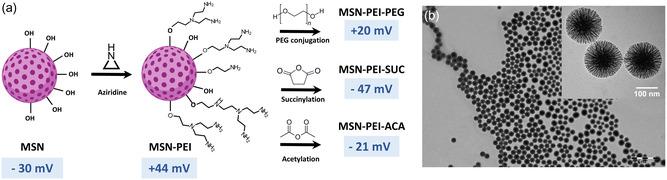
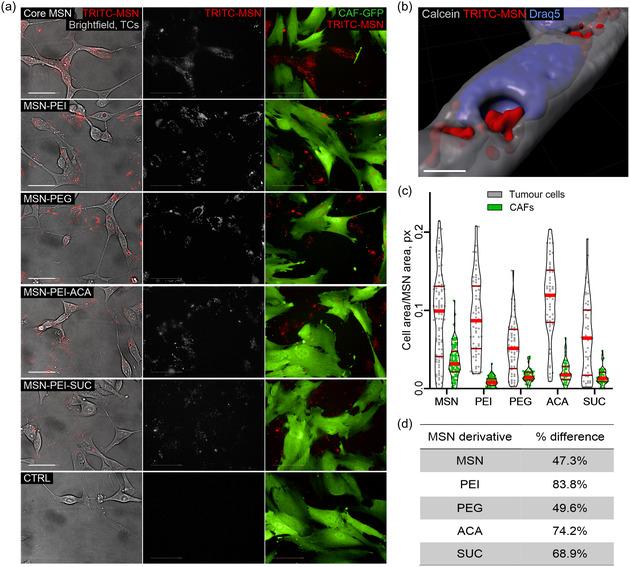
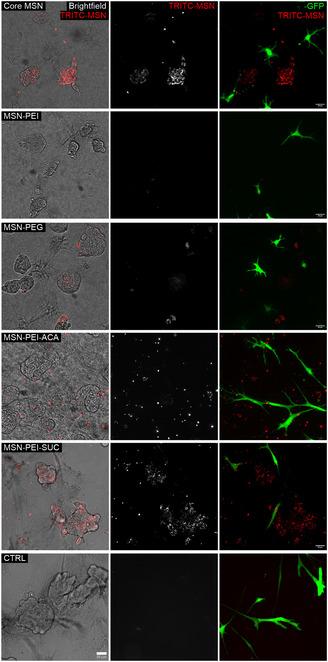
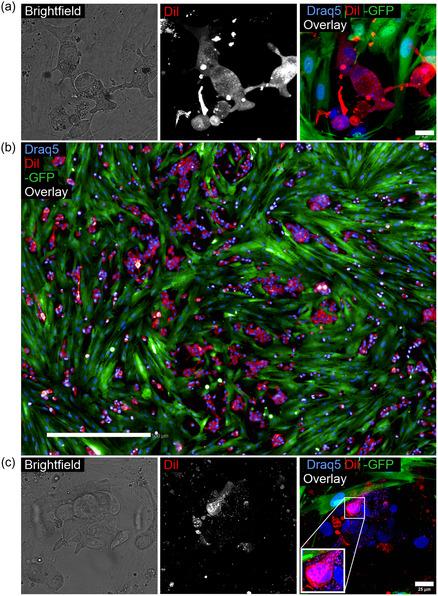
Mesoporous silica nanoparticles (MSNs) have emerged as promising drug carriers that can facilitate targeted anticancer drug delivery, but efficiency studies relying on active targeting mechanisms remain elusive. This study implements in vitro 3D cocultures, so-called microtissues, to model a physiologically relevant tumor microenvironment (TME) to examine the impact of surface-modified MSNs without targeting ligands on the internalization, cargo delivery, and cargo release in tumor cells and cancer-associated fibroblasts. Among these, acetylated MSNs most effectively localized in tumor cells in a 3D setting containing collagen, while other MSNs did so to a lesser degree, most likely due to remaining trapped in the extracellular matrix of the TME. Confocal imaging of hydrophobic model drug-loaded MSNs demonstrated effective cargo release predominantly in tumor cells, both in 2D and 3D cocultures. MSN-mediated delivery of an anticancer drug in the microtissues exhibited a significant reduction in tumor organoid size and enhanced the tumor-specific cytotoxic effects of a γ-secretase inhibitor, compared to the highly hydrophobic drug in free form. This inherent targeting potential suggests reduced off-target effects and increased drug efficacy, showcasing the promise of surface modification of MSNs as a means of direct cell-specific targeting and delivery for precise and successful targeted drug delivery.
介孔二氧化硅纳米颗粒(MSNs)已成为有前景的药物载体,可促进靶向抗癌药物递送,但依赖主动靶向机制的效率研究仍不明确。本研究采用体外三维共培养,即所谓的微组织,来模拟生理相关的肿瘤微环境(TME),以研究无靶向配体的表面修饰MSNs对肿瘤细胞和癌症相关成纤维细胞内化、货物递送和货物释放的影响。其中,乙酰化MSNs在含有胶原蛋白的三维环境中最有效地定位于肿瘤细胞,而其他MSNs的定位程度较低,最可能的原因是被困在TME的细胞外基质中。对负载疏水模型药物的MSNs进行共聚焦成像显示,在二维和三维共培养中,货物主要在肿瘤细胞中有效释放。与游离形式的高疏水性药物相比,MSN介导的抗癌药物在微组织中的递送显著减小了肿瘤类器官的大小,并增强了γ-分泌酶抑制剂的肿瘤特异性细胞毒性作用。这种内在的靶向潜力表明脱靶效应降低,药物疗效提高,展示了MSNs表面修饰作为一种直接细胞特异性靶向和递送手段以实现精确和成功靶向药物递送的前景。
 Zotero 插件