
纳米工程形状记忆止血剂
Nanoengineered Shape-Memory Hemostat.
作者信息
Hargett Sarah E, Lokhande Giriraj K, Duran Joseph, Hirani Zanir, Jang Lindy K, Foster Samantha, Deo Kaivalya A, George Sasha, Javed Mahjabeen, Ware Taylor H, Maitland Duncan J, Gaharwar Akhilesh K
机构信息
Department of Biomedical Engineering College of Engineering Texas A&M University College Station TX 77843 USA.
Materials Engineering Division Lawrence Livermore National Laboratory Livermore CA 94550 USA.
出版信息
Small Sci. 2024 Dec 11;5(2):2400321. doi: 10.1002/smsc.202400321. eCollection 2025 Feb.
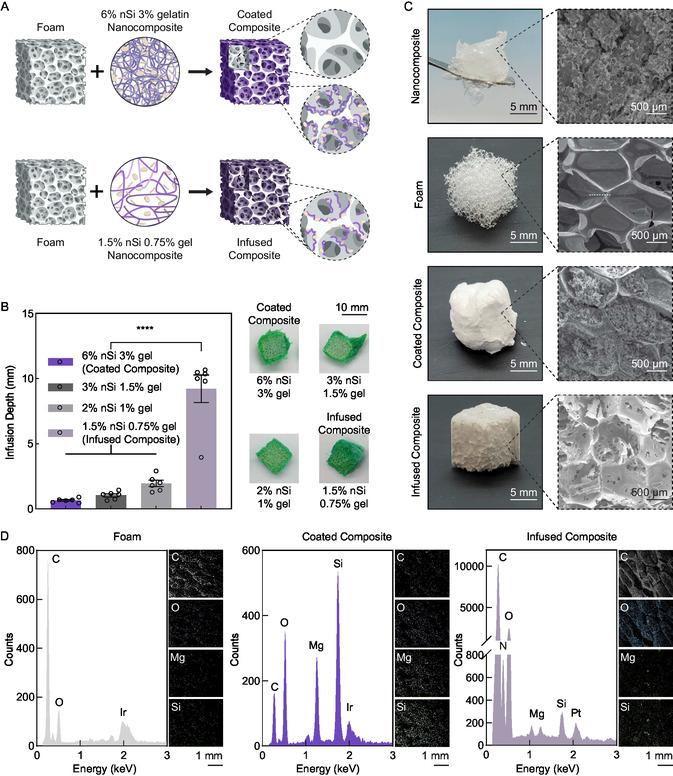
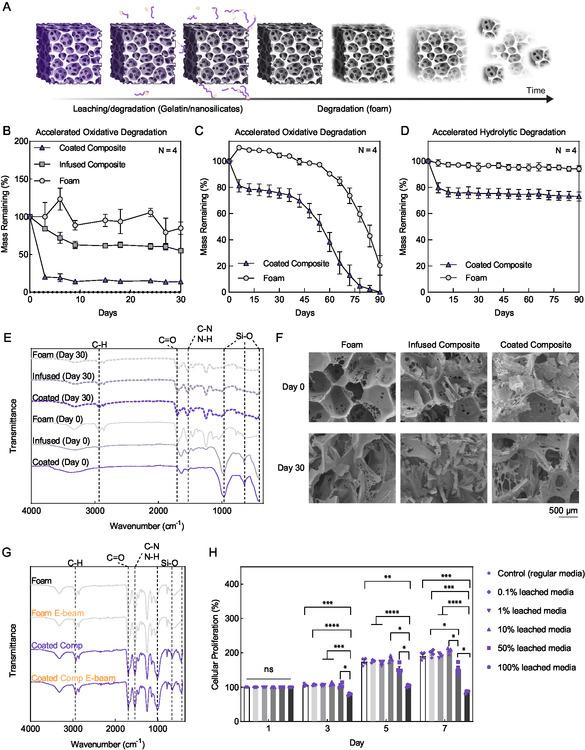
Uncontrolled hemorrhage is the predominant cause of preventable combat deaths. Various biomaterials serve as hemostatic agents due to their procoagulant or absorptive activity. However, these biomaterials often lack expansion capabilities, which severely limits use in noncompressible wounds. This study combines a hemostatic nanocomposite with a shape-memory polymer foam to design a composite material with both hemostatic and physical expansion properties. This composite is fabricated in two formulations: a foam externally coated in a highly concentrated nanocomposite ("coated composite") and a foam containing a diluted nanocomposite infused throughout its pores ("infused composite"). Both formulations retain the shape-memory foam's expansion property. Further, the coated composite shows improved fluid uptake (>2-fold) versus infused composites or foam. The nanocomposite component dissociates from the foam under degradative conditions, with the foam remaining stable for 30 days. Hemostatic studies illustrate that the coated composite reduces the clotting time by ≈20%. Alternatively, the infused composite improves clotting over a larger distance (up to ≈2× distance from the composite). These results signify a modular hemostatic ability: the coated composite reduces clotting and improves fluid uptake, while the infused composite achieves diffuse clotting and maintains mechanical properties. Thus, these materials pose a strong potential for use in noncompressible wounds.
失控性出血是可预防战斗死亡的主要原因。各种生物材料因其促凝血或吸收活性而用作止血剂。然而,这些生物材料往往缺乏膨胀能力,这严重限制了其在不可压缩伤口中的应用。本研究将一种止血纳米复合材料与一种形状记忆聚合物泡沫相结合,设计出一种兼具止血和物理膨胀特性的复合材料。这种复合材料有两种配方:一种是在高浓度纳米复合材料外包覆泡沫(“包覆复合材料”),另一种是在整个孔隙中注入稀释纳米复合材料的泡沫(“注入复合材料”)。两种配方都保留了形状记忆泡沫的膨胀特性。此外,与注入复合材料或泡沫相比,包覆复合材料的吸液能力有所提高(>2倍)。在降解条件下,纳米复合材料成分会与泡沫分离,泡沫可保持稳定30天。止血研究表明,包覆复合材料可使凝血时间缩短约20%。相比之下,注入复合材料在更大距离(距复合材料最远可达约2倍距离)内改善凝血效果。这些结果表明了一种模块化的止血能力:包覆复合材料可减少凝血并提高吸液能力,而注入复合材料可实现弥散性凝血并保持机械性能。因此,这些材料在不可压缩伤口的应用中具有强大潜力。



 Zotero 插件