
纳米复合水凝胶:一种治疗退行性关节疾病的有前景的方法。
Nanocomposite Hydrogels: A Promising Approach for the Treatment of Degenerative Joint Diseases.
作者信息
Chen Qizhu, Zheng Zitian, Lin Mian, Guo Zhengyu, Huang Hongjie, Xue Qingyun, Jiang Shengdan, Wang Jianquan, Wu Aimin
机构信息
Department of Orthopaedics Key Laboratory of Structural Malformations in Children of Zhejiang Province Key Laboratory of Orthopaedics of Zhejiang Province The Second Affiliated Hospital and Yuying Children's Hospital of Wenzhou Medical University Wenzhou Zhejiang 325000 China.
Department of Clinic of Spine Center Xinhua Hospital Shanghai Jiaotong University School of Medicine Shanghai 200082 China.
出版信息
Small Sci. 2024 Sep 3;4(11):2400236. doi: 10.1002/smsc.202400236. eCollection 2024 Nov.
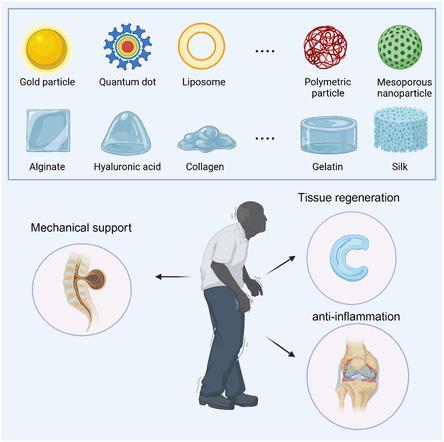
Degenerative joint diseases, as a global public health issue, impose significant burdens on patients' lives and substantial economic costs on society. Currently, the primary modalities include physical therapy, pharmaceutical intervention, and surgical procedures. None of these approaches can alter the course of this degenerative process. Due to their commendable biocompatibility, biodegradability, and heightened efficacy in drug delivery, hydrogels present themselves as a novel noninvasive remedy for degenerative joint ailments. However, the clinical application of hydrogels still faces some challenges, including the uncontrolled discharge of encapsulated medications, the absence of adequate mechanical reinforcement for destabilized joints, and adaptability to fluctuating microenvironments. Recently, nanocomposite hydrogels, formed by introducing nanomaterials into hydrogels by physical or chemical means, can improve the limitations of hydrogels and extend their potential for biological applications in degenerative joint diseases. In this study, the pathologic features of degenerative joint diseases and the multiple applications of different types of nanocomposite hydrogels in targeting these different pathologic features are briefly described. It also concludes with an outlook on the use of nanocomposite hydrogels in clinical settings and discusses their challenges and limitations.
退行性关节疾病作为一个全球性的公共卫生问题,给患者的生活带来了沉重负担,并给社会造成了巨大的经济成本。目前,主要的治疗方式包括物理治疗、药物干预和外科手术。这些方法都无法改变这种退行性病变的进程。由于水凝胶具有良好的生物相容性、可生物降解性以及在药物递送方面更高的功效,它们成为了一种用于治疗退行性关节疾病的新型非侵入性疗法。然而,水凝胶的临床应用仍然面临一些挑战,包括包封药物的无控制释放、不稳定关节缺乏足够的机械增强以及对波动微环境的适应性。最近,通过物理或化学方法将纳米材料引入水凝胶中形成的纳米复合水凝胶,可以改善水凝胶的局限性,并扩展其在退行性关节疾病生物应用方面的潜力。在本研究中,简要描述了退行性关节疾病的病理特征以及不同类型纳米复合水凝胶针对这些不同病理特征的多种应用。它还对纳米复合水凝胶在临床环境中的使用进行了展望,并讨论了它们的挑战和局限性。




 Zotero 插件