
可穿戴外骨骼机器人对跑步机上肌肉激活和步态参数的影响:一项随机对照试验。
Effect of Wearable Exoskeleton Robots on Muscle Activation and Gait Parameters on a Treadmill: A Randomized Controlled Trial.
作者信息
Lee Kyung-Jin, Nam Yeon-Gyo, Yu Jae-Ho, Kim Jin-Seop
机构信息
Department of Physical Therapy, Sun Moon University, Asan-si 31460, Republic of Korea.
出版信息
Healthcare (Basel). 2025 Mar 22;13(7):700. doi: 10.3390/healthcare13070700.
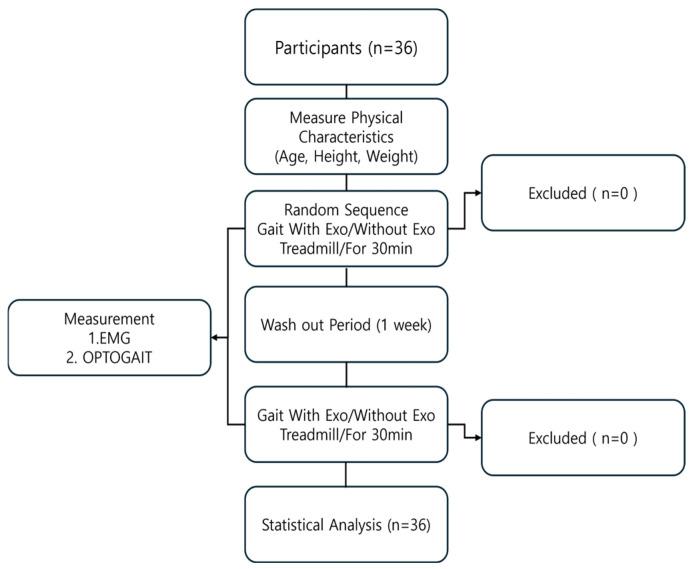
Exoskeleton robots are emerging as a transformative technology in healthcare, rehabilitation, and industrial settings, providing significant benefits such as improving gait restoration and preventing injuries. These robots enhance mobility for individuals with neuromuscular disorders by providing muscular assistance and reducing physical strain, while also supporting workers in physically demanding tasks. They improve gait efficiency, muscle activation, and overall physical function, contributing to both rehabilitation and occupational health. This study aims to investigate the impact of exoskeleton use on muscle activation patterns, fatigue levels, and gait parameters in healthy individuals. Thirty-six participants engaged in a randomized sequence gait experiment on a treadmill for 30 min, both with and without an exoskeleton, with electromyography (EMG) and OptoGait measurements collected during the sessions. A one-week washout period was implemented before participants switched conditions. In the Maximum voluntary contraction (MVC) analysis, significant differences were observed in the Rectus femoris (RF) and gastrocnemius(GM) when wearing the exoskeleton robot compared to not wearing it. At 10 min, 20 min, and 30 min, the differences were statistically significant ( < 0.05) for all muscles. In the muscle fatigue analysis, significant differences were observed in RF, GM, vastus medialis (VM), and hamstring(HS) at 10 min, 20 min, and 30 min ( < 0.05). In the step length and stride length analysis, significant differences were observed at 10 min and 30 min, but no differences were found at 20 min ( < 0.05). This study demonstrates that the use of the exoskeleton robot significantly impacts muscle activation, muscle fatigue, and gait parameters. The results emphasize the potential benefits of exoskeletons in enhancing mobility and reducing muscle strain, providing important insights for rehabilitation and occupational applications.
外骨骼机器人正在成为医疗保健、康复和工业领域的一项变革性技术,带来诸多显著益处,如改善步态恢复和预防损伤。这些机器人通过提供肌肉辅助和减轻身体负担,增强了神经肌肉疾病患者的行动能力,同时也为从事体力要求高的任务的工人提供支持。它们提高了步态效率、肌肉激活程度和整体身体功能,对康复和职业健康都有帮助。本研究旨在调查使用外骨骼对健康个体的肌肉激活模式、疲劳水平和步态参数的影响。36名参与者在跑步机上进行了随机顺序的步态实验,每次30分钟,分别在有和没有外骨骼的情况下进行,并在实验过程中收集肌电图(EMG)和OptoGait测量数据。在参与者更换条件之前,设置了一周的洗脱期。在最大自主收缩(MVC)分析中,与不穿戴外骨骼机器人相比,穿戴时股直肌(RF)和腓肠肌(GM)存在显著差异。在10分钟、20分钟和30分钟时,所有肌肉的差异均具有统计学意义(<0.05)。在肌肉疲劳分析中,RF、GM、股内侧肌(VM)和腘绳肌(HS)在10分钟、20分钟和30分钟时存在显著差异(<0.05)。在步长和步幅分析中,10分钟和30分钟时存在显著差异,但20分钟时未发现差异(<0.05)。本研究表明,使用外骨骼机器人对肌肉激活、肌肉疲劳和步态参数有显著影响。结果强调了外骨骼在增强行动能力和减轻肌肉紧张方面的潜在益处,为康复和职业应用提供了重要见解。


 Zotero 插件