
评估尼日利亚改善实验室绩效及加强抗菌药物耐药性监测的障碍与机遇——一项定量研究
Assessing barriers and opportunities for the improvement of laboratory performance and robust surveillance of antimicrobial resistance in Nigeria- a quantitative study.
作者信息
Okolie Obiageli J, Ismail Sanda U, Igwe Uzoma, Adukwu Emmanuel C
机构信息
School of Applied Sciences, University of the West England, Bristol, UK.
School of Health and Social Wellbeing, University of the West England, Bristol, UK.
出版信息
Antimicrob Resist Infect Control. 2025 Apr 12;14(1):29. doi: 10.1186/s13756-025-01530-9.
BACKGROUND
Good quality data is essential in optimising containment strategies for antimicrobial resistance, a global public health threat estimated to cause around 10 million deaths yearly and up-to 5% loss in GDP by 2050 if left unaddressed. The laboratory system plays an important role in the collection of high-quality data as well as ensuring validity, reliability and timeliness of data. However, in many low-medium income countries including Nigeria, the technical capacity of the laboratory for fulfilling these responsibilities is unknown. This paucity of information limits piloting of strategies to complement existing surveillance and planning improvement of subsequent laboratory iterations into the surveillance system. The focus of this study was to assess the gaps, vulnerabilities and enablers of laboratory strengthening processes in the scope of technical capacity for clinical and public health functions and to provide a roadmap for improved surveillance of antimicrobial resistance in Nigeria.
METHODS
A cross-sectional study design utilising structured questionnaire administered online via Qualtrics and reported in accordance with strengthening the Reporting of Observational Studies in Epidemiology (STROBE) guidelines. Data analysis involved descriptive and inferential statistics as well as bivariate and multivariate logistics to test predictive analysis of relationship between variables.
RESULTS
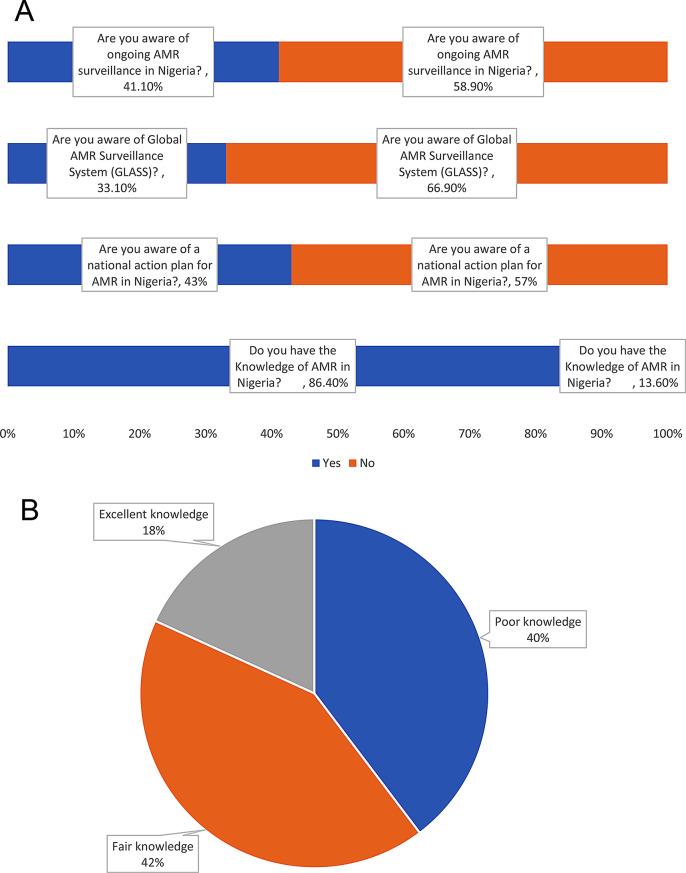
A total of 302 laboratories completed the questionnaire, 107 (53.4%) government laboratories and 195 (64.6%) private sector laboratories. 18.2% reported excellent knowledge, 25.5% has excellent capacity, 7.3% are fully ready for surveillance, 12.3% are participating in some surveillance, and 1.0% record important microbiological data that correlates with epidemiological information.
CONCLUSION
Tertiary laboratories reported highest performance across all surveillance quality indicators (SQIs). AMR surveillance is skewed toward government and tertiary laboratories, leaving lower-level and rural facilities underutilized despite their potential. This results in missing community-level data and undermines the representativeness of surveillance. The study identifies gaps in recruitment, assessment, and oversight but also offers strategies to address these issues.
背景
高质量数据对于优化抗菌药物耐药性控制策略至关重要,抗菌药物耐药性是一种全球公共卫生威胁,据估计,如果不加以应对,每年将导致约1000万人死亡,到2050年将使国内生产总值损失高达5%。实验室系统在高质量数据的收集以及确保数据的有效性、可靠性和及时性方面发挥着重要作用。然而,在包括尼日利亚在内的许多中低收入国家,实验室履行这些职责的技术能力尚不清楚。这种信息匮乏限制了对补充现有监测策略的试点,并阻碍了对后续实验室迭代纳入监测系统的规划改进。本研究的重点是评估临床和公共卫生功能技术能力范围内实验室加强过程的差距、脆弱性和推动因素,并为改进尼日利亚抗菌药物耐药性监测提供路线图。
方法
采用横断面研究设计,通过Qualtrics在线发放结构化问卷,并按照加强流行病学观察性研究报告(STROBE)指南进行报告。数据分析包括描述性和推断性统计以及双变量和多变量逻辑分析,以测试变量之间关系的预测分析。
结果
共有302个实验室完成了问卷,其中107个(53.4%)是政府实验室,195个(64.6%)是私营部门实验室。18.2%的实验室报告知识优秀,25.5%的实验室能力优秀,7.3%的实验室完全准备好进行监测,12.3%的实验室正在参与一些监测,1.0%的实验室记录与流行病学信息相关的重要微生物数据。
结论
三级实验室在所有监测质量指标(SQIs)方面表现最佳。抗菌药物耐药性监测偏向于政府和三级实验室,尽管基层和农村设施有潜力,但利用率较低。这导致社区层面的数据缺失,并削弱了监测的代表性。该研究确定了招聘、评估和监督方面的差距,但也提供了解决这些问题的策略。


 Zotero 插件