
利用深度学习解码癌症预后:用于肿瘤微环境分析的ASD-癌症框架
Decoding cancer prognosis with deep learning: the ASD-cancer framework for tumor microenvironment analysis.
作者信息
Huang Ziyuan, Li Yunzhan, Bucci Vanni, Haran John P
机构信息
Department of Emergency Medicine, UMass Chan Medical School, Worcester, Massachusetts, USA.
Department of Microbiology, UMass Chan Medical School, Worcester, Massachusetts, USA.
出版信息
mSystems. 2025 May 20;10(5):e0145524. doi: 10.1128/msystems.01455-24. Epub 2025 Apr 16.
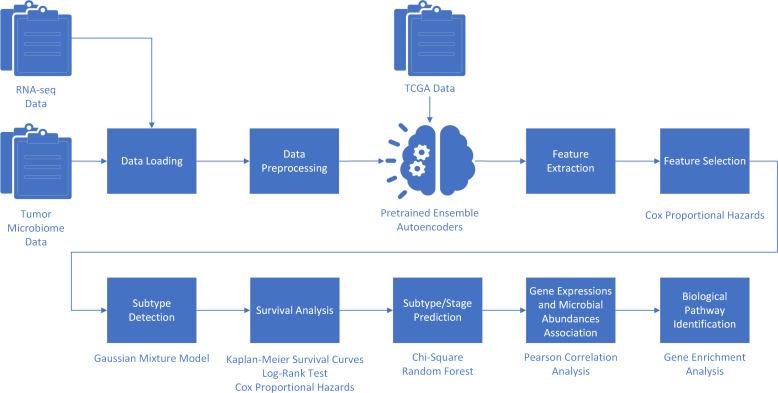
Deep learning is revolutionizing biomedical research by facilitating the integration of multi-omics data sets while bridging classical bioinformatics with existing knowledge. Building on this powerful potential, Zhang et al. proposed a semi-supervised learning framework called Autoencoder-Based Subtypes Detector for Cancer (ASD-cancer) to improve the multi-omics data analysis (H. Zhang, X. Xiong, M. Cheng, et al., 2024, mSystems 9:e01395-24, https://doi.org/10.1128/msystems.01395-24). By utilizing autoencoders pre-trained on The Cancer Genome Atlas data, the ASD-cancer framework outperforms the baseline model. This approach also makes the framework scalable, enabling it to process new data sets through transfer learning without retraining. This commentary explores the methodological innovations and scalability of ASD-cancer while suggesting future directions, such as the incorporation of additional data layers and the development of adaptive AI models through continuous learning. Notably, integrating large language models into ASD-cancer could enhance its interpretability, providing more profound insights into oncological research and increasing its influence in cancer subtyping and further analysis.
深度学习正在彻底改变生物医学研究,它通过促进多组学数据集的整合,同时将经典生物信息学与现有知识联系起来。基于这一强大潜力,Zhang等人提出了一种名为基于自动编码器的癌症亚型检测器(ASD-cancer)的半监督学习框架,以改进多组学数据分析(H. Zhang、X. Xiong、M. Cheng等人,2024年,《mSystems》9:e01395-24,https://doi.org/10.1128/msystems.01395-24)。通过利用在癌症基因组图谱数据上预训练的自动编码器,ASD-cancer框架优于基线模型。这种方法还使该框架具有可扩展性,使其能够通过迁移学习处理新的数据集,而无需重新训练。本评论探讨了ASD-cancer的方法创新和可扩展性,同时提出了未来的方向,例如纳入额外的数据层以及通过持续学习开发自适应人工智能模型。值得注意的是,将大语言模型集成到ASD-cancer中可以增强其可解释性,为肿瘤学研究提供更深刻的见解,并提高其在癌症亚型分类和进一步分析中的影响力。
 Zotero 插件