
复发慢性淋巴细胞白血病中基于微小残留病(MRD)指导的依鲁替尼联合维奈克拉的长期随访:2期VISION/HO141试验
Long-term follow-up of MRD-guided ibrutinib plus venetoclax in relapsed CLL: phase 2 VISION/HO141 trial.
作者信息
Niemann Carsten U, Dubois Julie, Nasserinejad Kazem, da Cunha-Bang Caspar, Kersting Sabina, Enggaard Lisbeth, Veldhuis Gerrit J, Mous Rogier, Mellink Clemens H M, van der Kevie-Kersemaekers Anne-Marie F, Dobber Johan A, Poulsen Christian B, Razawy Wida, Hollestein René, Frederiksen Henrik, Janssens Ann, Schjødt Ida, Dompeling Ellen C, Ranti Juha, Brieghel Christian, Mattsson Mattias, Bellido Mar, Tran Hoa T T, Kater Arnon P, Levin Mark-David
机构信息
Department of Hematology, Rigshospitalet, Copenhagen University Hospital, Copenhagen, Denmark.
Department of Hematology, Cancer Center Amsterdam, Amsterdam UMC, University of Amsterdam, Amsterdam, The Netherlands.
出版信息
Blood Adv. 2025 Aug 12;9(15):3665-3675. doi: 10.1182/bloodadvances.2024015180.
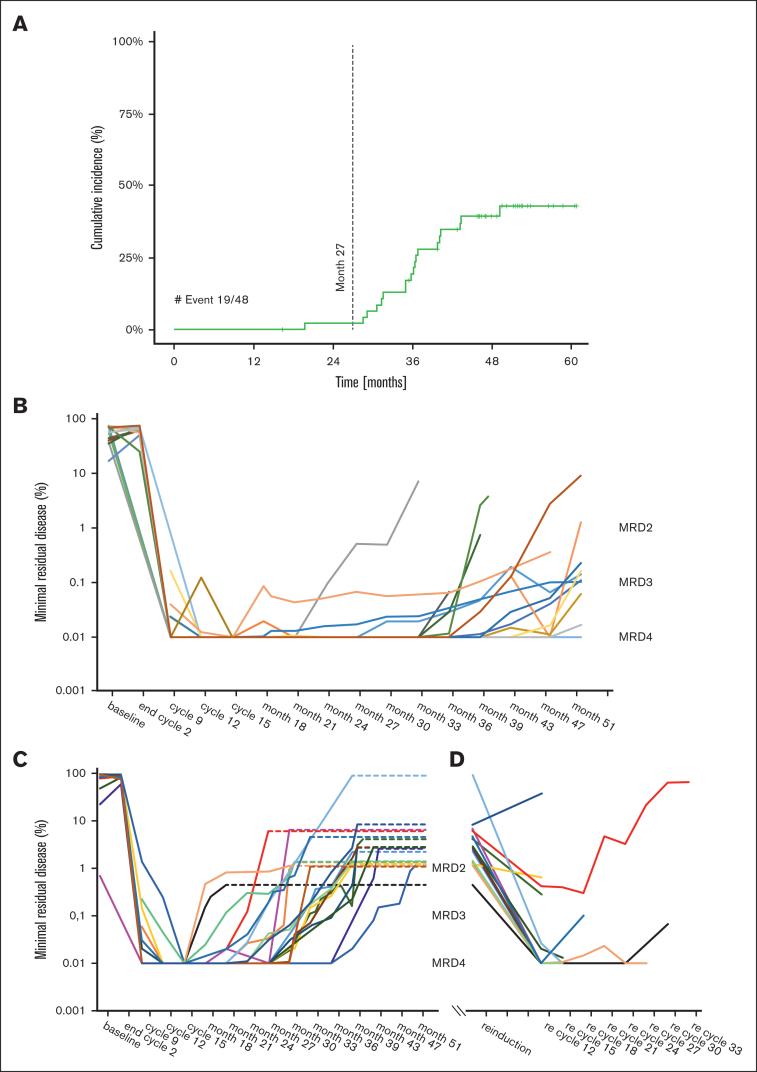
Patients with relapsed/refractory (R/R) chronic lymphocytic leukemia (CLL) are treated with fixed-duration B-cell lymphoma 2 inhibitors + CD20 monoclonal antibodies or continuous Bruton tyrosine kinase (BTK) inhibitors. Although continuous treatment may lead to cumulative toxicity or resistance, fixed-duration treatment may lead to undertreatment and early relapse. Efficacy and safety of minimal residual disease (MRD)-guided treatment cessation of ibrutinib + venetoclax (I+V) with reinitiated I+V upon MRD conversion was evaluated in the randomized VISION/HO41 phase 2 study. Four-year follow-up including long-term toxicity and MRD kinetics are reported. Patients received ibrutinib for 2 (28-day) cycles followed by 13 cycles of I+V. Patients reaching undetectable MRD at 4 years (<10-4, flow cytometry) in the blood and bone marrow at cycle 15 (C15) were randomized 2:1 between treatment cessation with reinitiated I+V upon detectable MRD2 (dMRD2; sensitivity of ≥10-2 by flow cytometry) and ibrutinib maintenance. MRD4-positive patients at C15 remained on ibrutinib (dMRD4 arm, defined by MRD sensitivity of ≥10-4 by flow cytometry). With a median of 51.7 months, the estimated 4-year overall survival (OS) was 88%, progression free survival (PFS) was 81%; 14% of patients required next-line treatment (NT). For patients randomized to treatment cessation, 40% had reinitiated therapy per protocol because of dMRD2. No difference between treatment cessation, ibrutinib maintenance, or the dMRD4 arm continuing ibrutinib was seen for OS, PFS, or NT in landmark analysis from C15 time of randomization. Lower toxicity was demonstrated for the treatment-cessation arm. MRD-guided cessation and reinitiation of I+V for R/R CLL is feasible, reduces toxicity compared with indefinite BTK inhibitor, while providing comparable PFS rates. This trial was registered at www.clinicaltrials.gov as #NCT03226301.
复发/难治性(R/R)慢性淋巴细胞白血病(CLL)患者接受固定疗程的B细胞淋巴瘤2抑制剂+CD20单克隆抗体治疗或持续使用布鲁顿酪氨酸激酶(BTK)抑制剂治疗。尽管持续治疗可能导致累积毒性或耐药,但固定疗程治疗可能导致治疗不足和早期复发。在随机的VISION/HO41 2期研究中,评估了微小残留病(MRD)指导下停用依鲁替尼+维奈克拉(I+V)并在MRD转化时重新开始使用I+V的疗效和安全性。报告了包括长期毒性和MRD动力学在内的4年随访结果。患者接受2个(28天)周期的依鲁替尼治疗,随后接受13个周期的I+V治疗。在第15周期(C15)时血液和骨髓中达到4年不可检测MRD(<10-4,流式细胞术)的患者,在可检测到MRD2(dMRD2;流式细胞术灵敏度≥10-2)时重新开始使用I+V的治疗中断与依鲁替尼维持治疗之间按2:1随机分组。C15时MRD4阳性的患者继续使用依鲁替尼(dMRD4组,由流式细胞术MRD灵敏度≥10-4定义)。中位随访51.7个月,估计4年总生存率(OS)为88%,无进展生存率(PFS)为81%;14%的患者需要接受二线治疗(NT)。对于随机分组至治疗中断的患者,40%因dMRD2而按照方案重新开始治疗。在从随机分组的C15时间进行的里程碑分析中,治疗中断组、依鲁替尼维持治疗组或dMRD4组继续使用依鲁替尼组在OS、PFS或NT方面未见差异。治疗中断组显示出较低的毒性。MRD指导下R/R CLL患者停用和重新开始使用I+V是可行的,与无限期使用BTK抑制剂相比可降低毒性,同时提供相当的PFS率。该试验在www.clinicaltrials.gov上注册,注册号为#NCT03226301。


 Zotero 插件