
基于网络药理学和分子对接技术探索六君子汤联合酸枣仁汤治疗肺癌伴失眠潜在作用机制
Exploring the mechanism of the potential effects of Liujunzi Tang combined with Suanzaoren Tang in the treatment of lung cancer with insomnia based on network pharmacology and molecular docking technology.
作者信息
Wang Yaoyao, Zhao Xin, Wang Xiaomei, Wang Xuemei, Zhang Tingting, Wang Yanchun
机构信息
Acupuncture and Moxibustion and Massage College of Henan University of Chinese Medicine, Zhengzhou, P.R. China.
Department of Chinese Medicine, Henan Provincial People's Hosptial, People's Hosptial of Zhengzhou University, Zhengzhou, P.R. China.
出版信息
Medicine (Baltimore). 2025 Apr 18;104(16):e42205. doi: 10.1097/MD.0000000000042205.
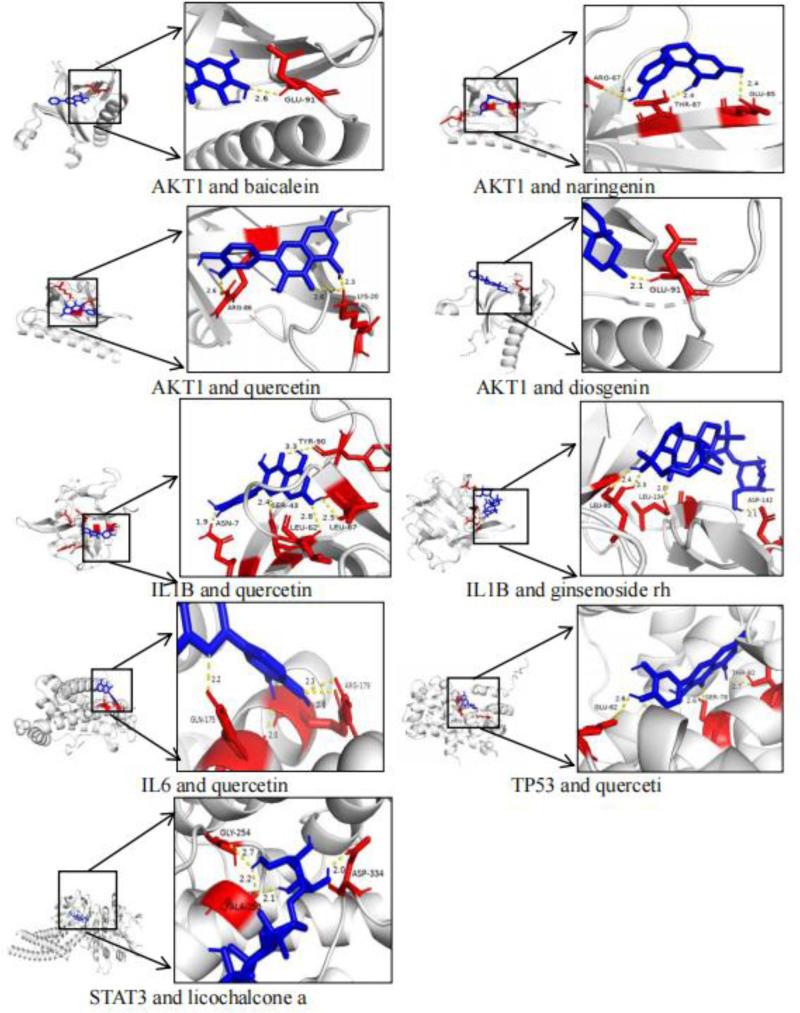
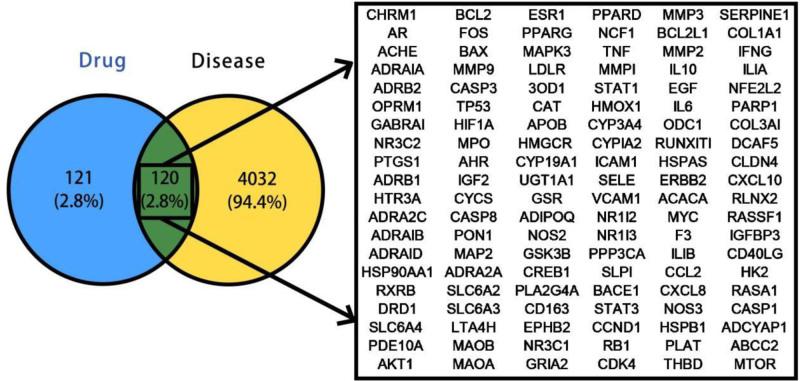
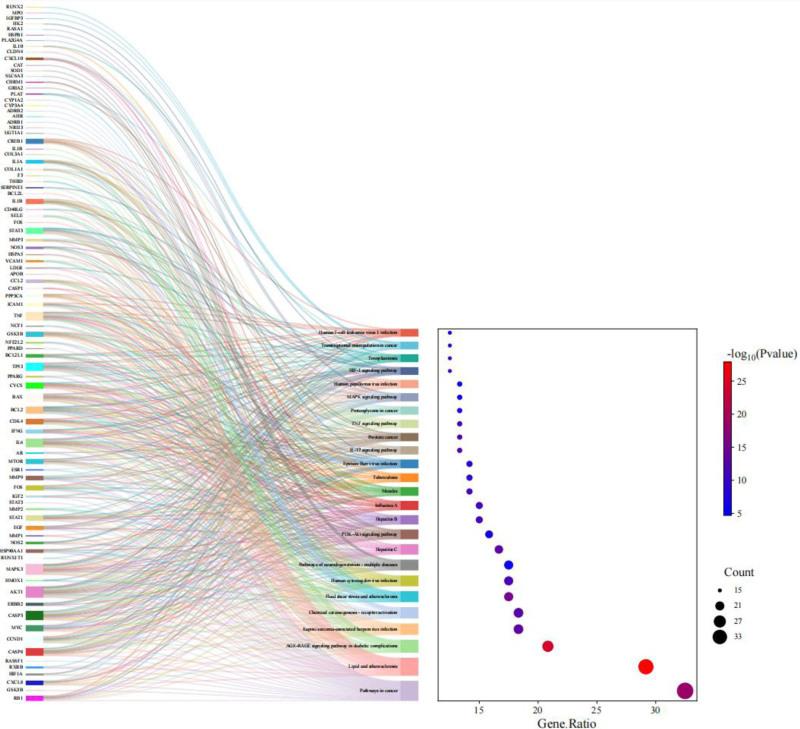
This study explores the potential mechanisms of Liujunzi Tang combined with Suanzaoren Tang in treating lung cancer with insomnia through network pharmacology and molecular docking methods. In the Traditional Chinese Medicine Systems Pharmacology (TCMSP) database, each single herb in the formula of Liujunzi Tang combined with Suanzaoren Tang was used as a search term, with repeated traditional Chinese medicines (TCMs) searched only once. Oral bioavailability (OB) ≥ 30% and drug-likeness (DL) ≥ 0.18 were set as screening criteria to obtain active components and targets of TCM. Disease-related targets for lung cancer with insomnia were obtained from the Gene Cards database, OMIM database, and PharmGKB database. The disease targets and drug effective component targets were intersected, and a disease-component intersection Venn diagram was drawn. The common intersection targets were imported into the DAVID database for Kyoto Encyclopedia of Genes and Genomics (KEGG) pathway and gene ontology (GO) function enrichment analysis, and molecular docking was performed to verify the affinity of active components with key targets. A total of 185 effective active components and 241 targets were obtained for Liujunzi Tang combined with Suanzaoren Tang. A total of 4290 disease targets were obtained from 3 disease databases. After removing 138 duplicate targets, a total of 4152 disease targets were obtained. The intersection of component targets and disease targets yielded 120 common targets. KEGG pathway enrichment was found in lipid and atherosclerosis, AGE-RAGE signaling pathway in diabetes complications, Kaposi sarcoma-related herpes virus infection, and other signaling pathways. Molecular docking showed that the core components naringenin had good binding activity with AKT1, quercetin and ginsenoside Rh2 with IL1B, and other targets. Through network pharmacology and molecular docking methods, it was explored that Liujunzi Tang combined with Suanzaoren Tang may treat lung cancer with insomnia through multiple components, multiple targets, and multiple pathways, regulating cancer pathways, lipid and atherosclerosis, and other signaling pathways, providing new ideas for the treatment of lung cancer with insomnia.
本研究通过网络药理学和分子对接方法,探讨六君子汤合酸枣仁汤治疗肺癌伴失眠的潜在机制。在中药系统药理学(TCMSP)数据库中,将六君子汤合酸枣仁汤方剂中的每味单药作为检索词,重复的中药仅检索一次。设定口服生物利用度(OB)≥30%和类药性(DL)≥0.18作为筛选标准,以获取中药活性成分及靶点。从基因卡片数据库、在线人类孟德尔遗传数据库(OMIM)和药物基因组学知识库(PharmGKB)中获取肺癌伴失眠的疾病相关靶点。将疾病靶点与药物有效成分靶点进行交集分析,并绘制疾病-成分交集韦恩图。将共同的交集靶点导入DAVID数据库进行京都基因与基因组百科全书(KEGG)通路和基因本体(GO)功能富集分析,并进行分子对接以验证活性成分与关键靶点的亲和力。六君子汤合酸枣仁汤共获得185个有效活性成分和241个靶点。从3个疾病数据库中总共获得4290个疾病靶点。去除138个重复靶点后,共获得4152个疾病靶点。成分靶点与疾病靶点的交集产生120个共同靶点。KEGG通路富集于脂质与动脉粥样硬化、糖尿病并发症中的晚期糖基化终末产物受体(AGE-RAGE)信号通路、卡波西肉瘤相关疱疹病毒感染等信号通路。分子对接显示,核心成分柚皮素与蛋白激酶B1(AKT1)具有良好的结合活性,槲皮素和人参皂苷Rh2与白细胞介素1β(IL1B)等靶点具有良好的结合活性。通过网络药理学和分子对接方法,探索了六君子汤合酸枣仁汤可能通过多成分、多靶点、多途径治疗肺癌伴失眠,调节癌症通路、脂质与动脉粥样硬化等信号通路,为肺癌伴失眠的治疗提供新思路。


 Zotero 插件