
抑郁症状、教育程度、性别与移民史——一项基于德国国民队列研究(NAKO)数据的交叉性分析
Depressive symptoms, education, gender and history of migration - an intersectional analysis using data from the German National Cohort (NAKO).
作者信息
Vonneilich Nico, Becher Heiko, Berger Klaus, Bohmann Patricia, Brenner Hermann, Castell Stefanie, Dragano Nico, Harth Volker, Jaskulski Stefanie, Karch André, Keil Thomas, Krist Lilian, Lange Berit, Leitzmann Michael, Massag Janka, Meinke-Franze Claudia, Mikolajczyk Rafael, Obi Nadia, Pischon Tobias, Reuter Marvin, Schmidt Börge, Velásquez Ilais Moreno, Völzke Henry, Wiessner Christian, von dem Knesebeck Olaf, Lüdecke Daniel
机构信息
Institute of Medical Sociology, University Medical Center Hamburg-Eppendorf, Hamburg, Germany.
Institute of Global Health, University Hospital Heidelberg, Heidelberg, Germany.
出版信息
Int J Equity Health. 2025 Apr 21;24(1):108. doi: 10.1186/s12939-025-02479-2.
BACKGROUND
The educational gradient in depressive symptoms is well documented. Gender and history of migration have also been found to be associated with depressive symptoms. Intersectional approaches enable the analysis of the interplay of different social factors at a time to gain a deeper understanding of inequalities in depressive symptoms. In this study, intersectional inequalities in depressive symptoms according to education, gender and history of migration are analysed.
METHODS
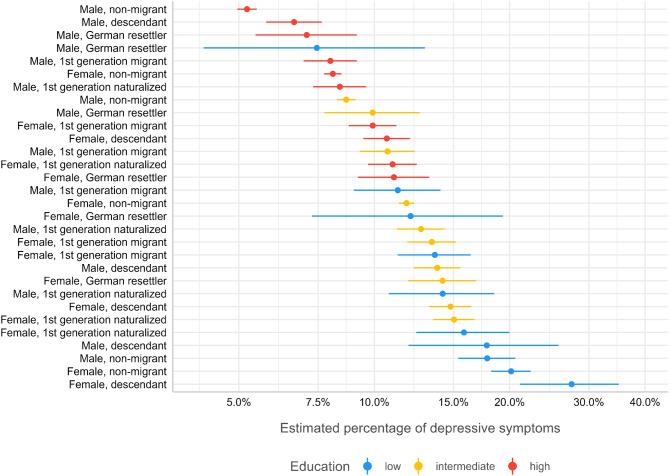
The German National Cohort (NAKO, N = 204,783) collected information on depressive symptoms (PHQ-9), which was used as an outcome variable. Educational attainment (ISCED-97), gender, and history of migration constituted the different social strata in the analyses. The predicted probabilities of depressive symptoms for 30 social strata were calculated. Multilevel analysis of individual heterogeneity and discriminatory accuracy (MAIHDA) was applied, using logistic regression and social strata were introduced as higher-level unit interaction terms.
RESULTS
The analyses revealed an educational gradient in depressive symptoms, with differences within each educational group when gender and history of migration were introduced to the models. The predicted probabilities of depressive symptoms varied between the most advantaged and the most disadvantaged social strata by more than 20% points. Among the three studied variables, education contributed the most to the variance explained by the MAIHDA models. The between-strata differences were largely explained by additive effects.
CONCLUSIONS
We observed a robust educational gradient in depressive symptoms, but gender and history of migration had substantial contribution on the magnitude of educational inequalities. An intersectional perspective on inequalities in depressive symptoms enhances current knowledge by showing that different social dimensions may intersect and contribute to inequalities in depressive symptoms. Future studies on inequalities in depression may greatly benefit from an intersectional approach, as it reflects lived inequalities in their diversity.
背景
抑郁症状的教育梯度已有充分记录。性别和移民史也被发现与抑郁症状有关。交叉性方法能够同时分析不同社会因素之间的相互作用,以更深入地理解抑郁症状方面的不平等现象。在本研究中,分析了根据教育程度、性别和移民史划分的抑郁症状交叉不平等情况。
方法
德国国民队列研究(NAKO,N = 204,783)收集了关于抑郁症状(PHQ - 9)的信息,该信息被用作结果变量。教育程度(国际标准教育分类法 - 97)、性别和移民史构成了分析中的不同社会阶层。计算了30个社会阶层抑郁症状的预测概率。应用个体异质性和判别准确性的多水平分析(MAIHDA),使用逻辑回归,并将社会阶层作为更高级别的单位交互项引入。
结果
分析揭示了抑郁症状的教育梯度,当将性别和移民史纳入模型时,每个教育组内部存在差异。最具优势和最弱势社会阶层之间抑郁症状的预测概率差异超过20个百分点。在研究的三个变量中,教育对MAIHDA模型解释的方差贡献最大。阶层间差异在很大程度上由加性效应解释。
结论
我们观察到抑郁症状存在稳健的教育梯度,但性别和移民史对教育不平等的程度有重大贡献。从交叉性角度看待抑郁症状的不平等现象,通过表明不同社会维度可能相互交叉并导致抑郁症状的不平等,增强了当前的知识。未来关于抑郁症不平等现象的研究可能会从交叉性方法中受益匪浅,因为它反映了现实生活中多样化的不平等现象。
 Zotero 插件