
静脉注射免疫球蛋白(IVIG)补充对接受靶向BCMA双特异性抗体治疗的多发性骨髓瘤患者无感染生存期的影响。
Effect of Intravenous Immunoglobulin (IVIG) Supplementation on infection-free survival in recipients of BCMA-directed bispecific antibody therapy for multiple myeloma.
作者信息
Mohan Meera, Szabo Aniko, Cheruvalath Heloise, Clennon Anna, Bhatlapenumarthi Vineel, Patwari Anannya, Balev Metodi, Bhutani Divaya, Shrestha Asis, Thanendrarajan Sharmilan, Dhakal Binod, Zangari Maurizio, Trikannad Anup, Vellanki Sruthi, Al-Hadidi Samer, Lentzsch Suzanne, van Rhee Frits, Bag Aishee, D'Souza Anita, Shah Nishi, Chakraborty Rajshekhar, Shah Mansi R, Schinke Carolina
机构信息
Division of Hematology/Oncology, Department of Medicine, Medical College of Wisconsin, Milwaukee, WI, USA.
Division of Biostatistics, Data Science Institute, Medical College of Wisconsin, Milwaukee, WI, USA.
出版信息
Blood Cancer J. 2025 Apr 23;15(1):74. doi: 10.1038/s41408-025-01282-0.
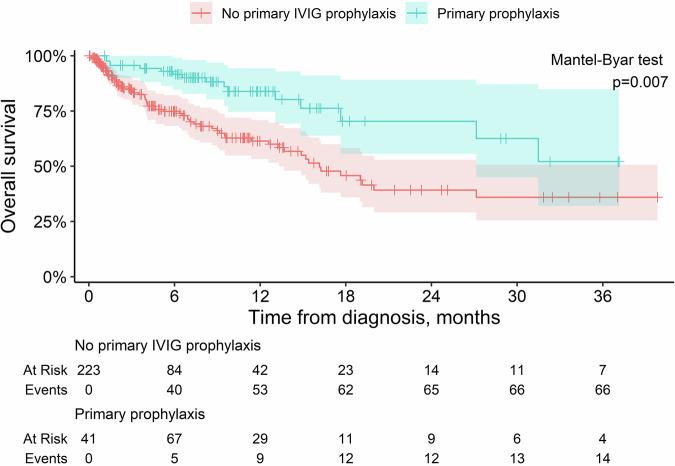
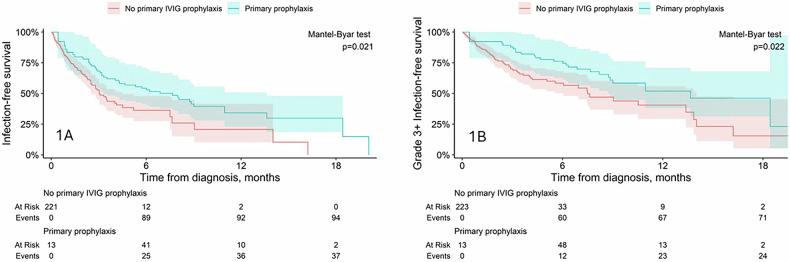
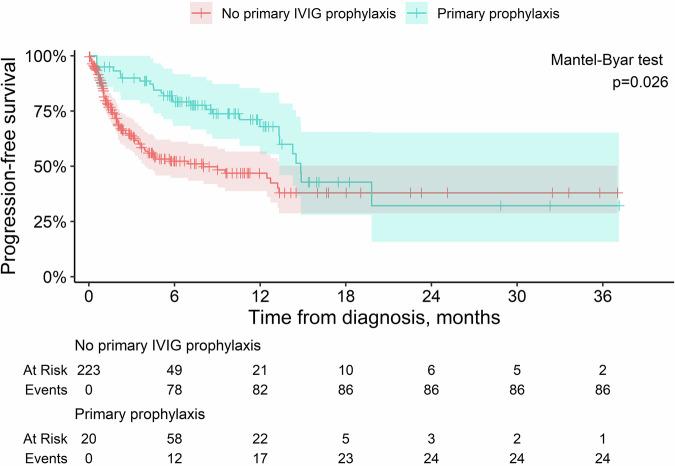
The main objective of this multi-institutional study is to understand the effect of primary intravenous immunoglobulin (IVIG) replacement on clinical outcomes in recipients of BCMA-directed bispecific antibody (bsAb), where infection remains an important cause of morbidity and mortality. This is a retrospective study of patients treated with either standard of care teclistamab or BCMA-directed investigational bsAb between Nov 2017 and Dec 2023. Primary IVIG prophylaxis was defined as starting IVIG prior to first documented infection. All analyses were adjusted for immortal-time bias inherent in this grouping. A total of 225 patients were included in this analysis. Primary IVIG prophylaxis was defined as starting IVIG prior to first documented infection. The median follow-up of patients treated with and without primary IVIG prophylaxis was, 9 and 11 months, respectively. The cumulative incidence of all grade infections at 12 months with and without primary IVIG prophylaxis were 56% (95%CI 40%,78%) and 60% (95% CI 48%, 76%); p = 0.72, respectively. The 12-month cumulative incidence of ≥ grade 3 infections was 35% (95% CI 21%, 57%) with primary IVIG prophylaxis and 45% (95% CI 34%, 60%) without; p = 0.37. The median infection free survival (IFS) for all-grade infections was 7.7 (95% CI 3.3, 14) months with primary IVIG prophylaxis and 3 (95% CI 2.6, 4.5) months without (p = 0.021). The median ≥ grade 3 IFS was 14 (95% CI 8.8, NR) and 7.5 (95% CI 6.1, 14) months, with and without primary IVIG respectively; p = 0.022. Patients on primary IVIG prophylaxis had a superior progression-free-survival (PFS) [median PFS 15 vs 8 months; p = 0.026] and overall-survival (OS) [median OS 16 vs 44 months; p = 0.007]. On multivariate analysis, primary IVIG prophylaxis was independently associated with improved OS (HR = 0.37; p = 0.021), while the presence of extra-medullary (HR = 2.71; p = <0.001) and high-risk disease (HR = 1.88; p = 0.031) conferred poor outcomes. In recipients of BCMA-directed bsAb, IVIG supplementation was associated with an improved clinical outcome, including favorable IFS and OS.
这项多机构研究的主要目的是了解原发性静脉注射免疫球蛋白(IVIG)替代疗法对接受靶向BCMA双特异性抗体(bsAb)治疗的患者临床结局的影响,在这些患者中,感染仍然是发病和死亡的重要原因。这是一项对2017年11月至2023年12月期间接受标准治疗替雷利珠单抗或靶向BCMA的研究性bsAb治疗的患者进行的回顾性研究。原发性IVIG预防定义为在首次记录感染之前开始使用IVIG。所有分析均针对该分组中固有的不朽时间偏倚进行了调整。本分析共纳入225例患者。原发性IVIG预防定义为在首次记录感染之前开始使用IVIG。接受和未接受原发性IVIG预防治疗的患者的中位随访时间分别为9个月和11个月。接受和未接受原发性IVIG预防治疗的患者在12个月时所有级别感染的累积发生率分别为56%(95%CI 40%,78%)和60%(95%CI 48%,76%);p = 0.72。接受原发性IVIG预防治疗的患者≥3级感染的12个月累积发生率为35%(95%CI 21%,57%),未接受预防治疗的为45%(95%CI 34%,60%);p = 0.37。接受原发性IVIG预防治疗的患者所有级别感染的中位无感染生存期(IFS)为7.7(95%CI 3.3,14)个月,未接受预防治疗的为3(95%CI 2.6,4.5)个月(p = 0.021)。≥3级IFS的中位时间分别为14(95%CI 8.8,NR)个月和7.5(95%CI 6.1,14)个月,分别为接受和未接受原发性IVIG预防治疗的患者;p = 0.022。接受原发性IVIG预防治疗的患者具有更好的无进展生存期(PFS)[中位PFS 15个月对8个月;p = 0.026]和总生存期(OS)[中位OS 16个月对44个月;p = 0.007]。在多变量分析中,原发性IVIG预防与改善的OS独立相关(HR = 0.37;p = 0.021),而髓外病变(HR = 2.71;p = <0.001)和高危疾病(HR = 1.88;p = 0.031)的存在则预示着不良结局。在接受靶向BCMA的bsAb治疗的患者中,补充IVIG与改善的临床结局相关,包括良好的IFS和OS。
 Zotero 插件