
使用正定矩阵分解法对法规对排放和空气质量的特定源影响进行责任评估。
Accountability Assessment of Source-Specific Impacts of Regulations on Emissions and Air Quality Using Positive Matrix Factorization.
作者信息
Gao Ziqi, Mei Eric J, He Xin, Ebelt Stefanie, Rich David Q, Russell Armistead G
机构信息
School of Civil and Environmental Engineering, Georgia Institute of Technology, Atlanta, Georgia 30332, United States.
Gangarosa Department of Environmental Health, Rollins School of Public Health, Emory University, Atlanta, Georgia 30322, United States.
出版信息
Environ Sci Technol. 2025 May 6;59(17):8651-8661. doi: 10.1021/acs.est.4c12511. Epub 2025 Apr 24.
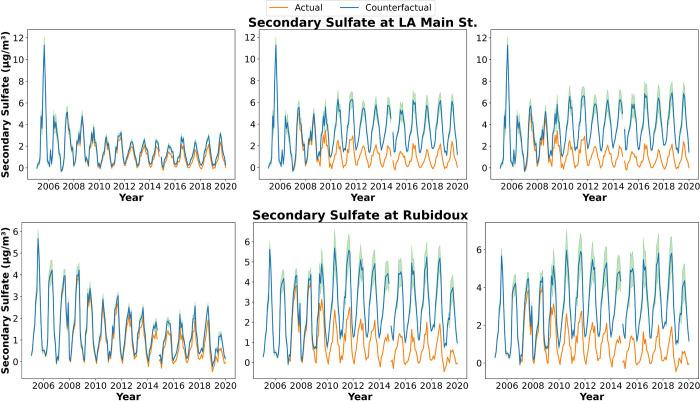
Emission controls targeting electric generating units (EGUs) and mobile sources have been implemented for decades to mitigate PM concentrations. Impacts of emission controls on source-apportioned PM concentrations (diesel/gasoline vehicles, biomass burning, secondary nitrate, secondary sulfate, soil/road dust, and residual oil estimated via positive matrix factorization) across three U.S. highly urbanized regions─Atlanta, New York City, and the South Coast Air Basin (SoCAB)─from 2005 to 2019 were evaluated. We considered major controls on EGUs, mobile sources, ports, and heating fuel. Daily counterfactual source-apportioned PM concentrations without emission controls were estimated based on meteorological indicators and counterfactual emissions using the generalized additive model. Results indicate that emission controls reduced the PM concentrations by 65-85% across all regions. Secondary sulfate concentrations without EGU controls would be 4.8 times higher, and diesel-vehicle-related PM would increase 6.8 times without mobile controls in Atlanta. Secondary inorganic aerosols in New York City would increase 5-fold from 1.92 to 10.5 μg/m, shifting the dominant PM contributors. Seasonal trends in the counterfactual PM concentrations were similar to the actual trends, but the peaks in the counterfactual scenario were clearer than those with emission controls.
数十年来,针对发电机组(EGU)和移动源实施了排放控制措施,以降低颗粒物(PM)浓度。评估了2005年至2019年期间排放控制措施对美国三个高度城市化地区——亚特兰大、纽约市和南海岸空气盆地(SoCAB)——按源分配的PM浓度(通过正定矩阵因子分解估算的柴油/汽油车辆、生物质燃烧、二次硝酸盐、二次硫酸盐、土壤/道路扬尘和残余油)的影响。我们考虑了对EGU、移动源、港口和取暖燃料的主要控制措施。基于气象指标和使用广义相加模型的反事实排放,估算了无排放控制情况下每日按源分配的反事实PM浓度。结果表明,排放控制措施使所有地区的PM浓度降低了65%至85%。在亚特兰大,若无EGU控制,二次硫酸盐浓度将高出4.8倍,若无移动源控制,与柴油车辆相关的PM将增加6.8倍。纽约市的二次无机气溶胶将从1.92微克/立方米增至10.5微克/立方米,增长5倍,这将改变主要的PM贡献源。反事实PM浓度的季节性趋势与实际趋势相似,但反事实情景中的峰值比有排放控制时更明显。

 Zotero 插件