
血液中硒、硒蛋白P和谷胱甘肽过氧化物酶3(GPx3)水平较低与生物衰老加速有关:来自柏林衰老研究II(BASE-II)的结果。
Low blood levels of selenium, selenoprotein P and GPx3 are associated with accelerated biological aging: results from the Berlin Aging Study II (BASE-II).
作者信息
Vetter Valentin Max, Demircan Kamil, Homann Jan, Chillon Thilo Samson, Mülleder Michael, Shomroni Orr, Steinhagen-Thiessen Elisabeth, Ralser Markus, Lill Christina M, Bertram Lars, Schomburg Lutz, Demuth Ilja
机构信息
Department of Endocrinology and Metabolic Diseases (Including Division of Lipid Metabolism), Lipid Clinic at the Interdisciplinary Metabolism Center, Biology of Aging Working Group, Charité - Universitätsmedizin Berlin, Corporate Member of Freie Universität Berlin and Humboldt-Universität zu Berlin, Augustenburger Platz 1, 13353, Berlin, Germany.
Max Rubner Center (MRC) for Cardiovascular Metabolic Renal Research, Institute for Experimental Endocrinology, Charité - Universitätsmedizin Berlin, Corporate Member of Freie Universität Berlin and Humboldt-Universität zu Berlin, 10115, Berlin, Germany.
出版信息
Clin Epigenetics. 2025 Apr 25;17(1):62. doi: 10.1186/s13148-025-01863-7.
BACKGROUND
Biological age reflects inter-individual differences in biological function and capacity beyond chronological age. DNA methylation age (DNAmA) and its deviation from chronological age, DNAmA acceleration (DNAmAA), which was calculated as residuals of leukocyte cell count adjusted linear regression of DNAmA on chronological age, were used to estimate biological age in this study. Low levels of serum selenium, selenoprotein P (SELENOP), and the selenocysteine-containing glutathione peroxidase 3 (GPx3) are associated with adverse health outcomes and selenium supplementation is discussed as an anti-aging intervention.
METHODS
In this study, we cross-sectionally analyzed 1568 older participants from the observational Berlin Aging Study II (mean age ± SD: 68.8 ± 3.7 years, 51% women). Serum selenium was measured by total reflection X-ray fluorescence (TXRF) spectroscopy and SELENOP was determined by sandwich ELISA. GPx3 was assessed as part of a proteomics dataset using liquid chromatography-mass spectrometry (LC-MS). The relationship between selenium biomarkers and epigenetic clock measures was analyzed using linear regression analyses. P values and 95% confidence intervals (not adjusted for multiple testing) are stated for each analysis.
RESULTS
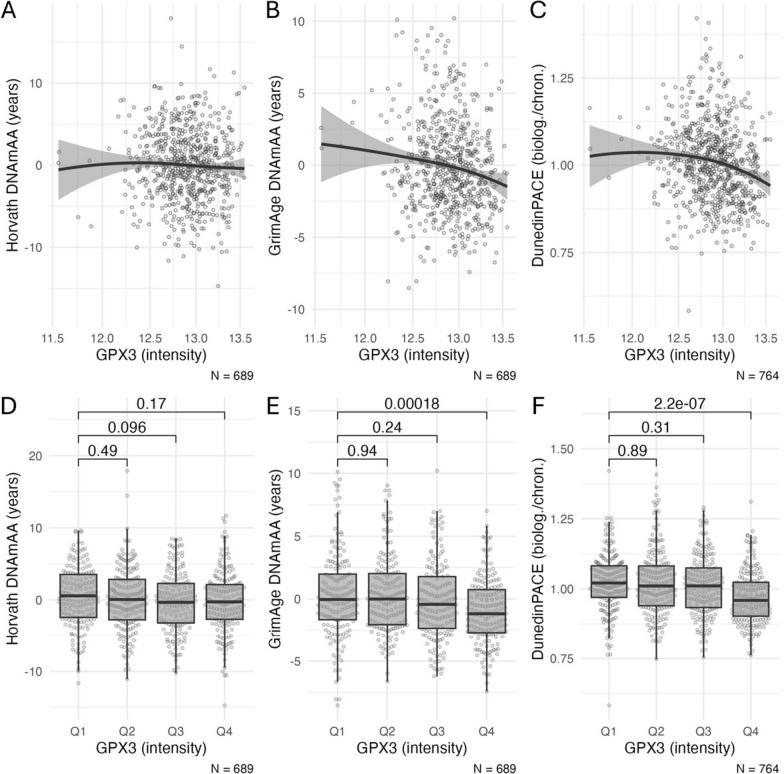
Participants with deficient serum selenium levels (< 90 μg/L) had a higher rate of biological aging (DunedinPACE, β = - 0.02, SE = 0.01, 95% CI - 0.033 to - 0.004, p = 0.010, n = 865). This association remained statistically significant after adjustment for age, sex, BMI, smoking, and first four genetic principal components (β = - 0.02, SE = 0.01, 95% CI - 0.034 to - 0.004, p = 0.012, n = 757). Compared to the highest quartile, participants in the lowest quartile of SELENOP levels showed an accelerated biological aging rate (DunedinPACE, β = - 0.03, SE = 0.01, 95% CI - 0.051 to - 0.008, p = 0.007, n = 740, fully adjusted model). Similarly, after adjustment for confounders, accelerated biological age was found in participants within the lowest GPx3 quartile compared to participants in the fourth quartile (DunedinPACE, β = - 0.04, SE = 0.01, 95% CI - 0.06 to - 0.02, p = 0.001, n = 674 and GrimAge, β = - 0.98, SE = 0.32, 95% CI - 1.6 to - 0.4, p = 0.002, n = 608). Only the association with GPx3 remained statistically significant after multiple testing correction.
CONCLUSION
Our study suggests that low levels of selenium biomarkers are associated with accelerated biological aging measured through epigenetic clocks. This effect was not substantially changed after adjustment for known confounders.
背景
生物学年龄反映了个体在生物学功能和能力方面超越实际年龄的个体差异。在本研究中,使用DNA甲基化年龄(DNAmA)及其与实际年龄的偏差,即DNAmA加速度(DNAmAA)(计算为DNAmA在按年龄调整的白细胞计数线性回归中的残差)来估计生物学年龄。血清硒、硒蛋白P(SELENOP)和含硒半胱氨酸的谷胱甘肽过氧化物酶3(GPx3)水平较低与不良健康结果相关,并且讨论了补充硒作为一种抗衰老干预措施。
方法
在本研究中,我们对来自观察性柏林衰老研究II的1568名老年参与者进行了横断面分析(平均年龄±标准差:68.8±3.7岁,51%为女性)。通过全反射X射线荧光(TXRF)光谱法测量血清硒,并通过夹心ELISA法测定SELENOP。使用液相色谱-质谱联用(LC-MS)将GPx3作为蛋白质组学数据集的一部分进行评估。使用线性回归分析来分析硒生物标志物与表观遗传时钟指标之间的关系。每次分析均给出P值和95%置信区间(未针对多重检验进行调整)。
结果
血清硒水平不足(<90μg/L)的参与者生物学衰老率更高(达尼丁PACE,β = -0.02,标准误 = 0.01,95%置信区间 -0.033至-0.004,p = 0.010,n = 865)。在对年龄、性别、体重指数、吸烟和前四个遗传主成分进行调整后,这种关联仍然具有统计学意义(β = -0.02,标准误 = 0.01,95%置信区间 -0.034至-0.004,p = 0.012,n = 757)。与最高四分位数相比,SELENOP水平最低四分位数的参与者显示出生物学衰老率加快(达尼丁PACE,β = -0.03,标准误 = 0.01,95%置信区间 -0.051至-0.008,p = 0.007,n = 740,完全调整模型)。同样,在对混杂因素进行调整后,与第四四分位数的参与者相比,最低GPx3四分位数内的参与者被发现生物学年龄加快(达尼丁PACE,β = -0.04,标准误 = 0.01,95%置信区间 -0.06至-0.02,p = 0.001,n = 674;以及格里姆年龄,β = -0.98,标准误 = 0.32,95%置信区间 -1.6至-0.4,p = 0.002,n = 608)。在进行多重检验校正后,只有与GPx3的关联仍然具有统计学意义。
结论
我们的研究表明,低水平的硒生物标志物与通过表观遗传时钟测量出的生物学衰老加速有关。在对已知混杂因素进行调整后,这种效应没有实质性改变。


 Zotero 插件