
中国深圳儿童呼吸道病原体的流行病学转变:新冠疫情非药物干预措施放宽前后的对比分析
Epidemiological Shifts in Children Respiratory Pathogens in Shenzhen, China: A Comparative Analysis Before and After the Relaxation of COVID-19 Non-Pharmaceutical Interventions.
作者信息
Wang Heping, Guo Yuping, Wang Rongjun, Liu Zihao, Li Li, Li Yuzheng, Bao Yanmin, Wang Wenjian
机构信息
Shenzhen Children's Hospital, Shenzhen, Guangdong, China.
Yudu County Traditional Chinese Medicine Hospital, Ganzhou, Jiangxi, China.
出版信息
Influenza Other Respir Viruses. 2025 Apr;19(4):e70114. doi: 10.1111/irv.70114.
BACKGROUND
The COVID-19 pandemic and associated non-pharmaceutical interventions significantly altered the epidemiology of respiratory pathogens. This study aimed to evaluate the changes in the prevalence and distribution of respiratory pathogens among children with acute respiratory infections (ARIs) before and after the relaxation of COVID-19 restrictions in Shenzhen, China.
METHODS
This study enrolled hospitalized children with ARIs in Shenzhen Children's Hospital during the COVID-19 epidemic and those post-epidemic period. Demographic data of the patients enrolled were retrieved from the Shenzhen Children's Hospital electronic patient dossiers. Nasopharyngeal swabs were collected and detected for 11 pathogens, and epidemiological trends were analyzed by age, season, and pathogen distribution.
RESULTS
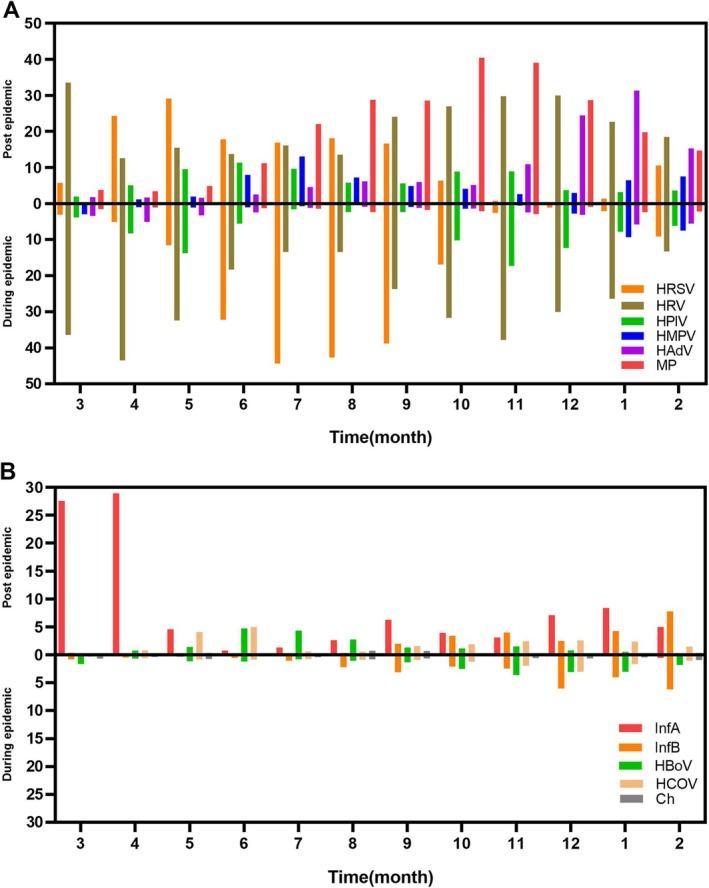
A total of 40,174 children with ARIs were enrolled, including 14,816 during the COVID-19 epidemic and 25,358 in the post-epidemic period. Hospital admissions for ARIs increased by 71.2% in the post-epidemic period. The median age of patients rose from 27 to 47 months. Pathogen detection rates increased significantly from 59.3% during epidemic period to 73.0% in post-epidemic period (p < 0.001), with co-detection (≥ 2 pathogens) rising from 10.5% to 21.2%. The dominant pathogens shifted from HRV, RSV, and HPIV during COVID-19 epidemic to HRV, MP, and RSV in the post-epidemic. Notably, MP detection rates surged from 1.69% to 20.87%, while RSV and HPIV peaks were replaced by MP and HMPV in winter.
CONCLUSION
The relaxation of COVID-19 non-pharmaceutical interventions led to a significant rebound in ARIs among children, with altered pathogen dominance and increased co-detection.
背景
新型冠状病毒肺炎(COVID-19)大流行及相关非药物干预措施显著改变了呼吸道病原体的流行病学特征。本研究旨在评估中国深圳放宽COVID-19限制措施前后,急性呼吸道感染(ARI)儿童中呼吸道病原体的流行率和分布变化。
方法
本研究纳入了COVID-19疫情期间及疫情后在深圳儿童医院住院的ARI儿童。从深圳儿童医院电子病历中检索所纳入患者的人口统计学数据。采集鼻咽拭子并检测11种病原体,并按年龄、季节和病原体分布分析流行病学趋势。
结果
共纳入40174例ARI儿童,其中COVID-19疫情期间14816例,疫情后25358例。疫情后ARI的住院人数增加了71.2%。患者的中位年龄从27个月升至47个月。病原体检测率从疫情期间的59.3%显著增至疫情后的73.0%(p<0.001),合并检测(≥2种病原体)从10.5%升至21.2%。优势病原体从COVID-19疫情期间的人鼻病毒(HRV)、呼吸道合胞病毒(RSV)和人副流感病毒(HPIV)转变为疫情后的HRV、肺炎支原体(MP)和RSV。值得注意的是,MP检测率从1.69%激增至20.87%,而冬季RSV和HPIV的高峰被MP和人偏肺病毒(HMPV)取代。
结论
放宽COVID-19非药物干预措施导致儿童ARI显著反弹,病原体优势改变且合并检测增加。

 Zotero 插件