
新冠疫情对疫情前创伤幸存者的压力、创伤后应激障碍及前额叶皮质厚度的影响
COVID-19 Pandemic Impacts on STRESS, PTSD, and Prefrontal Cortical Thickness in Pre-Pandemic Trauma Survivors.
作者信息
Chandra Sharad, Amer Atheer, Shih Chia-Hao, Shao Qin, Wang Xin, Xie Hong
机构信息
Department of Neurosciences and Psychiatry, University of Toledo College of Medicine and Life Sciences, Toledo, OH 43614, USA.
Department of Emergency Medicine, University of Toledo College of Medicine and Life Sciences, Toledo, OH 43614, USA.
出版信息
J Pers Med. 2025 Mar 26;15(4):127. doi: 10.3390/jpm15040127.
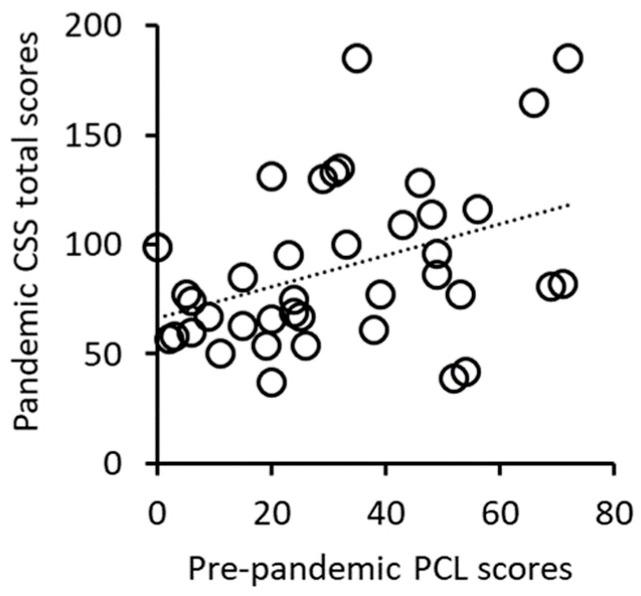
: The COVID-19 pandemic increased psychiatric symptoms in patients with pre-pandemic mental health conditions. However, the effects of pandemic on the brain, stress, and mental illness remain largely conjectural. Our objective was to examine how the pandemic affected prefrontal cortical thicknesses (CTs), stress, and PTSD symptoms in people with pre-pandemic trauma histories. : Fifty-one survivors from a pre-pandemic trauma study who had completed a pre-pandemic PTSD Checklist-5 (PCL) to assess PTSD symptoms and a sMRI scan to measure prefrontal CTs were re-recruited after the pandemic. They subsequently completed the COVID Stress Scale (CSS) to assess stress, the Clinician Administered PTSD Scale-5 (CAPS) to diagnose PTSD, and a second sMRI scan. COVID-19 infection was self-reported. Associations between stress and symptom assessments and post-pandemic CTs, differences in CTs in PTSD vs. non-PTSD groups, and changes in pre- to post-pandemic CTs were examined. : Pre-pandemic PCL scores were positively associated with CSS scores which, in turn, were higher in the PTSD group. Thicker IFG-opercularis CTs were associated with COVID-19 infection. Post-pandemic rMFG and IFG-orbitalis CTs were positively associated with CAPS scores. rACC CTs were negatively associated with CSS scores. Pre- to post-pandemic rMFG and frontal pole CTs thickened in the PTSD group but thinned in the non-PTSD group, whereas rACC CTs thinned in the PTSD group but thickened in the non-PTSD group. : These findings provide novel evidence that the COVID-19 pandemic had diverse effects involving prefrontal cortex structure, stress, and PTSD symptoms in subjects with pre-pandemic trauma history and suggest that treatments are needed to counter these diverse effects.
新冠疫情增加了疫情前就有心理健康问题患者的精神症状。然而,疫情对大脑、压力和精神疾病的影响在很大程度上仍是推测性的。我们的目的是研究疫情如何影响有疫情前创伤史人群的前额叶皮质厚度(CT)、压力和创伤后应激障碍(PTSD)症状。
在疫情爆发后,重新招募了51名来自疫情前创伤研究的幸存者,他们在疫情前完成了创伤后应激障碍检查表-5(PCL)以评估PTSD症状,并进行了结构磁共振成像(sMRI)扫描以测量前额叶CT。随后,他们完成了新冠压力量表(CSS)以评估压力,临床医生管理的创伤后应激障碍量表-5(CAPS)以诊断PTSD,并进行了第二次sMRI扫描。新冠病毒感染情况由患者自我报告。研究了压力与症状评估和疫情后CT之间的关联、PTSD组与非PTSD组CT的差异以及疫情前到疫情后CT的变化。
疫情前的PCL得分与CSS得分呈正相关,而CSS得分在PTSD组中更高。岛盖部额下回(IFG-opercularis)CT更厚与新冠病毒感染有关。疫情后的额中回(rMFG)和眶部额下回(IFG-orbitalis)CT与CAPS得分呈正相关。前扣带回皮质(rACC)CT与CSS得分呈负相关。疫情前到疫情后,PTSD组的rMFG和额极CT增厚,而非PTSD组变薄,而rACC CT在PTSD组变薄,但在非PTSD组增厚。
这些发现提供了新的证据,表明新冠疫情对有疫情前创伤史的受试者的前额叶皮质结构、压力和PTSD症状产生了多种影响,并表明需要采取治疗措施来应对这些多种影响。



 Zotero 插件