
心肺运动试验在预测肺切除患者术后发病率和死亡率中的实际作用
The Actual Role of CPET in Predicting Postoperative Morbidity and Mortality of Patients Undergoing Pneumonectomy.
作者信息
Mazzella Antonio, Orlandi Riccardo, Maisonneuve Patrick, Uslenghi Clarissa, Chiari Matteo, Casiraghi Monica, Bertolaccini Luca, Caffarena Giovanni, Spaggiari Lorenzo
机构信息
Division of Thoracic Surgery, IEO European Institute of Oncology, IRCCS, 20141 Milan, Italy.
Division of Epidemiology and Biostatistics, IEO European Institute of Oncology, IRCCS, 20141 Milan, Italy.
出版信息
J Pers Med. 2025 Mar 31;15(4):136. doi: 10.3390/jpm15040136.
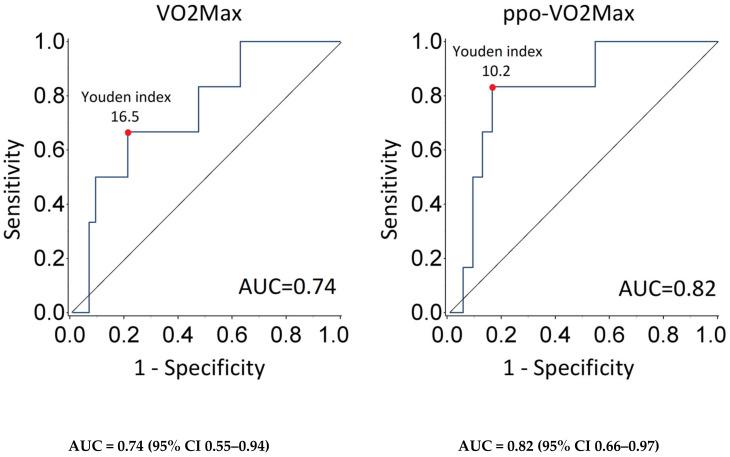
This study aims to determine whether maximal oxygen consumption (VO2max) or predicted postoperative (ppo)-VO2max could still reliably predict postoperative complications and deaths in lung cancer patients undergoing pneumonectomy and which values could be more reliably considered as the optimal threshold. : We retrospectively collected data of consecutive patients undergoing pneumonectomy for primary lung cancer at the European Oncological Institute (April 2019-April 2023). Routine preoperative assessment included cardiopulmonary exercise testing (CPET) and a lung perfusion scan. We evaluated the morbidity and mortality rates; associations between morbidity, mortality, VO2max, and ppoVO2max values were investigated through ANOVA or Fisher's exact test as appropriate. Receiver operating characteristic (ROC) curves were applied to further explore the relation between VO2max, ppoVO2max values, and 90-day mortality. : The cardiopulmonary morbidity rate was 32.2%; the 30-day and 90-day mortality rates were 2.2% and 6.7%. The PpoVO2max values were significantly lower in patients experiencing cardiopulmonary complications or deaths compared to the whole cohort, whereas VO2max, though showing a trend towards lower values, did not reach statistical significance. A VO2max value threshold of 15 mL/kg/min correlated significantly with 90-day mortality, while a ppoVO2max cut-off of 10 mL/kg/min was significantly associated with cardiopulmonary complications and 30-day and 90-day mortality rates. ROC curve analysis revealed ppoVO2max as a better predictor of 90-day mortality compared to VO2max. : CPET and a lung perfusion scan are two key elements for the preoperative evaluation of patients undergoing pneumonectomy, since it provides a holistic assessment of cardiopulmonary functionality. We recommend the routine calculation of ppoVO2max, particularly when adopting a 10 mL/kg/min threshold.
本研究旨在确定最大摄氧量(VO2max)或预测术后(ppo)-VO2max是否仍能可靠地预测接受肺叶切除术的肺癌患者的术后并发症和死亡情况,以及哪些值可更可靠地视为最佳阈值。:我们回顾性收集了欧洲肿瘤研究所(2019年4月至2023年4月)连续接受原发性肺癌肺叶切除术患者的数据。常规术前评估包括心肺运动试验(CPET)和肺灌注扫描。我们评估了发病率和死亡率;通过方差分析或Fisher精确检验(视情况而定)研究发病率、死亡率、VO2max和ppoVO2max值之间的关联。应用受试者工作特征(ROC)曲线进一步探讨VO2max、ppoVO2max值与90天死亡率之间的关系。:心肺发病率为32.2%;30天和90天死亡率分别为2.2%和6.7%。与整个队列相比,发生心肺并发症或死亡的患者的ppoVO2max值显著更低,而VO2max虽然显示出值较低的趋势,但未达到统计学意义。VO2max值阈值为15 mL/kg/min与90天死亡率显著相关,而ppoVO2max临界值为10 mL/kg/min与心肺并发症以及30天和90天死亡率显著相关。ROC曲线分析显示,与VO2max相比,ppoVO2max是90天死亡率的更好预测指标。:CPET和肺灌注扫描是接受肺叶切除术患者术前评估的两个关键要素,因为它能对心肺功能进行全面评估。我们建议常规计算ppoVO2max,尤其是采用10 mL/kg/min阈值时。
 Zotero 插件