
首次通过乳房X光检查发现的癌症预示着被诊断为乳腺癌的年轻女性的生存期更差。
First mammogram-detected cancers portend worse survival in young women diagnosed with breast cancer.
作者信息
Wilkerson Avia D, Obi Megan, Gentle Corey, Wei Wei, Ortega Camila, Al-Hilli Zahraa
机构信息
Department of General Surgery, Digestive Disease and Surgery Institute, Cleveland Clinic, 9500 Euclid Avenue/A10 Cleveland, Cleveland, OH, 44195, USA.
Department of Quantitative Health Sciences, Cleveland Clinic, Cleveland, OH, USA.
出版信息
Breast Cancer Res Treat. 2025 Jul;212(1):87-95. doi: 10.1007/s10549-025-07703-9. Epub 2025 Apr 25.
PURPOSE
Breast cancer (BC) screening guidelines for women ages 40-45 have differed across multiple organizations, resulting in variable ages of screening commencement among women in the US. We previously reported that delay in screening beyond age 40 increases risk for first mammogram cancer diagnoses. We hypothesize that first mammogram cancer detection may also diminish recurrence-free and overall survival (RFS, OS).
STUDY DESIGN
This retrospective cohort study included 738 women diagnosed with BC from ages 40-45 years and treated within a single hospital system from 2010 to 2019. First mammogram cancers were defined as those with tissue diagnoses established within 3 months of baseline mammogram. RFS after surgery and OS after BC diagnosis were analyzed in patients diagnosed on first versus subsequent mammograms via the Kaplan-Meier method, with p-values generated by log rank tests. Cumulative incidences of local and distant recurrence were also assessed.
RESULTS
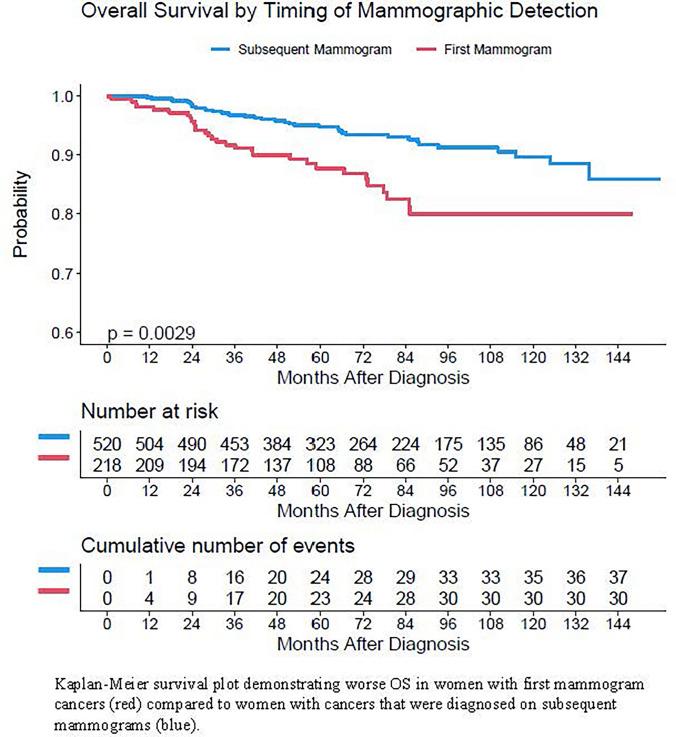
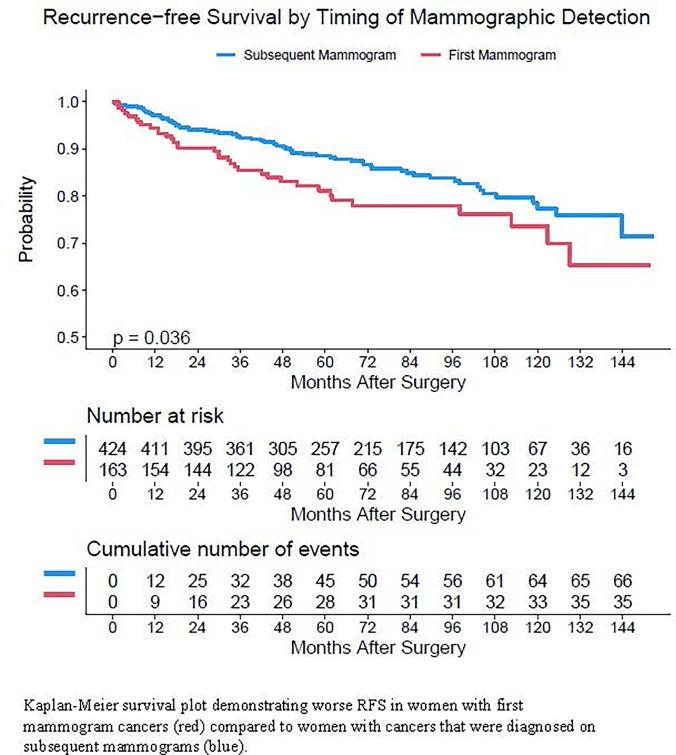
Of 738 women, 218 had first mammogram cancers while 520 were diagnosed on subsequent mammograms. Median follow-up was 72.2 months (0.5-155.8 months). At 5 and 10 years after diagnosis, OS was significantly worse in patients diagnosed on their first mammogram (0.88 [0.83-0.93] and 0.80 [0.73-0.87]) versus subsequent mammograms (0.95 [0.93-0.97] and 0.90 [0.86-0.93]), p = 0.003. Patients with first mammogram cancers also had inferior 5- and 10-years RFS rates (0.81 [0.71-0.88] and 0.74 [0.65-0.83] vs. 0.88 [0.85-0.92] and 0.77 [0.72-0.83]), p = 0.04.
CONCLUSION
First mammogram cancers were associated with worse survival in our study cohort, reinforcing the importance of consistent guidelines for screening commencement at age 40.
目的
40至45岁女性的乳腺癌(BC)筛查指南在多个组织中存在差异,导致美国女性开始筛查的年龄各不相同。我们之前报告过,40岁以后延迟筛查会增加首次乳房X光检查癌症诊断的风险。我们推测,首次乳房X光检查发现癌症也可能降低无复发生存期和总生存期(RFS,OS)。
研究设计
这项回顾性队列研究纳入了2010年至2019年期间在单一医院系统接受治疗的738名40至45岁被诊断为BC的女性。首次乳房X光检查癌症定义为在基线乳房X光检查后3个月内确诊的组织诊断病例。通过Kaplan-Meier方法分析首次乳房X光检查与后续乳房X光检查确诊患者手术后的RFS和BC诊断后的OS,通过对数秩检验生成p值。还评估了局部和远处复发的累积发生率。
结果
在738名女性中,218例为首次乳房X光检查发现癌症,520例为后续乳房X光检查确诊。中位随访时间为72.2个月(0.5至155.8个月)。诊断后5年和10年时,首次乳房X光检查确诊患者的OS明显差于后续乳房X光检查确诊患者(分别为0.88 [0.83至0.93]和0.80 [0.73至0.87] vs. 0.95 [0.93至0.97]和0.90 [0.86至0.93]),p = 0.003。首次乳房X光检查发现癌症的患者5年和10年RFS率也较低(分别为0.81 [0.71至0.88]和0.74 [0.65至0.83] vs. 0.88 [0.85至0.92]和0.77 [0.72至0.83]),p = 0.04。
结论
在我们的研究队列中,首次乳房X光检查发现癌症与较差的生存率相关,这进一步强调了40岁开始筛查的统一指南的重要性。
 Zotero 插件