
基于数据非依赖采集和平行反应监测的糖尿病视网膜病变患者房水中的阶段依赖性蛋白质组学改变
Stage-dependent proteomic alterations in aqueous humor of diabetic retinopathy patients based on data-independent acquisition and parallel reaction monitoring.
作者信息
Jin Yeanqi, Liu Junbin, Zhang Xueli, Zhang Liang, Cui Ying, Luo Xiaoyang, Zhu Haoxian, Chen Zhifan, Liu Mengya, Wu Xiyu, Chen Xinyu, Liao Shuoxin, Wu Guanrong, Fang Xiang, Meng Qianli
机构信息
Department of Ophthalmology, Guangdong Eye Institute, Guangdong Provincial People's Hospital (Guangdong Academy of Medical Sciences), Southern Medical University, Guangzhou, China.
School of Medicine, South China University of Technology, Guangzhou, China.
出版信息
J Transl Med. 2025 Apr 25;23(1):476. doi: 10.1186/s12967-025-06452-z.
BACKGROUND
Diabetic retinopathy (DR), a microvascular complication of diabetes mellitus (DM), represents the predominant cause of preventable vision loss in working-age populations globally. While the pathophysiological mechanisms underlying DR progression remain incompletely understood, our study employs comprehensive proteomic profiling of aqueous humor (AH) to identify stage-specific biomarkers and therapeutic targets in type 2 diabetes mellitus (T2DM) patients across DR progression.
METHODS
Utilizing data-independent acquisition (DIA) mass spectrometry, we quantified AH proteomes in a discovery cohort comprising 24 subjects: 18 T2DM patients stratified by DR severity [6 non-DR, 6 non-proliferative DR (NPDR), 6 proliferative DR (PDR)] and 6 cataract controls without diabetes (non-DM). Validation cohort analysis (including 10 AH samples in each group) was performed using parallel reaction monitoring (PRM) strategy for verification of target proteins. Comprehensive bioinformatics analyses included gene set enrichment analysis (GSEA), weighted gene co-expression network analysis (WGCNA), Kyoto encyclopedia of genes and genomes (KEGG) enrichment analysis, protein-protein interaction (PPI) network construction, receiver operating characteristic (ROC) curve analysis, and ConnectivityMap (Cmap)-based drug prediction.
RESULTS
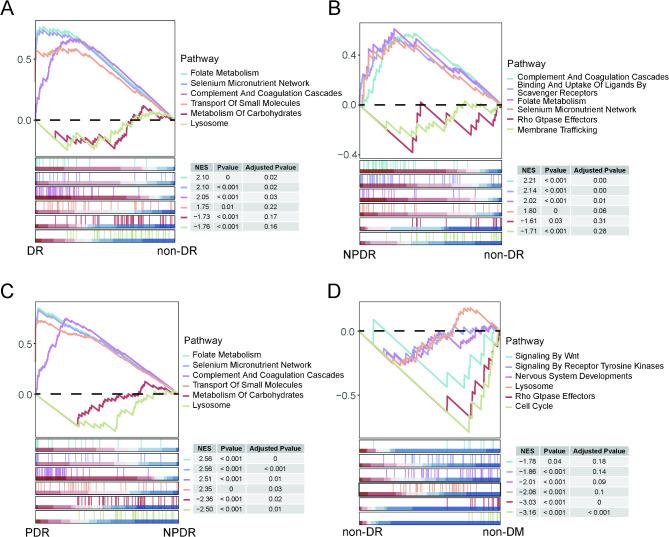
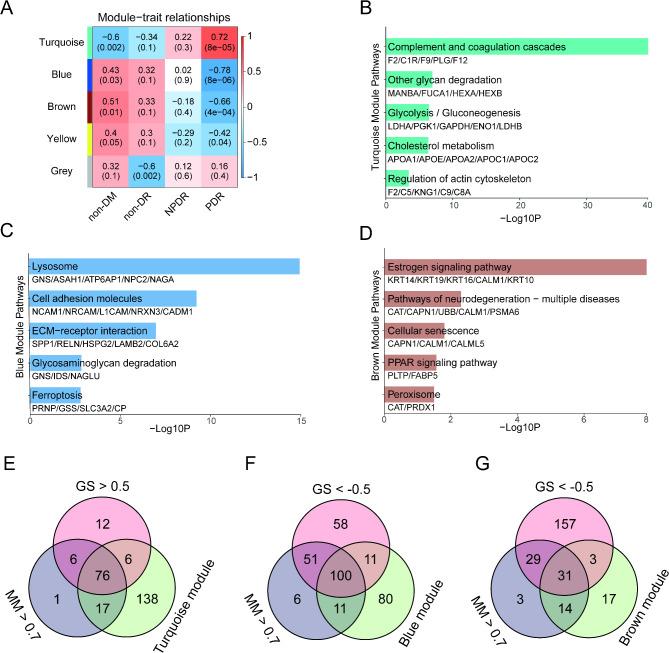
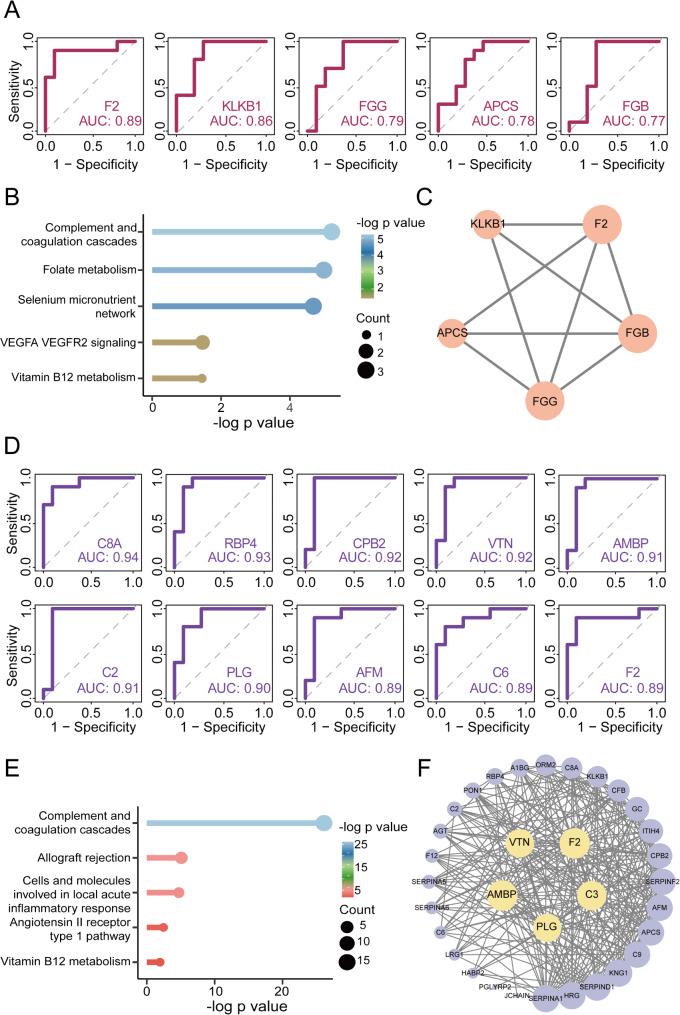
Proteomic profiling identified 739 quantifiable AH proteins (62% extracellular) with clear separation among the four clinical stages in the discovery cohort. GSEA uncovered altered expression of proteins mainly related to complement and coagulation cascades, folate metabolism, and the selenium micronutrient network in patients with DR. WGCNA-derived protein modules yielded 83 PRM-validated targets, including 5 hub proteins differentiating NPDR from non-DR and 33 hub proteins showed significant upregulation in PDR versus NPDR comparison. Clinical correlation analysis identified F2, FGG, FGB, RBP4, AMBP, VTN, C8A, CPB2, and C2 associated with clinical traits. C6, FAM3C, SPP1, and JCHAIN levels were altered post-anti-VEGF treatment. Pharmacological prediction identified potential therapeutic compounds, including perindopril, triciribine, and XAV-939 for NPDR, and topiramate, triciribine, and vecuronium for PDR.
CONCLUSION
This study established a comprehensive AH proteomic signature of DR progression, offering insights into the pathogenesis of DR and highlighting potential biomarkers and novel therapeutic targets.
背景
糖尿病视网膜病变(DR)是糖尿病(DM)的一种微血管并发症,是全球劳动年龄人群可预防视力丧失的主要原因。虽然DR进展的病理生理机制仍未完全了解,但我们的研究采用房水(AH)的综合蛋白质组分析来识别2型糖尿病(T2DM)患者在DR进展过程中的阶段特异性生物标志物和治疗靶点。
方法
利用数据非依赖采集(DIA)质谱法,我们在一个包含24名受试者的发现队列中对AH蛋白质组进行了定量分析:18名T2DM患者按DR严重程度分层[6名非DR、6名非增殖性DR(NPDR)、6名增殖性DR(PDR)]和6名无糖尿病(非DM)的白内障对照。使用平行反应监测(PRM)策略进行验证队列分析(每组包括10个AH样本)以验证目标蛋白。综合生物信息学分析包括基因集富集分析(GSEA)、加权基因共表达网络分析(WGCNA)、京都基因与基因组百科全书(KEGG)富集分析、蛋白质-蛋白质相互作用(PPI)网络构建、受试者工作特征(ROC)曲线分析以及基于连接图谱(Cmap)的药物预测。
结果
蛋白质组分析在发现队列的四个临床阶段中识别出739种可定量的AH蛋白(62%为细胞外蛋白),且有明显区分。GSEA发现DR患者中主要与补体和凝血级联、叶酸代谢以及硒微量营养素网络相关的蛋白表达发生改变。WGCNA衍生的蛋白质模块产生了83个经PRM验证的靶点,包括5个区分NPDR与非DR的枢纽蛋白,以及33个在PDR与NPDR比较中显著上调的枢纽蛋白。临床相关性分析确定F2、FGG、FGB、RBP4、AMBP、VTN、C8A、CPB2和C2与临床特征相关。抗VEGF治疗后C6、FAM3C、SPP1和JCHAIN水平发生改变。药物预测确定了潜在的治疗化合物,包括用于NPDR的培哚普利、曲西立滨和XAV - 939,以及用于PDR的托吡酯、曲西立滨和维库溴铵。
结论
本研究建立了DR进展的综合AH蛋白质组特征,为DR的发病机制提供了见解,并突出了潜在的生物标志物和新的治疗靶点。




 Zotero 插件