
药物与非药物技术支持的戒烟干预措施的有效性及依从性:一项系统综述
Effectiveness and Adherence of Pharmacological vs. Non-Pharmacological Technology-Supported Smoking Cessation Interventions: An Umbrella Review.
作者信息
Di Spirito Federica, Di Palo Maria Pia, Garofano Marina, Del Sorbo Rosaria, Allegretti Gianluca, Rizki Iman, Bartolomeo Marianna, Giordano Massimo, Amato Massimo, Bramanti Alessia
机构信息
Department of Medicine, Surgery and Dentistry, University of Salerno, Via S. Allende, 84081 Baronissi, Italy.
出版信息
Healthcare (Basel). 2025 Apr 21;13(8):953. doi: 10.3390/healthcare13080953.
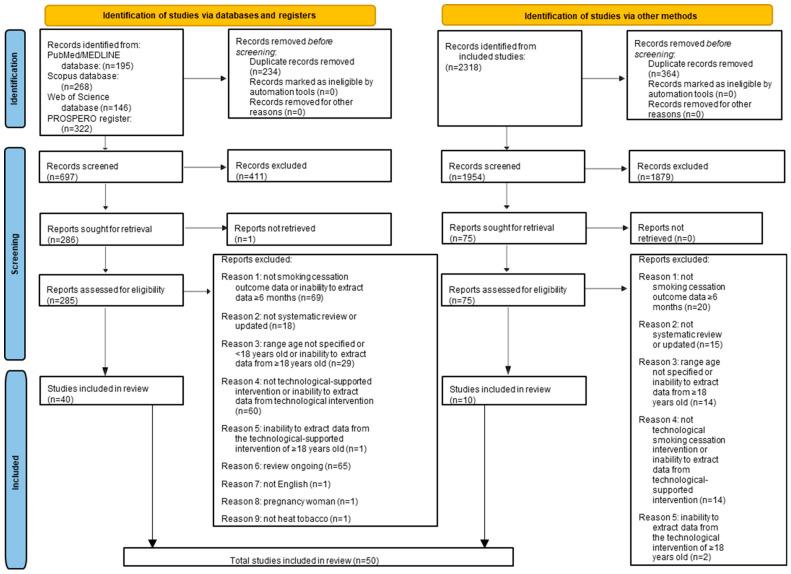
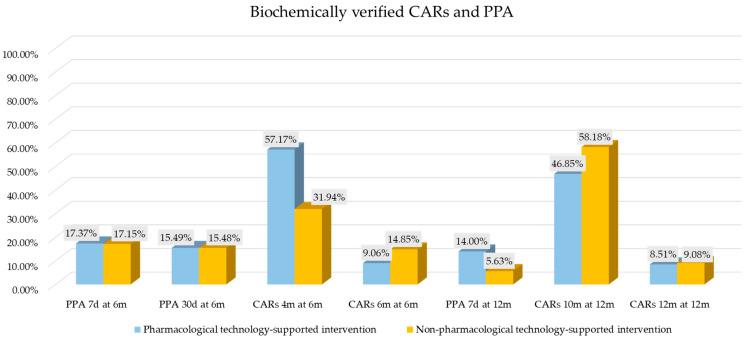
: Smoking cessation has a crucial public health role. To overcome non-technological and technology-based smoking cessation intervention limitations, technology-supported programs were developed. : The present umbrella review aimed to evaluate the long-term effectiveness (≥6 months) of pharmacological vs. non-pharmacological technology-supported smoking cessation interventions on adult daily smokers and the related human health benefits. : Following PRISMA guidelines, the protocol was registered on PROSPERO (CRD42024601824). Fifty systematic reviews were included, evaluated through AMSTAR-2, and qualitatively synthesized. : A total of 69,269 smokers underwent pharmacological (39,367) and non-pharmacological (29,902) technology-supported interventions. The biochemically-verified effectiveness assessed as continuous abstinence rates (CARs) and seven-day point prevalence abstinence (PPA) of pharmacological vs. non-pharmacological at 6 and 12 months were, respectively, CARs 9.06% vs. 14.85%, 7-day PPA 17.37% vs. 17.15%; CARs 8.51% vs. 9.08%, 7-day PPA 14.00% vs. 5.63%. The 6-month adherence rates were higher in the non-pharmacological group (41.37% vs. 83.43%). : Non-pharmacological technology-supported interventions showed similar effectiveness and higher adherence at 6 months. At 12 months, the CARs were similar despite lower adherence. Adherence quality and consistency may be important for sustained success, probably due to the "reverse causality". Non-pharmacological interventions showed similar effectiveness, lower costs, and shorter durations than pharmacological interventions.
戒烟在公共卫生中具有关键作用。为克服基于非技术和技术的戒烟干预措施的局限性,开发了技术支持项目。本综合评价旨在评估药物性与非药物性技术支持的戒烟干预措施对成年每日吸烟者的长期有效性(≥6个月)以及相关的人类健康益处。遵循PRISMA指南,该方案已在PROSPERO(CRD42024601824)上注册。纳入了50项系统评价,通过AMSTAR-2进行评估,并进行了定性综合分析。共有69269名吸烟者接受了药物性(39367名)和非药物性(29902名)技术支持的干预措施。在6个月和12个月时,以持续戒烟率(CARs)和七天点流行率戒烟率(PPA)评估的药物性与非药物性干预措施经生化验证的有效性分别为:CARs为9.06%对14.85%,七天PPA为17.37%对17.15%;CARs为8.51%对9.08%,七天PPA为14.00%对5.63%。非药物性组的6个月依从率更高(41.37%对83.43%)。非药物性技术支持的干预措施在6个月时显示出相似的有效性和更高的依从性。在12个月时,尽管依从性较低,但CARs相似。依从性的质量和一致性可能对持续成功很重要,这可能是由于“反向因果关系”。非药物性干预措施显示出与药物性干预措施相似的有效性、更低的成本和更短的持续时间。

 Zotero 插件