
运动训练后绝经前女性抗氧化能力与血管血流动力学之间的关联
Association Between Antioxidant Capacity and Vascular Hemodynamics in Premenopausal Women Following Exercise Training.
作者信息
Fisher Gordon, Tamhane Aparna, Moellering Douglas R, Behrens Christian E, Hunter Gary R
机构信息
Department of Human Studies, University of Alabama at Birmingham, Birmingham, Alabama, USA.
Nutrition Sciences, University of Alabama at Birmingham, Birmingham, Alabama, USA.
出版信息
J Clin Hypertens (Greenwich). 2025 Apr;27(4):e70046. doi: 10.1111/jch.70046.
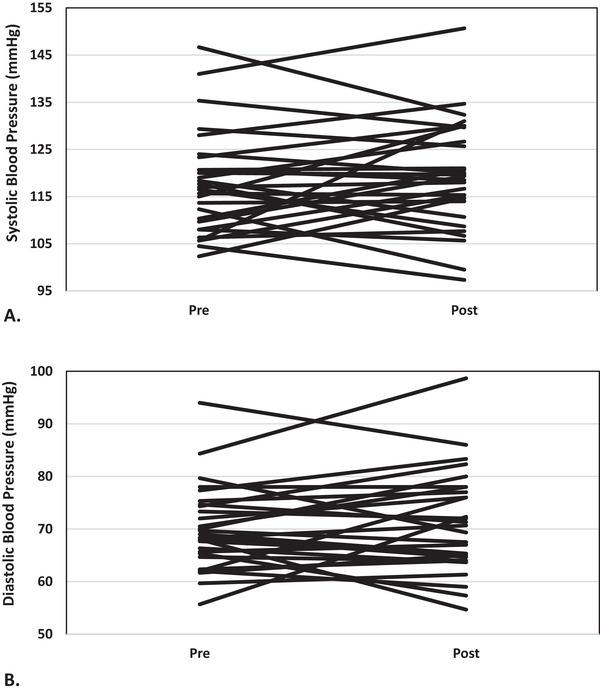
Oxidative stress plays a role in vascular dysfunction and cardiometabolic health. The purpose of this study was to assess the effects of aerobic exercise training on antioxidant capacity (ferric reducing ability of plasma/FRAP) and hemodynamic measures: systolic blood pressure (∆SBP), diastolic blood pressure (∆DBP), mean arterial blood pressure (∆MAP), large arterial elasticity index (∆LAEI), and small arterial elasticity index (∆SAEI) in a cohort of healthy women. This was a secondary data analysis of a study designed to evaluate cardiometabolic outcomes. Participants performed supervised aerobic exercise 3 times/week on a stationary cycle ergometer. FRAP and hemodynamic measures were measured baseline and post-training. The analysis included 15 African American and 14 Caucasian women aged 32.2 ± 5.5 years. No significant changes were observed for FRAP or hemodynamic measures. However, significant negative correlations between ∆FRAP and ∆SBP, ∆DBP, and MAP, as well as a positive correlation with ∆SAEI and ∆LAEI were observed. ∆SBP, ∆DBP, and ∆MAP were each modeled with three multiple regression models: (1) ∆FRAP, ∆SAEI, and ∆LAEI as independent variables. All models had significant R. ∆FRAP was significantly related to ∆DBP and ∆MAP after adjusting for ∆SAEI and ∆LAEI (partial R -0.38 and -0.32 respectively). ∆SAEI was independently related to ∆SBP (partial -0.32) and ∆MAP (partial -0.34). ∆LAEI was independently related to ∆SBP (partial -0.36) and ∆MAP (partial -0.40). ∆FRAP is significantly associated with lowered blood pressure and elevated arterial elasticity. While multiple regression analysis suggests that at least some of the lowered blood pressure is achieved through processes associated with increased arterial elasticity.
氧化应激在血管功能障碍和心脏代谢健康中起作用。本研究的目的是评估有氧运动训练对一组健康女性抗氧化能力(血浆铁还原能力/FRAP)和血流动力学指标的影响:收缩压(∆SBP)、舒张压(∆DBP)、平均动脉压(∆MAP)、大动脉弹性指数(∆LAEI)和小动脉弹性指数(∆SAEI)。这是一项旨在评估心脏代谢结局的研究的二次数据分析。参与者每周在固定自行车测力计上进行3次有监督的有氧运动。在基线和训练后测量FRAP和血流动力学指标。分析包括15名非裔美国女性和14名年龄在32.2±5.5岁的白人女性。未观察到FRAP或血流动力学指标有显著变化。然而,观察到∆FRAP与∆SBP、∆DBP和MAP之间存在显著负相关,与∆SAEI和∆LAEI之间存在正相关。∆SBP、∆DBP和∆MAP分别用三个多元回归模型进行建模:(1)以∆FRAP、∆SAEI和∆LAEI作为自变量。所有模型的R均显著。在调整∆SAEI和∆LAEI后,∆FRAP与∆DBP和∆MAP显著相关(偏R分别为-0.38和-0.32)。∆SAEI与∆SBP(偏-0.32)和∆MAP(偏-0.34)独立相关。∆LAEI与∆SBP(偏-0.36)和∆MAP(偏-0.40)独立相关。∆FRAP与血压降低和动脉弹性升高显著相关。虽然多元回归分析表明,至少部分血压降低是通过与动脉弹性增加相关的过程实现的。

 Zotero 插件