
白杨素-6-O-岩藻糖苷对过氧化物酶体增殖物激活受体γ的选择性活性
Selective Activity of Chrysin-6--Fucopyranoside from Toward Peroxisome Proliferator-Activated Receptor Gamma.
作者信息
Zuccolo Marco, Bassoli Angela, Borgonovo Gigliola, Giupponi Luca, Giorgi Annamaria, Moriello Aniello Schiano, Iannotti Fabio Arturo
机构信息
Centre of Applied Studies for the Sustainable Management and Protection of Mountain Areas-CRC Ge.S.Di.Mont., Università degli Studi di Milano, 25048 Edolo, Italy.
Department of Agricultural and Environmental Sciences-Production, Landscape and Agroenergy-DiSAA, Università degli Studi di Milano, 20133 Milan, Italy.
出版信息
Molecules. 2025 Apr 5;30(7):1626. doi: 10.3390/molecules30071626.
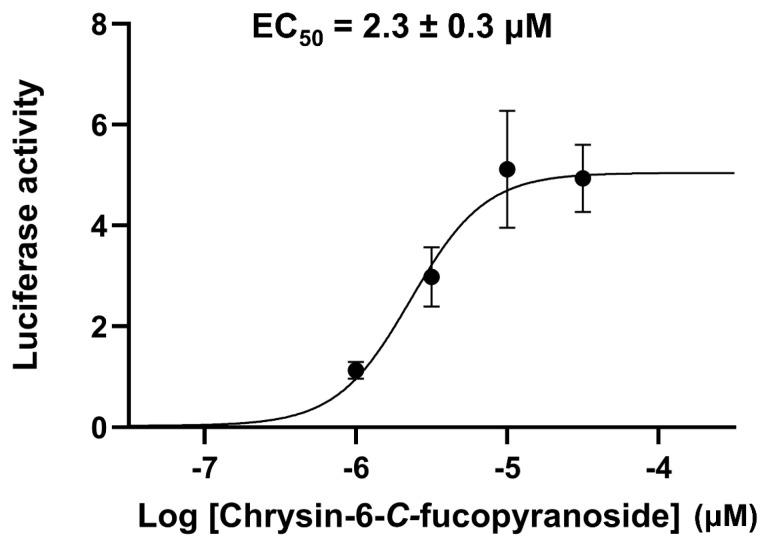
Caigua ( (L.) Schrad.) is a traditional herbal remedy traditionally used in Latin America for its health benefits and to treat metabolic disorders, including diabetes. Despite interest in its herbal use, the phytochemical properties of caigua's secondary metabolites are poorly known. This study aimed to isolate the main flavone glycosides from the leaves of caigua landrace cultivated in the Camonica Valley (Italy) using flash chromatography and evaluate their potential activity toward peroxisome proliferator-activated receptors (PPARs) and transient receptor potential (TRP) ion channels through luciferase and intracellular calcium assays. We found that the caigua species-specific flavone glycoside, chrysin-6--fucopyranoside, showed potent and selective activity toward PPARγ, with no effects on other PPAR subtypes or TRP channels. These findings indicate that the caigua plant could offer a safer alternative to conventional PPARγ agonists, whose use as antidiabetic drugs is limited by severe side effects that currently restrict the clinical use of conventional PPAR agonists.
瓜蒌(Caigua ( (L.) Schrad.))是一种传统草药,在拉丁美洲传统上因其对健康有益且用于治疗包括糖尿病在内的代谢紊乱而被使用。尽管对其草药用途感兴趣,但瓜蒌次生代谢产物的植物化学特性却鲜为人知。本研究旨在通过快速色谱法从意大利卡莫尼卡山谷种植的瓜蒌地方品种叶片中分离主要黄酮苷,并通过荧光素酶和细胞内钙测定评估它们对过氧化物酶体增殖物激活受体(PPARs)和瞬时受体电位(TRP)离子通道的潜在活性。我们发现,瓜蒌物种特异性黄酮苷,白杨素-6--岩藻吡喃糖苷,对PPARγ表现出强效和选择性活性,对其他PPAR亚型或TRP通道无影响。这些发现表明,瓜蒌植物可以为传统PPARγ激动剂提供一种更安全的替代品,传统PPARγ激动剂作为抗糖尿病药物的使用受到严重副作用的限制,这些副作用目前限制了传统PPAR激动剂的临床应用。



 Zotero 插件