
丹参酮IIA通过激活小鼠的Hippo信号通路减轻三邻甲苯基磷酸酯诱导的卵巢损伤。
Tanshinone IIA alleviates tri-ortho-cresyl phosphate-induced ovarian damage through Hippo signaling pathway activation in mice.
作者信息
Ma Zhangqiang, Hu Na, Zheng Liping, Xue Yue, Zhou Chong, Wang Wencan, Cheng Xiu, Luo Tao, Yu Jianlin, Hu Liaoliao
机构信息
School of Public Health, Jiangxi Medical College, Nanchang University, Nanchang, Jiangxi, China.
Jiangxi Provincial Key Laboratory of Disease Prevention and Public Health, Nanchang University, Nanchang, Jiangxi, China.
出版信息
J Ovarian Res. 2025 Apr 26;18(1):85. doi: 10.1186/s13048-025-01671-w.
BACKGROUND
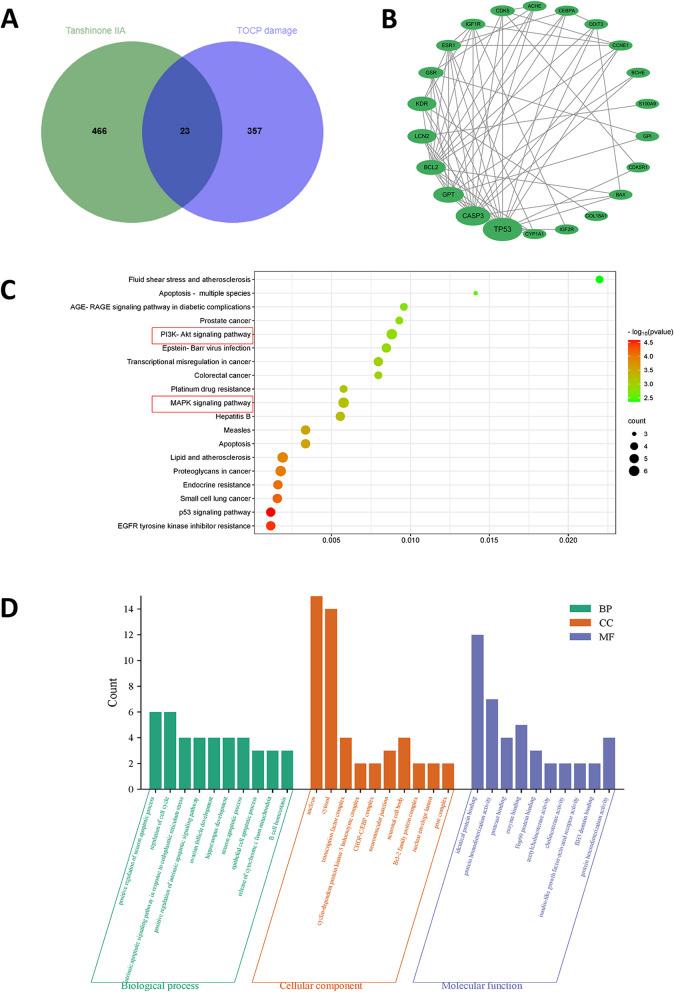
Tri-ortho-cresyl phosphate (TOCP), a widely used plasticizer, has been shown to impair ovarian function. While tanshinone IIA exhibits ovarian protective effects in aging models, its potential to counteract TOCP-induced ovarian damage and associated signaling mechanisms remains unexplored. This study investigates the therapeutic effects of tanshinone IIA on TOCP-damaged ovaries in mice, with focus on Hippo, AKT, and MAPK pathways.
RESULTS
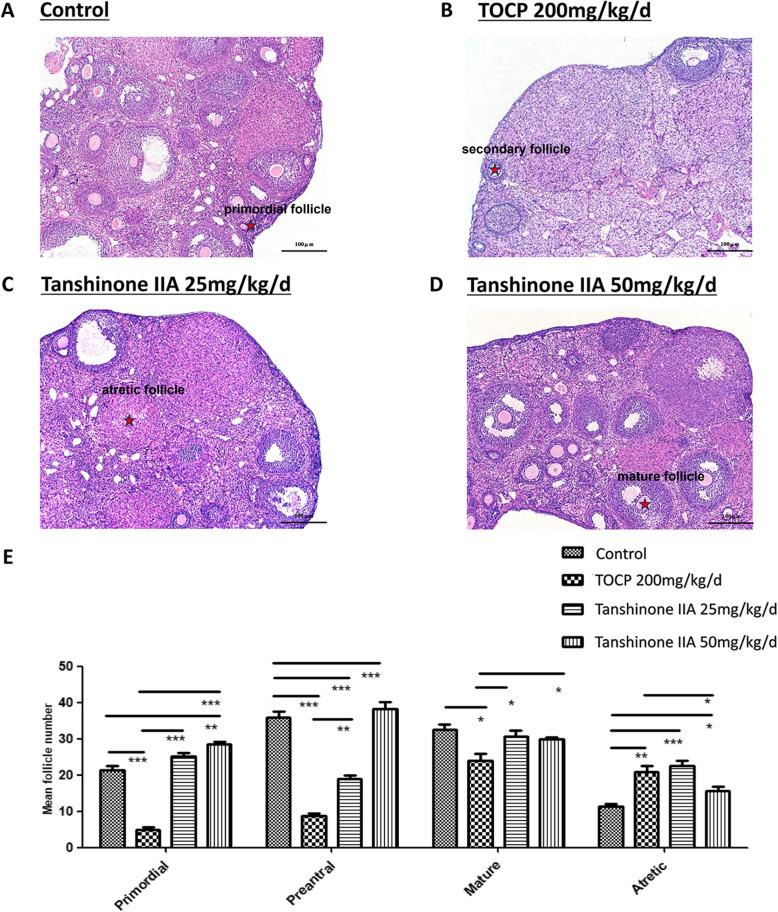
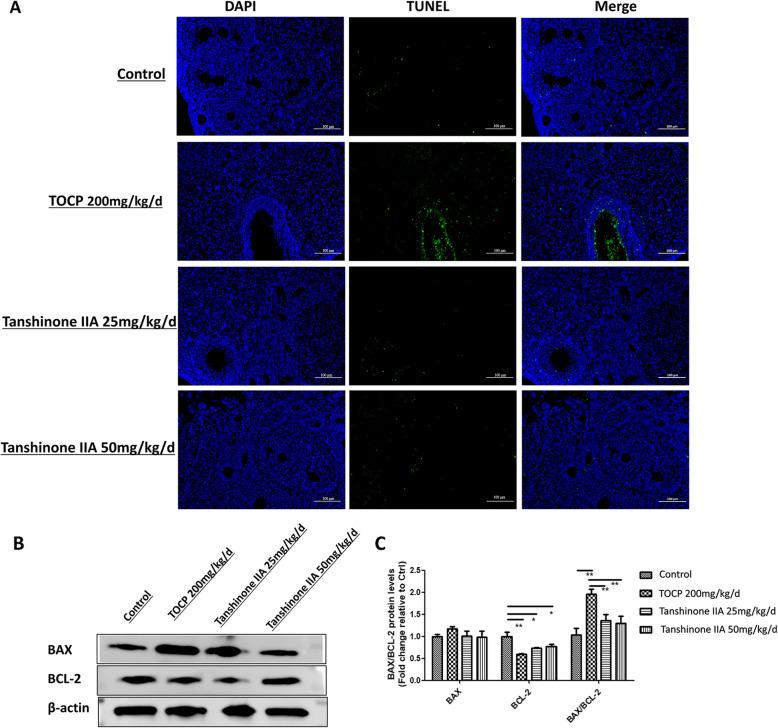
TOCP exposure (200 mg/kg/d for 28 days) significantly reduced ovarian follicle counts (primordial, preovulatory, and mature follicles) and disrupted hormone levels (elevated Estrogen(E2), decreased Follicle stimulating hormone(FSH)/ Anti-Mueller tube hormone(AMH)) in mice. Treatment with high-dose tanshinone IIA restored ovarian structure and function: growing follicle counts increased significantly (p < 0.001), FSH (p < 0.001) and AMH (p < 0.001) levels surged to marked degrees, while E2 (p < 0.001) levels decreased significantly. All changes were statistically significant. Immunohistochemistry and Western blot analysis revealed that tanshinone IIA restored ovarian AMH and Follicle-Stimulating Hormone Receptor (FSHR) protein expression, which were suppressed by TOCP. In vitro experiments further demonstrated that TOCP dose-dependently inhibited granulosa cell viability (p < 0.001) and proliferation (p < 0.001). Co-treatment with tanshinone IIA (0.01 mM) rescued cell viability (p < 0.01) and proliferation (p < 0.05). Mechanistically, tanshinone IIA suppressed ovarian apoptosis (p < 0.01) and modulated multiple signaling pathways: it attenuated Hippo signaling (p < 0.05) and reactivated PI3K/AKT (p < 0.05), p38 (p < 0.05), and ERK1/2 (p < 0.01) pathways.
CONCLUSIONS
Tanshinone IIA alleviates TOCP-induced ovarian dysfunction primarily through coordinated modulation of Hippo signaling and AKT/MAPK pathway activities, offering a potential therapeutic strategy for chemical-induced ovarian injury.
背景
磷酸三邻甲苯酯(TOCP)是一种广泛使用的增塑剂,已被证明会损害卵巢功能。虽然丹参酮IIA在衰老模型中表现出卵巢保护作用,但其对抗TOCP诱导的卵巢损伤及相关信号机制的潜力仍未得到探索。本研究调查了丹参酮IIA对小鼠TOCP损伤卵巢的治疗效果,重点关注Hippo、AKT和MAPK信号通路。
结果
TOCP暴露(200mg/kg/d,持续28天)显著减少了小鼠卵巢卵泡数量(原始卵泡、排卵前卵泡和成熟卵泡),并扰乱了激素水平(雌激素(E2)升高,卵泡刺激素(FSH)/抗苗勒管激素(AMH)降低)。高剂量丹参酮IIA治疗恢复了卵巢结构和功能:生长卵泡数量显著增加(p<0.001),FSH(p<0.001)和AMH(p<0.001)水平大幅上升,而E2(p<0.001)水平显著下降。所有变化均具有统计学意义。免疫组织化学和蛋白质印迹分析表明,丹参酮IIA恢复了卵巢AMH和卵泡刺激素受体(FSHR)蛋白表达,这些表达被TOCP抑制。体外实验进一步证明,TOCP剂量依赖性地抑制颗粒细胞活力(p<0.001)和增殖(p<0.001)。与丹参酮IIA(0.01mM)共同处理可挽救细胞活力(p<0.01)和增殖(p<0.05)。机制上,丹参酮IIA抑制卵巢细胞凋亡(p<0.01)并调节多种信号通路:它减弱了Hippo信号(p<0.05),并重新激活了PI3K/AKT(p<0.05)、p38(p<0.05)和ERK1/2(p<0.01)信号通路。
结论
丹参酮IIA主要通过协同调节Hippo信号和AKT/MAPK信号通路活性来减轻TOCP诱导的卵巢功能障碍,为化学诱导的卵巢损伤提供了一种潜在的治疗策略。






 Zotero 插件