
用于颜色转换发光二极管的固态荧光碳量子点的真空辅助合成
Vacuum-Assisted Synthesis of Solid-State Fluorescent Carbon Quantum Dots for Color Conversion LEDs.
作者信息
Altintas Hikmet, Sahin Tiras Kevser
机构信息
Department of Physics, Faculty of Science, Erciyes University, Kayseri 38030, Turkey.
出版信息
ACS Omega. 2025 Apr 11;10(15):15654-15662. doi: 10.1021/acsomega.5c01047. eCollection 2025 Apr 22.
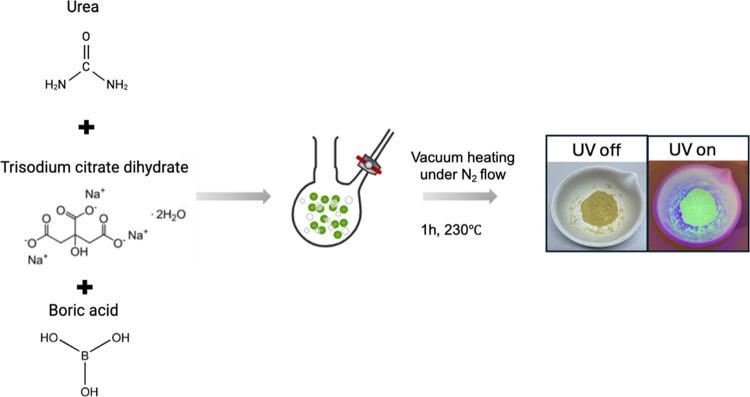
Carbon dots (CDs) are one of the most promising nanomaterials with tunable optical properties and very good biocompatibility, opening wide perspectives in sensing, imaging, and optoelectronic applications. However, fluorescent CDs in powder form that are both adjustable and effective remain a significant issue. Here, we describe a simple, quick, and scalable process for creating solid-state green-emissive CDs using urea and trisodium citrate dihydrate with boric acid as a matrix and no dispersion solvent. The process employs a vacuum-assisted synthesis method, which enhances the molecular interaction between the precursors and ensures uniform dispersion, significantly improving the quality and stability of the final product. CDs embedded in a boric acid matrix (B-CDs) exhibit a photoluminescence quantum yield (PLQY) with a nearly 18% decrease when transitioning from aqueous solution to solid-state films. In contrast, CDs without the boric acid matrix display a significantly lower PLQY in aqueous form and no luminescence in the solid state, highlighting the enhancing effect of the boric acid matrix. By effectively reducing the aggregation-induced quenching, the boric acid matrix's spatial confinement is thought to cause this rise in fluorescence. The resulting B-CD powders exhibit adjustable CIE coordinates and have been used to fabricate color-conversion light-emitting devices on UV chips. The current study presents a viable and scalable approach to solid-state fluorescent CDs that are very stable and efficient. These CDs will find extensive potential use in luminescent devices based on CDs, ranging from flexible lighting systems to color conversion, opening a new era of possibilities.
碳点(CDs)是最具前景的纳米材料之一,具有可调节的光学性质和良好的生物相容性,在传感、成像和光电子应用方面有着广阔的前景。然而,兼具可调节性和有效性的粉末状荧光碳点仍然是一个重大问题。在此,我们描述了一种简单、快速且可扩展的方法,以尿素、二水合柠檬酸三钠和硼酸为基质,不使用分散溶剂来制备固态绿色发光碳点。该方法采用真空辅助合成法,增强了前驱体之间的分子相互作用并确保均匀分散,显著提高了最终产物的质量和稳定性。嵌入硼酸基质中的碳点(B - CDs)从水溶液转变为固态薄膜时,其光致发光量子产率(PLQY)下降了近18%。相比之下,没有硼酸基质的碳点在水溶液形式下的PLQY显著更低,在固态时不发光,这突出了硼酸基质的增强作用。硼酸基质的空间限制被认为是通过有效减少聚集诱导猝灭从而导致荧光增强。所得的B - CD粉末具有可调节的CIE坐标,并已用于在紫外芯片上制造颜色转换发光器件。当前的研究提出了一种可行且可扩展的方法来制备非常稳定且高效的固态荧光碳点。这些碳点在基于碳点的发光器件中具有广泛的潜在用途,从柔性照明系统到颜色转换,开启了一个充满可能性的新时代。



 Zotero 插件