
CALLY指数作为食管鳞状细胞癌术后肺炎的预测工具:一项回顾性队列研究
The CALLY Index as a Predictive Tool for Postoperative Pneumonia in Esophageal Squamous Cell Carcinoma: A Retrospective Cohort Study.
作者信息
Xu Zhiyun, Chen Chen, Zhao Jianqiang, Li Chenglin, Zang Bao, Xiong Xinkui
机构信息
Department of Thoracic Surgery, The Affiliated Huaian No. 1 People's Hospital of Nanjing Medical University, Huai'an, 223300, People's Republic of China.
出版信息
J Inflamm Res. 2025 Apr 23;18:5463-5475. doi: 10.2147/JIR.S517074. eCollection 2025.
BACKGROUND
Esophageal Squamous Cell Carcinoma poses a significant global health challenge, with postoperative pneumonia being a critical complication affecting recovery and prognosis. Traditional predictive models have proven to be insufficient. This study investigates the CALLY Index as a novel tool for predicting postoperative pneumonia in resectable ESCC patients.
METHODS
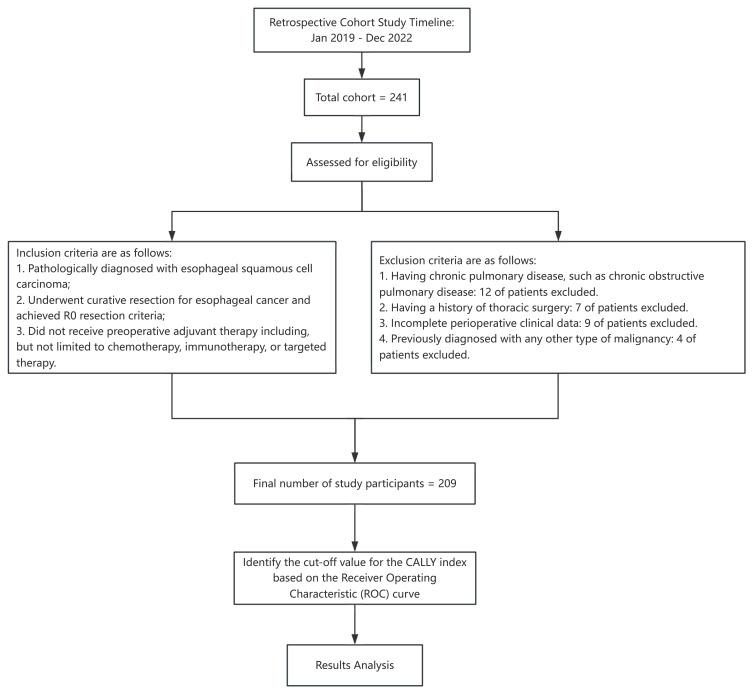
A retrospective cohort study was conducted involving 209 patients undergoing thoraco-laparoscopic McKeown procedure for resectable ESCC from January 2019 to December 2022. Patients with chronic pulmonary diseases or previous malignancies were excluded. Clinical data, including age, gender, tumor stage, preoperative albumin, lymphocyte counts, and CRP levels, were analyzed to calculate the CALLY Index. Univariate and multivariate logistic regression analyses were performed to identify independent predictors of postoperative pneumonia, and receiver operating characteristic curves were used to evaluate the CALLY Index's predictive validity.
RESULTS
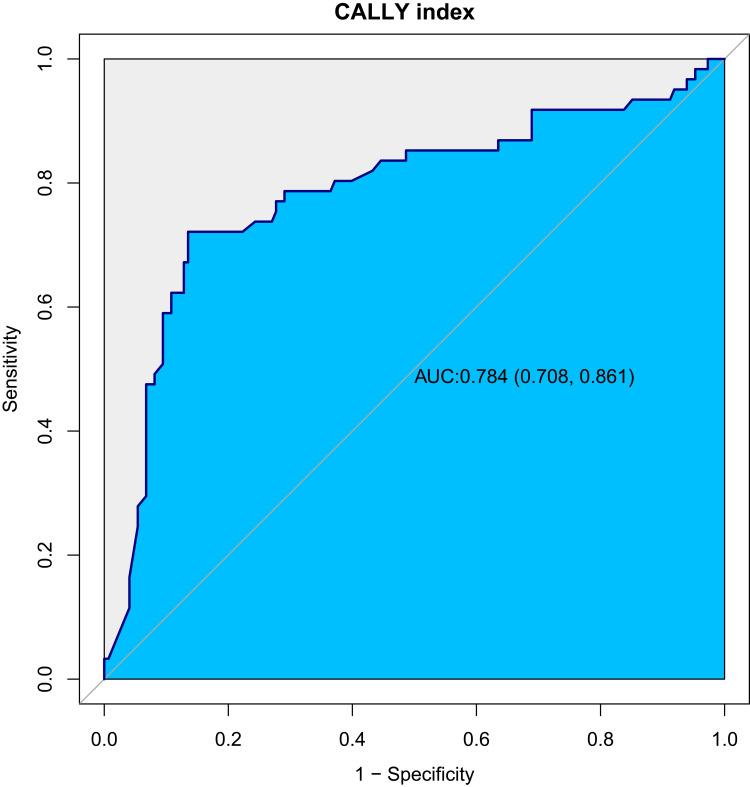
Among the cohort, 63.8% of patients with low CALLY Index scores developed postoperative pneumonia compared to 12.1% with high scores (p < 0.001). The optimal cutoff for the CALLY Index was determined to be 3.47, achieved sensitivity of 0.721 and specificity of 0.865. In multivariate analyses, the CALLY Index remained a strong predictor of pneumonia (adj. OR: 0.64, 95% CI: 0.51-0.77, p < 0.001). Notably, higher tumor stage and prolonged hospital stays were also associated with an increased risk of pneumonia.
CONCLUSION
The CALLY Index is an effective predictor of postoperative pneumonia in patients with esophageal squamous cell carcinoma, especially when evaluated in conjunction with tumor stage and length of hospital stay. This approach can aid clinicians in conducting early risk assessments and customizing therapeutic strategies, ultimately enhancing patient management and outcomes.
背景
食管鳞状细胞癌对全球健康构成重大挑战,术后肺炎是影响恢复和预后的关键并发症。传统的预测模型已被证明是不够的。本研究调查了CALLY指数作为预测可切除食管鳞状细胞癌患者术后肺炎的一种新工具。
方法
进行了一项回顾性队列研究,纳入了2019年1月至2022年12月期间接受胸腔镜辅助腹腔镜McKeown手术治疗可切除食管鳞状细胞癌的209例患者。排除患有慢性肺部疾病或既往有恶性肿瘤的患者。分析包括年龄、性别、肿瘤分期、术前白蛋白、淋巴细胞计数和CRP水平在内的临床数据,以计算CALLY指数。进行单因素和多因素逻辑回归分析以确定术后肺炎的独立预测因素,并使用受试者工作特征曲线评估CALLY指数的预测有效性。
结果
在该队列中,CALLY指数得分低的患者中有63.8%发生了术后肺炎,而得分高的患者中这一比例为12.1%(p<0.001)。CALLY指数的最佳截断值确定为3.47,敏感性为0.721,特异性为0.865。在多因素分析中,CALLY指数仍然是肺炎的有力预测因素(调整后OR:0.64,95%CI:0.51-0.77,p<0.001)。值得注意的是,更高的肿瘤分期和更长的住院时间也与肺炎风险增加相关。
结论
CALLY指数是食管鳞状细胞癌患者术后肺炎的有效预测指标,尤其是与肿瘤分期和住院时间一起评估时。这种方法可以帮助临床医生进行早期风险评估并制定个性化治疗策略,最终改善患者管理和治疗结果。

 Zotero 插件