
动态氟代脱氧葡萄糖正电子发射断层显像/计算机断层扫描成像:定量评估、优势及在恶性实体瘤诊断中的应用
Dynamic FDG PET/CT imaging: quantitative assessment, advantages and application in the diagnosis of malignant solid tumors.
作者信息
Wang Yiling, Yang Yuanshan, Li Jinxin, Cheng Dezhou, Xu Hai, Huang Jinbai
机构信息
Nuclear Medicine Department, The First Affiliated Hospital of Yangtze University, Jingzhou, Hubei, China.
Department of Medical Imaging, Health Science Center, Yangtze University, Jingzhou, Hubei, China.
出版信息
Front Oncol. 2025 Apr 14;15:1539911. doi: 10.3389/fonc.2025.1539911. eCollection 2025.
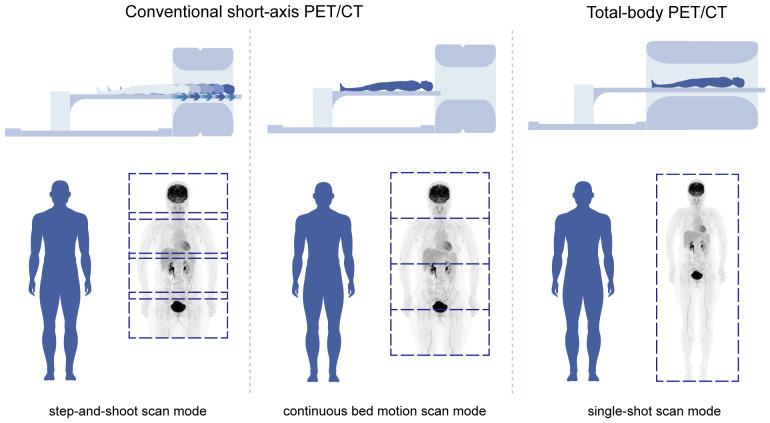
Dynamic imaging has obtained remarkable achievements among a variety of malignant tumors due to the development of multiple simplified scanning protocols and the emergence of whole-body PET/CT scanners, which promote wider application of dynamic PET/CT. In this paper, we mainly review the acquisition protocols of dynamic imaging, related kinetic parameters, advantages and the application of dynamic PET/CT imaging in malignant tumors, including lung cancer, hepatocellular carcinoma, breast cancer, pancreatic carcinoma, prostate neoplasm, and cancer of head and neck. Dynamic PET/CT imaging is increasingly being applied the diagnosis, staging, efficacy monitoring, and prognosis evaluation of malignant tumors. Although standardized uptake value is the most frequently employed semi-quantitative assessment index for static imaging, it is susceptible to several factors, thus cannot be used to evaluate the tracer kinetic information of the lesion. Dynamic PET/CT imaging can be used to achieve continuous assessment of the metabolic activity of a lesion over a certain time frame through quantitative measurement of kinetic parameters, such as the net uptake rate constant. Compared with conventional static imaging, dynamic scanning can be used for the early estimation of minute metabolic changes in tumors. Besides, dynamic scanning can directly and effectively reflect tracer uptake. Nevertheless, the intricacy of parameter analysis and the lengthy scanning time related to dynamic scanning limits its clinical application. Dynamic imaging has obtained remarkable achievements among a variety of malignant tumors due to the development of multiple simplified scanning protocols and the emergence of whole-body PET/CT scanners, which promote wider application of dynamic PET/CT. In this paper, we mainly review the acquisition protocols of dynamic imaging, related kinetic parameters, advantages and the application of dynamic PET/CT imaging in malignant tumors, including lung cancer, hepatocellular carcinoma, breast cancer, pancreatic carcinoma, prostate neoplasm, and cancer of head and neck.
由于多种简化扫描协议的发展以及全身PET/CT扫描仪的出现,动态成像在多种恶性肿瘤中取得了显著成就,这促进了动态PET/CT的更广泛应用。在本文中,我们主要综述动态成像的采集协议、相关动力学参数、优势以及动态PET/CT成像在恶性肿瘤中的应用,包括肺癌、肝细胞癌、乳腺癌、胰腺癌、前列腺肿瘤以及头颈部癌。动态PET/CT成像越来越多地应用于恶性肿瘤的诊断、分期、疗效监测和预后评估。虽然标准化摄取值是静态成像中最常用的半定量评估指标,但它易受多种因素影响,因此不能用于评估病变的示踪剂动力学信息。动态PET/CT成像可通过定量测量动力学参数(如净摄取速率常数),在一定时间范围内对病变的代谢活性进行连续评估。与传统静态成像相比,动态扫描可用于早期估计肿瘤微小的代谢变化。此外,动态扫描能直接有效地反映示踪剂摄取情况。然而,参数分析的复杂性以及与动态扫描相关的冗长扫描时间限制了其临床应用。由于多种简化扫描协议的发展以及全身PET/CT扫描仪的出现,动态成像在多种恶性肿瘤中取得了显著成就,这促进了动态PET/CT的更广泛应用。在本文中,我们主要综述动态成像的采集协议、相关动力学参数、优势以及动态PET/CT成像在恶性肿瘤中的应用,包括肺癌、肝细胞癌、乳腺癌、胰腺癌、前列腺肿瘤以及头颈部癌。



 Zotero 插件