
在高盐处理过程中,髓系p38α/丝裂原活化蛋白激酶促进破骨细胞活性和炎性巨噬细胞反应,从而促进正畸牙齿移动。
During high salt treatment myeloid p38α/MAPK fosters osteoclast activity and inflammatory macrophage responses promoting orthodontic tooth movement.
作者信息
Schröder Agnes, Fischer Florian, Reinert Beatrice, Jantsch Jonathan, Proff Peter, Paddenberg-Schubert Eva, Kirschneck Christian
机构信息
Department of Orthodontics, University Hospital Regensburg, Regensburg, Germany.
Institute for Medical Microbiology and Hygiene, University Regensburg, Regensburg, Germany.
出版信息
Front Immunol. 2025 Apr 15;16:1571268. doi: 10.3389/fimmu.2025.1571268. eCollection 2025.
INTRODUCTION
During orthodontic tooth movement, sterile inflammatory processes and alveolar bone resorption occur in the periodontal ligament, involving myeloid cells such as macrophages and osteoclasts. The myeloid p38α/MAPK (mitogen-activated protein kinase) not only regulates the inflammatory response of macrophages and osteoclast differentiation but also the activation of the osmoprotective transcription factor NFAT5 (nuclear factor of activated T cells 5) under high-salt conditions. Therefore, this study aims to investigate the relative role of myeloid p38α/MAPK in orthodontic tooth movement as a function of extracellular salt content.
MATERIAL AND METHODS
Macrophages and osteoclasts were differentiated from the bone marrow of mice lacking p38α/MAPK expression in myeloid cells ( ) and controls for RNA analysis and calcium phosphate resorption assay. Controls and mice were fed a low or a high salt diet for a total of two weeks. One week after the start of the diet, an elastic band was inserted between the first and second molar to induce orthodontic tooth movement. Atomic absorption spectrometry was used to assess the sodium balance of the jaw bone tissue. RNA was isolated from the periodontium of the first molar, osteoclast numbers and extent of orthodontic tooth movement were assessed.
RESULTS
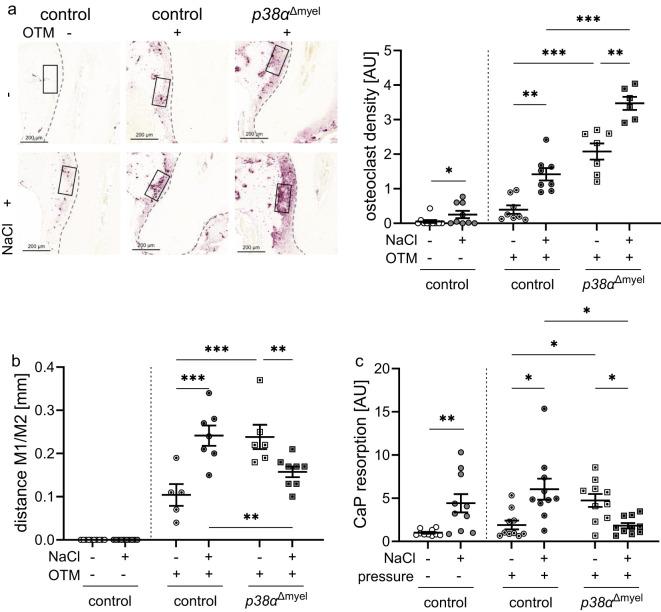
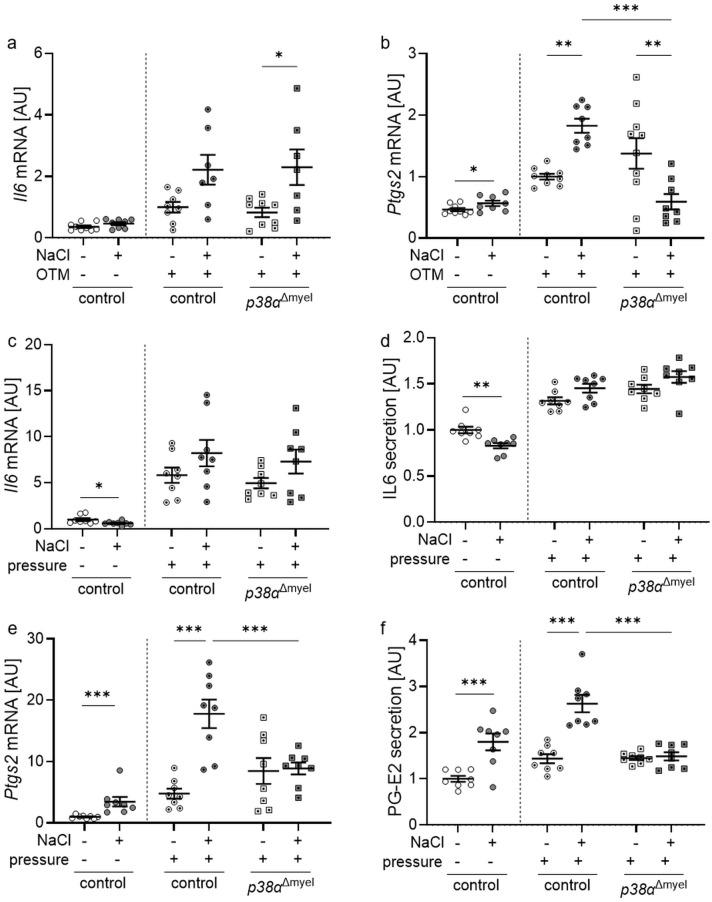
mRNA was increased in macrophages and osteoclasts and in the periodontium after high salt treatment in control mice but not in mice. While there was no salt effect on interleukin-6 () gene expression, prostaglandin endoperoxide synthase-2 () mRNA was upregulated in control but not in mice and . p38α/MAPK deletion increased osteoclast numbers after low and high salt diet. Of note, deletion of p38α/MAPK elevated osteoclast activity under control salt conditions but reduced osteoclast activity under high salt conditions. High-salt diet resulted in increased sodium ion deposition in the jaw of both genotypes, while tooth movement was only increased in control mice. In mice, high salt diet reduced the extent of orthodontic tooth movement, which could be explained by the reduced bone resorption of osteoclasts.
CONCLUSION
We conclude that myeloid p38α/MAPK promotes macrophage expression and osteoclast activity in response to extracellular salt levels, thereby supporting orthodontic tooth movement.
引言
在正畸牙齿移动过程中,牙周膜会发生无菌性炎症反应和牙槽骨吸收,涉及巨噬细胞和破骨细胞等髓样细胞。髓样p38α/丝裂原活化蛋白激酶(MAPK)不仅调节巨噬细胞的炎症反应和破骨细胞分化,还在高盐条件下调节渗透压保护转录因子NFAT5(活化T细胞核因子5)的激活。因此,本研究旨在探讨髓样p38α/MAPK在正畸牙齿移动中作为细胞外盐含量函数的相对作用。
材料与方法
从髓样细胞中缺乏p38α/MAPK表达的小鼠骨髓中分化出巨噬细胞和破骨细胞( ),并作为对照用于RNA分析和磷酸钙吸收测定。对照小鼠和 小鼠分别喂食低或高盐饮食,共两周。饮食开始一周后,在第一和第二磨牙之间插入橡皮筋以诱导正畸牙齿移动。采用原子吸收光谱法评估颌骨组织的钠平衡。从第一磨牙的牙周组织中分离RNA,评估破骨细胞数量和正畸牙齿移动程度。
结果
对照小鼠高盐处理后,巨噬细胞、破骨细胞以及牙周组织中的mRNA增加,但 小鼠中未增加。虽然盐对白细胞介素-6( )基因表达没有影响,但前列腺素内过氧化物合酶-2( )mRNA在对照小鼠中上调,而在 小鼠中未上调。低和高盐饮食后,p38α/MAPK缺失增加了破骨细胞数量。值得注意的是,p38α/MAPK缺失在对照盐条件下提高了破骨细胞活性,但在高盐条件下降低了破骨细胞活性。高盐饮食导致两种基因型小鼠颌骨中钠离子沉积增加,而仅对照小鼠的牙齿移动增加。在 小鼠中,高盐饮食减少了正畸牙齿移动的程度,这可以通过破骨细胞骨吸收减少来解释。
结论
我们得出结论,髓样p38α/MAPK响应细胞外盐水平促进巨噬细胞 表达和破骨细胞活性,从而支持正畸牙齿移动。

 Zotero 插件