
葡萄牙野生动物和家畜中[具体物种1]和[具体物种2]感染的分子检测与分布情况
Molecular Detection and Distribution of and spp. Infections in Wild and Domestic Animals in Portugal.
作者信息
Figueiredo Ana M, Köster Pamela C, Dashti Alejandro, Torres Rita T, Fonseca Carlos, Mysterud Atle, Bailo Begoña, Carvalho João, Ferreira Eduardo, Hipólito Dário, Fernandes Joana, Lino Ana, Palmeira Josman D, Sarmento Pedro, Neves Nuno, Carrapato Carlos, Calero-Bernal Rafael, Carmena David
机构信息
Department of Biology and CESAM, University of Aveiro, Campus Universitário de Santiago, 3810-193, Aveiro, Portugal.
Centre for Ecological and Evolutionary Synthesis, Department of Bioscience, University of Oslo, P.O Box 1066 Blindern, NO-316 Oslo, Norway.
出版信息
Transbound Emerg Dis. 2023 Nov 8;2023:5849842. doi: 10.1155/2023/5849842. eCollection 2023.
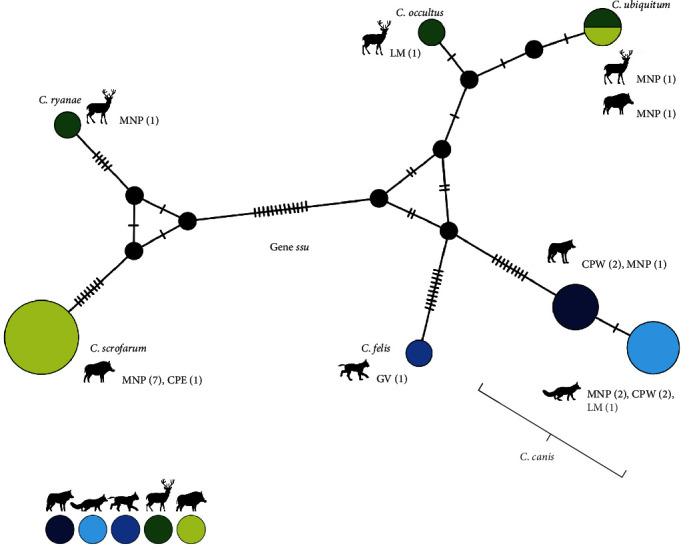
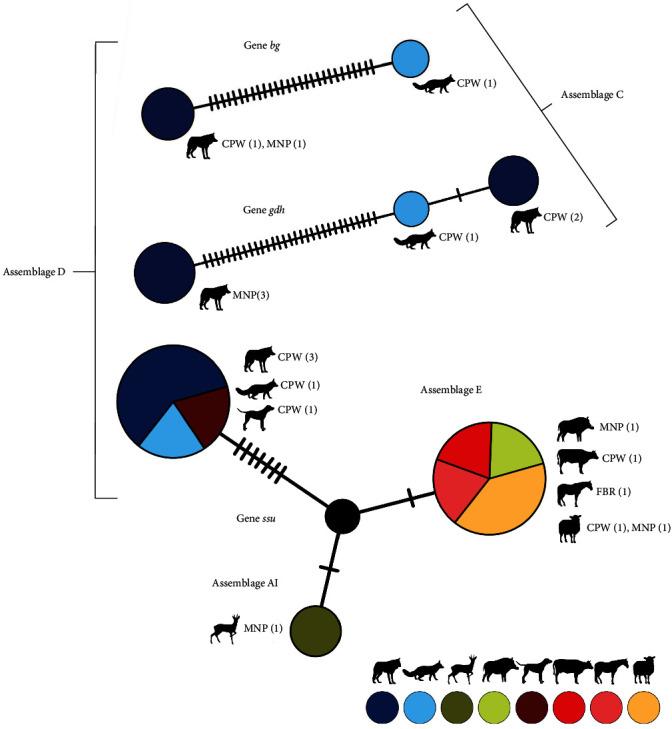
Enteric protozoan parasites , spp., and, to a lesser extent, the ciliate are responsible for severe human and animal intestinal disorders globally. However, limited information is available on the occurrence and epidemiology of these parasites in domestic, but especially wild species in Portugal. To fill this gap of knowledge, we have investigated , spp., and occurrence, distribution, genetic diversity, and zoonotic potential by analyzing 756 fecal samples from several wild carnivores ( = 288), wild ungulates ( = 242), and domestic species ( = 226) collected across different areas of mainland Portugal. Overall, infection rates were 16.1% (122/756; 95% CI: 13.59-18.96) for and 2.7% (20/756; CI: 1.62-4.06) for spp., while no ungulate sample analyzed yielded positive results for was found across a wide range of hosts and sampling areas, being most prevalent in the Iberian lynx (26.7%), the Iberian wolf (24.0%), and the domestic dog (23.9%). spp. was only identified in wild boar (8.4%), red fox (3.4%), Iberian lynx (3.3%), red deer (3.1%), and Iberian wolf (2.5%). Sequence analysis of determined zoonotic assemblage A (subassemblage AI) in one roe deer sample, canine-specific assemblages C and D in Iberian wolf, red fox, and domestic dog, and ungulate-specific assemblage E in wild boar, sheep, cattle, and horse. Six species were identified: in wild boar, in the Iberian wolf and red fox, in red deer and wild boar, in the Iberian lynx, and both and in red deer. and spp. coinfections were observed in 0.7% (5/756) of the samples. This is the first, most comprehensive, and largest molecular-based epidemiology study of its kind carried out in Portugal, covering a wide range of wild and domestic hosts and sampling areas. The detection of zoonotic spp. and subassemblage AI demonstrates the role of wild and domestic host species in the transmission of these agents while representing a potential source of environmental contamination for other animals and humans.
肠道原生动物寄生虫、等孢球虫属以及程度较轻的纤毛虫,在全球范围内都是导致人类和动物严重肠道疾病的原因。然而,关于这些寄生虫在葡萄牙家养动物,尤其是野生动物中的发生情况和流行病学的信息有限。为填补这一知识空白,我们通过分析从葡萄牙大陆不同地区收集的756份粪便样本,研究了等孢球虫属、的发生情况、分布、遗传多样性和人畜共患病潜力,这些样本来自几种野生食肉动物(n = 288)、野生有蹄类动物(n = 242)和家养动物(n = 226)。总体而言,等孢球虫属的感染率为16.1%(122/756;95%置信区间:13.59 - 18.96),的感染率为2.7%(20/756;置信区间:1.62 - 4.06),而在分析的有蹄类动物样本中未发现呈阳性结果。在广泛的宿主和采样区域均有发现,在伊比利亚猞猁中最为普遍(26.7%),其次是伊比利亚狼(24.0%)和家犬(23.9%)。仅在野猪(8.4%)、赤狐(3.4%)、伊比利亚猞猁(3.3%)、马鹿(3.1%)和伊比利亚狼(2.5%)中被鉴定出来。对的序列分析确定了一只狍样本中的人畜共患组合A(子组合AI),伊比利亚狼、赤狐和家犬中的犬特异性组合C和D,以及野猪、绵羊、牛和马中的有蹄类动物特异性组合E。鉴定出了六种等孢球虫物种:野猪中的,伊比利亚狼和赤狐中的,马鹿和野猪中的,伊比利亚猞猁中的,以及马鹿中的和。在0.7%(5/756)的样本中观察到和的混合感染。这是在葡萄牙开展的同类研究中首次进行的、最全面且规模最大的基于分子的流行病学研究,涵盖了广泛的野生和家养宿主以及采样区域。人畜共患的和子组合AI的检测表明野生和家养宿主物种在这些病原体传播中的作用,同时也是对其他动物和人类的潜在环境污染源。

 Zotero 插件